In the realm of process improvement, the Analyse phase of the DMAIC (Define, Measure, Analyse, Improve, Control) methodology represents the critical juncture where data is transformed into actionable intelligence. The fundamental purpose of this phase is to identify the root causes of defects or process variations. To achieve this with scientific rigor, practitioners rely on hypothesis testing: a statistical method used to determine if there is enough evidence in a sample of data to infer that a certain condition is true for the entire population.
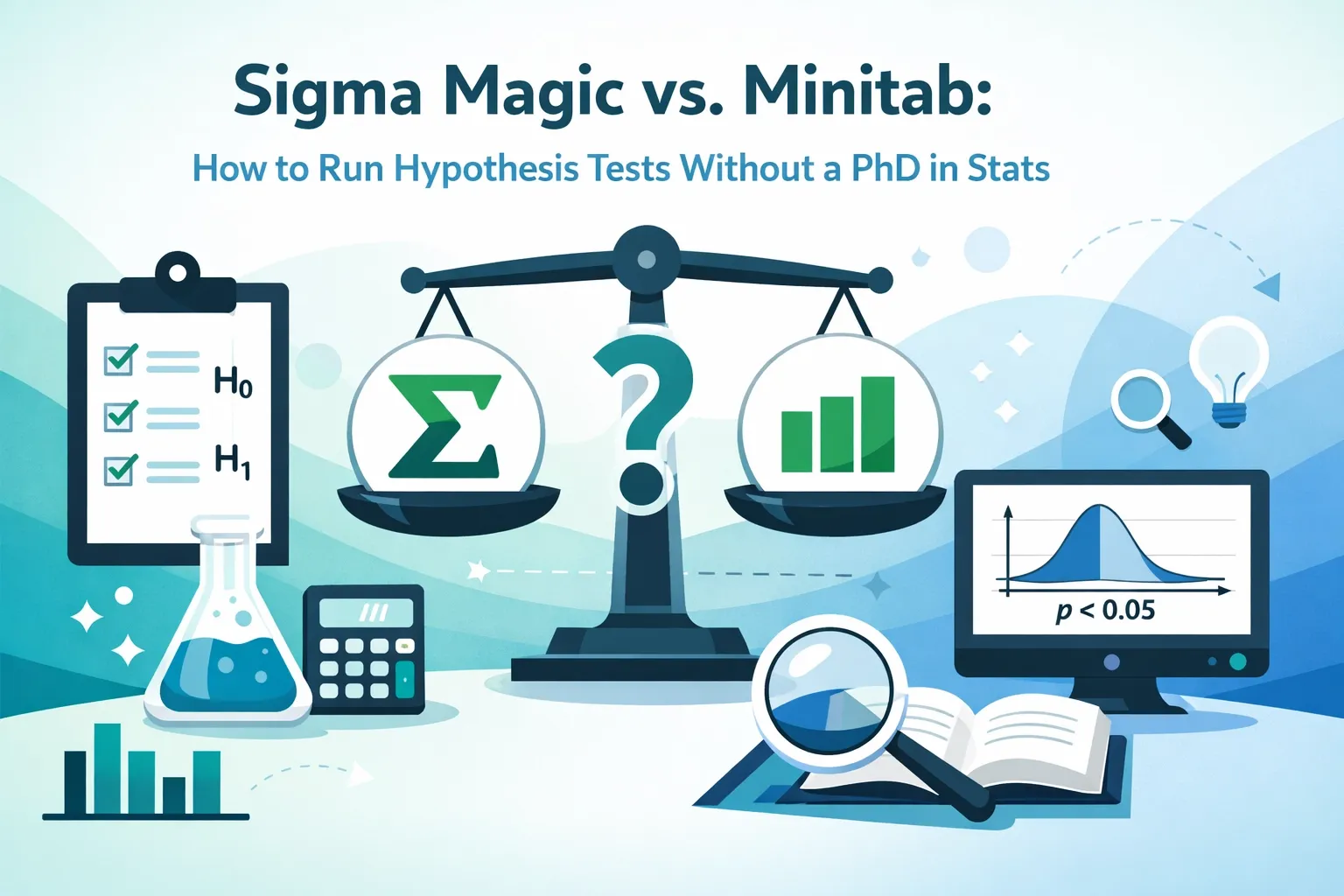
For many professionals undergoing six sigma training, the transition from basic data collection to complex inferential statistics can be daunting. The market has long been dominated by heavyweights like Minitab, but a more accessible alternative, Sigma Magic, has emerged as a preferred tool for those who prioritize practical application over academic complexity.
The Statistical Barrier in Lean Six Sigma
The challenge for most Lean Six Sigma practitioners is not the logic of the methodology, but the technical execution of the statistical tests. To successfully navigate the Analyse phase, one must understand how to formulate a Null Hypothesis (H0) and an Alternative Hypothesis (Ha), choose the correct test based on data types (continuous vs. discrete), and accurately interpret the resulting P-value.
In a traditional lean six sigma online training environment, students are often taught the underlying mathematics of T-tests, ANOVA, and Chi-Square tests. However, in a fast-paced corporate setting, the goal is rarely to become a statistician; the goal is to solve a business problem. This is where the choice of software becomes a strategic decision for the organization.
Minitab: The Comprehensive Powerhouse
Minitab has been the industry standard for decades. It is a standalone statistical software package that offers an exhaustive suite of tools ranging from basic descriptive statistics to complex Design of Experiments (DOE) and Reliability Engineering.
The Strengths of Minitab
Minitab is unparalleled in its depth. It provides:
- High-Level Customization: Users can tweak almost every parameter of a statistical test.
- Advanced Visualization: It offers sophisticated graphing capabilities that can handle massive datasets.
- Industry Recognition: Most Fortune 500 companies have historically utilized Minitab for their quality departments.
The Learning Curve
The primary drawback of Minitab is its steep learning curve. The interface can feel like the cockpit of a commercial airliner: powerful, but overwhelming for someone who only needs to perform a simple 2-sample t-test. For many Green Belts, the software requires a significant investment in time just to learn the navigation, often distracting from the actual problem-solving process.

Sigma Magic: The Practical Alternative
Sigma Magic takes a radically different approach. Instead of a standalone application, Sigma Magic is an Excel Add-in. This is a crucial distinction. Since almost every professional is already proficient in Microsoft Excel, the psychological barrier to entry is significantly lowered.
Integration and Accessibility
The fundamental advantage of Sigma Magic is that it lives where your data already resides. There is no need to export data from Excel, format it for a different software, and then import it. This seamless integration reduces the risk of data entry errors and saves valuable time during the Analyse phase.
The "Statistical Wizard"
One of the most praised features of Sigma Magic is its built-in logic. In Minitab, you must know exactly which test to select from a menu of dozens. In Sigma Magic, the software often guides the user through a series of questions:
- Is your data continuous or discrete?
- How many groups are you comparing?
- Are you looking for a difference in means or variation?
Based on your answers, Sigma Magic selects the appropriate test. This "Wizard" approach ensures that practitioners with a practical focus: rather than a PhD in statistics: can produce accurate, CSSC-accredited results without the fear of selecting the wrong tool.
Head-to-Head: Running a Hypothesis Test
To fully appreciate the difference, let us consider a common scenario: comparing the cycle time of two different shifts to see if one is significantly slower than the other.
The Minitab Workflow:
- Open Minitab.
- Import data from Excel.
- Navigate to Stat > Basic Statistics > 2-Sample t…
- Select the columns.
- Check for normality and equal variances (often requiring separate menu navigations).
- Interpret a text-heavy output window to find the P-value.
The Sigma Magic Workflow:
- Highlight your data within your existing Excel sheet.
- Click the "Sigma Magic" tab.
- Select "Hypothesis Testing."
- Follow the prompts.
- Receive a report that includes the P-value and a plain-English interpretation (e.g., "There is a statistically significant difference between the two shifts").
For a professional pursuing lean six sigma online training, the ability of Sigma Magic to translate "P < 0.05" into "The change you made actually worked" is invaluable. It bridges the gap between raw data and business decisions.
Which Tool Aligns with Lean 6 Sigma Hub’s Philosophy?
At Lean 6 Sigma Hub, our CSSC-accredited courses are designed with a focus on practical application. While we acknowledge the power of Minitab, we often lean toward Sigma Magic for our students because it aligns with the Lean principle of reducing non-value-added activity.
Spending hours learning a complex software interface is "waste" if a simpler tool can provide the same level of accuracy for 95% of typical business projects. Our LSS Black Belt sample projects frequently demonstrate that the most successful improvements come from clear, well-interpreted data, not necessarily the most complex statistical models.
If you are just starting your journey, you might want to explore our free Six Sigma calculator to see how simplified tools can still provide professional-grade insights.
Cost and Deployment Considerations
For organizational leadership, the choice between Minitab and Sigma Magic often comes down to ROI.
- Minitab typically requires an expensive annual subscription per user, which can be a barrier for smaller companies or individual practitioners.
- Sigma Magic is generally more cost-effective and, because it is an Excel add-in, it is easier for IT departments to deploy across a broad team of Green Belts.
When a company invests in six sigma training for 50 employees, the licensing costs for software can equal the cost of the training itself. Choosing a tool like Sigma Magic allows organizations to scale their improvement programs more efficiently.

Beyond the Tool: The Importance of Interpretation
Regardless of whether you choose Sigma Magic or Minitab, the most important skill is the ability to interpret the results. A common mistake in the Analyse phase is focusing solely on the P-value while ignoring the "practical significance."
For example, a test might show a "statistically significant" difference in process speed of 2 seconds. However, if the total process time is 4 hours, those 2 seconds are practically irrelevant to the business. Sigma Magic’s reporting structure often highlights these nuances, helping the practitioner stay focused on the project's ROI and charter goals.
Conclusion: Making the Right Choice for Your Career
If you are a career statistician or working in a highly specialized field like pharmaceutical R&D, Minitab’s depth is essential. However, if you are a Lean Six Sigma practitioner tasked with improving manufacturing efficiency, reducing service errors, or streamlining supply chains, Sigma Magic offers a faster, more intuitive path to the root cause.
The goal of the Analyse phase is to move from "I think" to "I know." Tools should facilitate that movement, not hinder it with unnecessary complexity. By removing the "math-phobia" often associated with hypothesis testing, Sigma Magic empowers more people to use data-driven decision-making in their daily work.
Whether you are preparing for your Black Belt exam or just starting out with a Green Belt certification, choosing the right tool will define how effectively you can lead change within your organization.

To fully realize your potential as a data-driven leader and master the tools of the Analyse phase, enroll in one of our CSSC-accredited Lean Six Sigma certification programs today.