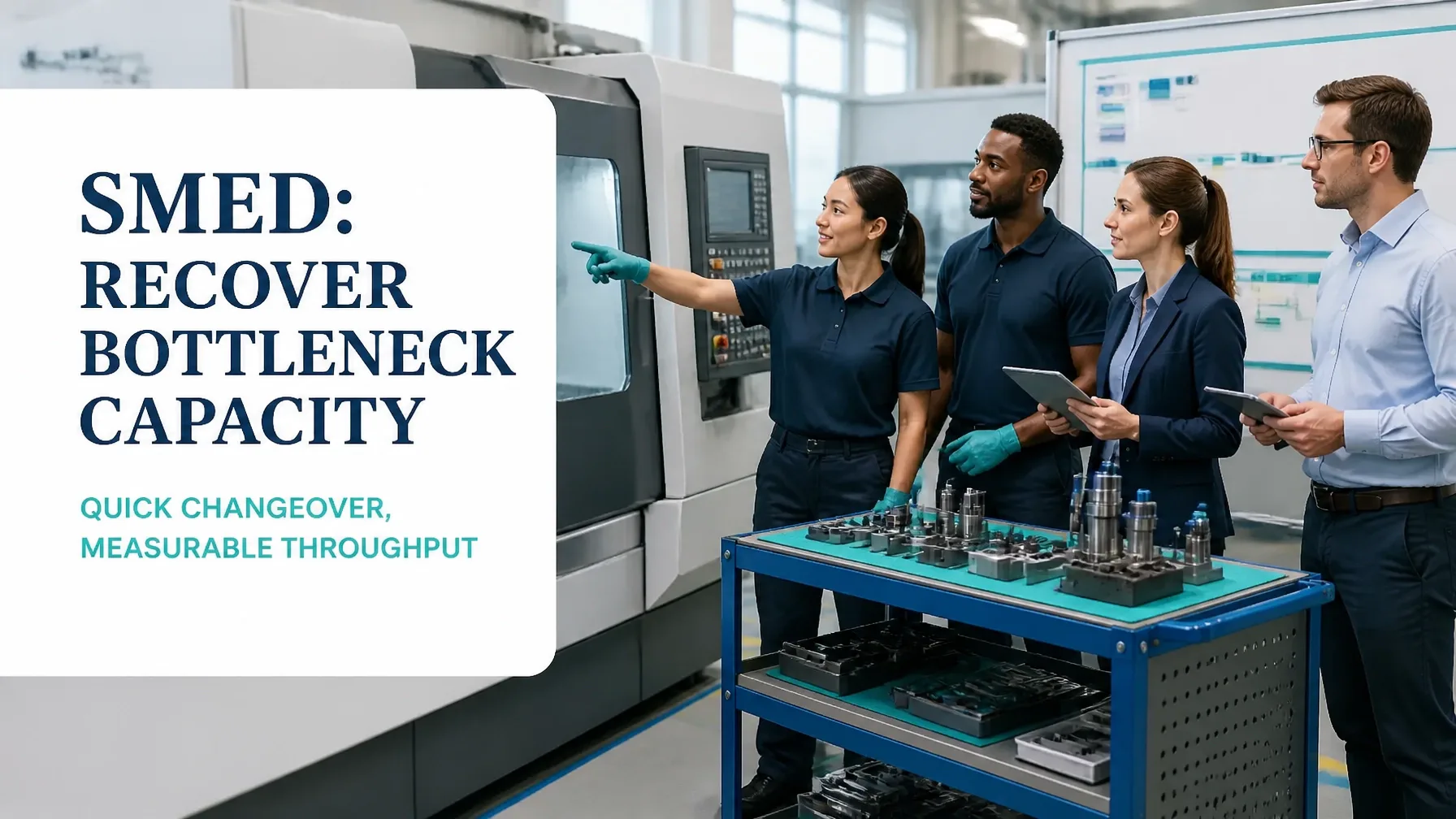
A production machine can be technically capable of producing thousands of units each day and still lose a significant share of that capacity to changeovers. When tooling, dies, materials, programs, inspections, and adjustments are handled inefficiently, the bottleneck spends valuable time preparing to work instead of creating customer value.
Single-Minute Exchange of Die (SMED) provides a disciplined method for changing that equation. It helps teams reduce setup time, recover bottleneck capacity, improve OEE, and create a practical foundation for TPM and Kaizen.
The objective is not to rush operators or remove necessary quality checks. The objective is to redesign the changeover so that every minute has a clear purpose.
What Is SMED?
SMED is a Lean methodology developed by Shigeo Shingo to reduce equipment changeover time to a single-digit number of minutes wherever possible. In practical terms, a changeover is the period between producing the last acceptable unit of the previous product and producing the first acceptable unit of the next product.
The fundamental purpose of SMED is to distinguish between two types of setup activity:
- Internal setup: Work that can only be completed while the machine is stopped, such as removing a die, installing tooling, or making a final mechanical adjustment.
- External setup: Work that can be completed while the machine is still running the previous job or after the next job has started, such as preparing tools, staging materials, loading documents, and preheating components.
A typical SMED improvement follows four principles:
- Observe and measure the current changeover.
- Separate internal and external activities.
- Convert internal work into external work wherever possible.
- Streamline the remaining activities through standardisation, quick-release devices, 5S, and parallel work.
This approach is closely related to the Lean principle of reducing Waiting, one of the eight DOWNTIME wastes. Every minute that a constrained machine is idle represents capacity that the wider system cannot recover elsewhere.

Why Changeover Time Matters More at the Bottleneck
In the realm of operations management, not all lost minutes have the same financial impact. If a non-constrained machine loses 30 minutes, another resource may be able to absorb the delay. If the bottleneck loses 30 minutes, the entire value stream may lose throughput.
This is the central connection between SMED and the Theory of Constraints (TOC).
TOC teaches organisations to identify the system’s limiting factor and improve it systematically. The usual sequence is to:
- Identify the constraint.
- Exploit the constraint by maximising its productive time.
- Subordinate other activities to support the constraint.
- Elevate the constraint through additional improvement or investment.
- Repeat the process when the constraint moves.
A long changeover is often a clear opportunity to exploit the constraint. Before purchasing another machine, adding a shift, or increasing headcount, a team should ask whether the current bottleneck is spending too much time on setup, adjustment, searching, movement, or avoidable approvals.
SMED also enables smaller production batches. When a 60-minute changeover becomes a 15-minute changeover, the organisation can switch products more frequently without absorbing the same capacity penalty. This can improve responsiveness, reduce finished-goods inventory, and support a more customer-focused production schedule.
The 30-Minute SMED Observation
The phrase “SMED in 30 minutes” should not be interpreted as a promise that every complete transformation will be finished in half an hour. Rather, 30 minutes is enough to begin a focused improvement cycle by observing one changeover and exposing where capacity is being lost.
During a short observation, record:
- The exact start and finish time of the changeover.
- The time spent waiting for tools, people, materials, or information.
- The sequence of every operator activity.
- Which activities require the machine to be stopped.
- Which activities could be completed before the machine stops.
- The number of adjustments and trial pieces required.
- Quality checks, approvals, and documentation steps.
- Safety controls that must remain unchanged.
A simple video recording, supported by operator interviews and a time observation sheet, can reveal more than a meeting-room discussion. The aim is not to judge performance. It is to understand the work as it actually occurs.
A Worked Production Example
Consider a stamping machine that is the constraint in a plant producing metal brackets.
Before SMED
The machine operates for 16 planned production hours per day. It completes four changeovers, with each changeover taking 60 minutes.
- Changeover time: 4 × 60 = 240 minutes
- Total changeover loss: 4 hours per day
- Available production time: 16 − 4 = 12 hours
- Production rate: 100 units per hour
- Daily output: 12 × 100 = 1,200 units
- Simplified availability: 12 ÷ 16 = 75%
The team conducts a SMED observation and identifies several sources of lost time:
- The next die is collected only after the machine stops.
- Tools are stored across the production area.
- Fasteners require multiple turns to remove and reinstall.
- The next program is manually located and checked during downtime.
- One operator completes all tasks sequentially.
- First-piece inspection is delayed because documentation is prepared late.
SMED Improvements
The team applies a focused Kaizen event involving operators, maintenance, quality, and production planning. The improvement actions include:
- Preparing a complete changeover kit before the previous batch ends.
- Prechecking the next die, program, materials, and documentation.
- Using quick-release clamps instead of conventional fastening methods where safe and appropriate.
- Creating a 5S tool cart with fixed locations and visual labels.
- Assigning two operators to complete compatible tasks in parallel.
- Establishing standard work with defined handoffs.
- Using a first-piece checklist to reduce avoidable adjustment loops.
After SMED
The average changeover falls from 60 minutes to 15 minutes.
- Changeover time: 4 × 15 = 60 minutes
- Total changeover loss: 1 hour per day
- Recovered time: 4 − 1 = 3 hours per day
- Available production time: 16 − 1 = 15 hours
- Daily output: 15 × 100 = 1,500 units
- Simplified availability: 15 ÷ 16 = 93.75%
The bottleneck therefore gains:
- 3 recovered production hours per day
- 300 additional units per day
- 25% more daily output, calculated as 300 ÷ 1,200
- 75% reduction in changeover loss, calculated as (60 − 15) ÷ 60
- Availability improvement from 75% to 93.75%
If the plant operates 250 production days per year, the recovered capacity represents:
300 units × 250 days = 75,000 additional units per year
If each additional unit contributes $4.00 toward fixed costs and profit, the potential annual throughput contribution is:
75,000 × $4.00 = $300,000
This is why SMED can have a disproportionately strong financial effect when applied to a constraint. The value does not come from reducing setup time in isolation. It comes from converting that time into profitable throughput.

How SMED Improves OEE and TPM
Overall Equipment Effectiveness (OEE) is commonly calculated as:
OEE = Availability × Performance × Quality
SMED primarily improves the Availability component by reducing setup and adjustment losses. In the example above, availability increased from 75% to 93.75% before considering any secondary effects.
However, the wider impact may extend beyond availability:
- Performance: Faster and more stable setups can reduce minor stops and speed losses.
- Quality: Standardised setups can reduce startup scrap and adjustment variation.
- Flexibility: Smaller batches become more practical.
- Flow: The bottleneck can respond more effectively to changing demand.
Within Total Productive Maintenance (TPM), SMED complements focused improvement, autonomous maintenance, planned maintenance, and early equipment management. A machine that is clean, accessible, standardised, and maintained is easier to change over consistently.
TPM teams should therefore examine the equipment design itself. Are tools easy to access? Are adjustment points clearly marked? Can fixtures be installed in one position only? Are wear points causing repeated setup corrections? SMED exposes these questions and converts them into structured improvement opportunities.
How to Sustain the Improvement
A rapid improvement is valuable only when it becomes the new normal. To sustain the result:
- Create a documented standard changeover sequence.
- Define the target changeover time and the acceptable range.
- Use visual controls for tools, dies, fixtures, and materials.
- Train all relevant operators using the same standard.
- Track changeover time on the daily management board.
- Review OEE losses by category rather than relying only on the overall percentage.
- Include changeover performance in layered process audits.
- Record deviations and address their causes through ongoing Kaizen.
A control plan should also specify the reaction when performance deteriorates. For example, if the average changeover exceeds 20 minutes for three consecutive events, the process owner may initiate a short root-cause review. This prevents gradual erosion from becoming accepted practice.
The Lean Six Sigma Hub guide to conducting Kaizen events provides a useful structure for preparing a cross-functional team, measuring a baseline, testing solutions, and sustaining gains.
Apply SMED Where Capacity Has the Highest Value
SMED is most powerful when it is directed at a genuine constraint rather than selected because a changeover appears inconvenient. Start with data:
- Identify the bottleneck using throughput, utilisation, queue, and schedule information.
- Quantify its current changeover loss.
- Observe the work directly.
- Separate internal and external activities.
- Convert, simplify, and standardise.
- Recalculate recovered capacity and financial impact.
- Sustain the gain through TPM, OEE review, and daily Kaizen.
The Lean Six Sigma Green Belt online training course covers practical process mapping, root-cause identification, Lean tools, statistical process control, and project sustainability. These skills help improvement professionals connect a shop-floor changeover to measurable business outcomes.
For broader development, explore Lean Six Sigma online training and build the capability to lead structured improvement projects across manufacturing, healthcare, logistics, finance, and IT.
Choose one bottleneck, observe one changeover, and begin your SMED improvement today. Then pursue accredited Lean Six Sigma training or professional certification to strengthen your ability to deliver and sustain measurable results.