In the realm of organizational excellence, the transition from a Black Belt to a Master Black Belt (MBB) represents more than just an incremental step in technical proficiency. It is a fundamental shift in identity: moving from a practitioner who executes projects to a strategic leader who architectures entire ecosystems of improvement. For high-level professionals already commanding significant influence, the question often arises: Is the investment in lean six sigma master black belt training truly necessary, or is it a redundant credential?
To answer this, one must look beyond the belt and into the evolving demands of modern enterprise leadership. While a Black Belt is the master of the DMAIC (Define, Measure, Analyze, Improve, Control) methodology, the Master Black Belt is the custodian of the organization’s continuous improvement culture.
The Fundamental Shift: From Project Lead to System Architect
The primary distinction between these two tiers lies in the scope of impact. A Black Belt typically focuses on high-impact projects, moving from one problem-to-solve to the next. In contrast, the fundamental purpose of a Master Black Belt is to ensure that the infrastructure exists for those projects to succeed and sustain over time.
1. Strategic Alignment and Hoshin Kanri
While a Black Belt utilizes a Project Selection Scoring Calculator to determine which project to tackle next, a Master Black Belt works with the C-suite to align those projects with the organization's three-to-five-year strategic goals. They utilize Hoshin Kanri (Policy Deployment) to ensure that every Lean Six Sigma initiative is a direct lever for moving a key business metric.
2. Infrastructure Development
Master Black Belts do not just "do" Six Sigma; they "build" Six Sigma. This involves designing the governance structures, selecting the software tools, and establishing the reporting cadences that allow a program to scale from a single department to a global enterprise.
The Mentorship Mandate: Building the Next Generation
A critical component of lean six sigma master black belt training is the development of advanced pedagogical and coaching skills. In many organizations, the MBB serves as the internal consultant and lead instructor.
The transition from "doing" to "teaching" is often where professionals find the most challenge. It requires a deep understanding of human psychology, change management, and the ability to simplify complex statistical concepts for various audiences. A Master Black Belt is responsible for:
- Mentoring Black and Green Belts: Guiding them through roadblocks in their projects, such as complex data collection methods or resistance from stakeholders.
- Curriculum Design: Customizing training materials to fit the specific nuances of their industry, whether it be healthcare, manufacturing, or fintech.
- Certification Standards: Acting as the final authority on whether a project has met the rigorous standards required for internal certification.

Technical Mastery Beyond the Standard Toolkit
While leadership and strategy are paramount, the MBB must also possess a level of technical depth that exceeds the standard Black Belt curriculum. When a Black Belt encounters a statistical anomaly that they cannot explain, they turn to the Master Black Belt.
Professional lean six sigma master black belt training delves into:
- Advanced Inferential Statistics: Going beyond basic hypothesis testing into multivariate analysis and non-linear modeling.
- Design of Experiments (DOE) at Scale: Managing complex experimental designs that involve dozens of variables across multiple production sites.
- Measurement Systems Analysis (MSA): Ensuring the integrity of the data being collected before any analysis begins. Understanding statistical sampling plans is a baseline requirement; the MBB must optimize these plans for cost and accuracy across the enterprise.
To fully appreciate the technical rigor required, consider the MBB's role in validation. They must be experts in how to conduct process audits, ensuring that the "Control" phase of DMAIC isn't just a document, but a living, breathing reality in the operation.
The Financial Reality: ROI and Earning Potential
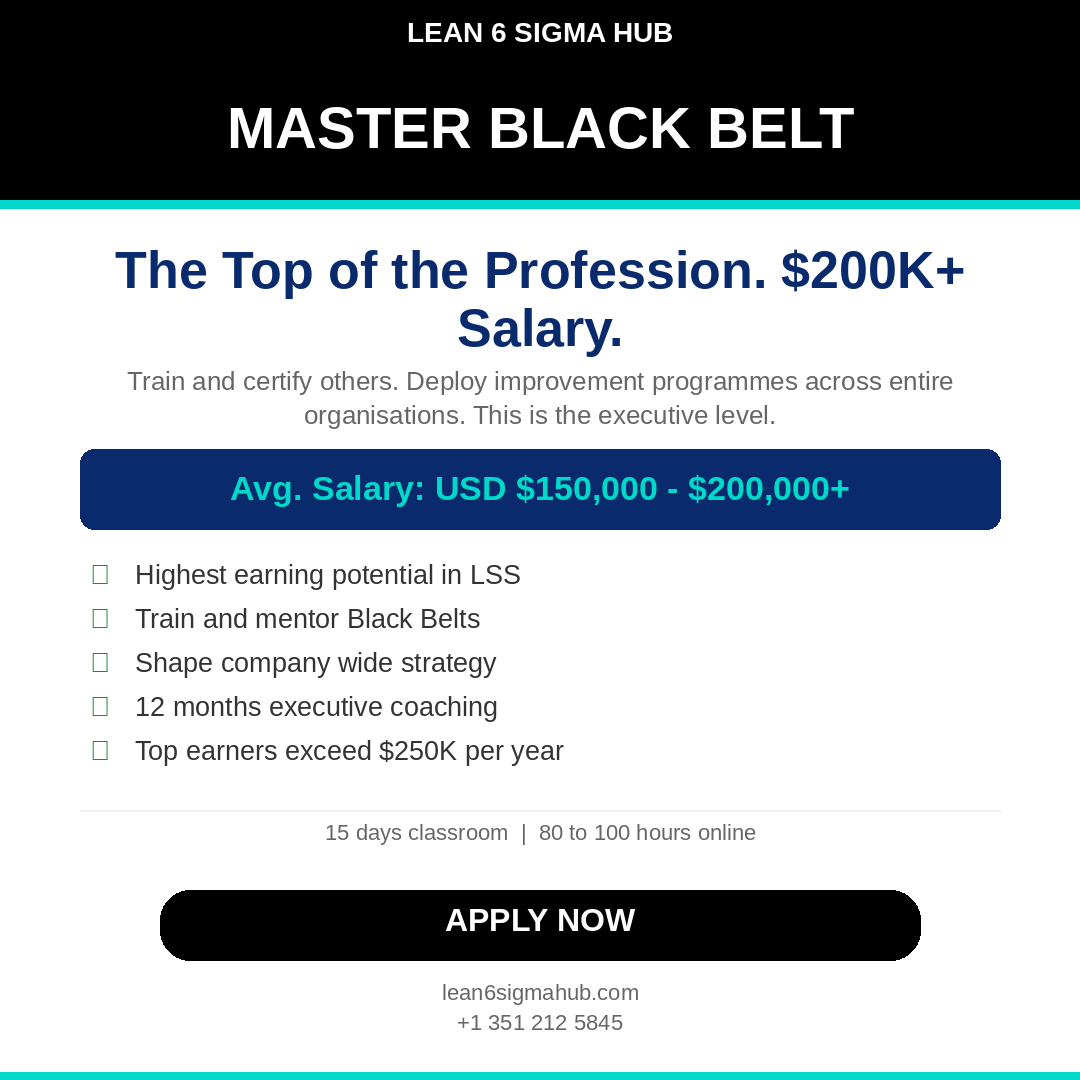
For high-level professionals, the decision to pursue an MBB certification is often a financial one. The data suggests that the return on investment (ROI) is substantial, both for the individual and the organization.
| Metric | Black Belt | Master Black Belt |
|---|---|---|
| Average Salary (USD) | $120,000 – $168,000 | $150,000 – $250,000+ |
| Typical Project Savings | $100k – $500k | $1M – $10M+ (Program Level) |
| Scope of Influence | Department/Project | Global/Enterprise |
| Primary Role | Tactical Problem Solver | Strategic Transformation Leader |
Organizations are willing to pay a premium for Master Black Belts because of their ability to deliver multi-million dollar impacts through program governance and the multiplication of talent. When an MBB trains 10 new Black Belts, they are effectively creating a workforce capable of generating millions in annual savings.
Why CSSC Accreditation is Non-Negotiable
In the crowded market of professional certifications, the source of your training matters. The Council for Six Sigma Certification (CSSC) is the industry standard for accreditation. A CSSC-accredited lean six sigma master black belt training ensures that your credentials are recognized globally by recruiters and top-tier corporations.
At Lean 6 Sigma Hub, we provide a CSSC-accredited path that combines theoretical depth with the practical, "in-the-trenches" experience required for executive leadership. Our MBB program includes:
- 12 months of executive coaching.
- An enterprise deployment toolkit.
- Live mentorship to guide you through your first enterprise-level transformation.
Is the Leap Right for You?
To determine if you are ready for Master Black Belt training, ask yourself the following questions:
- Have you hit a ceiling? If you have led dozens of successful projects and find that you are repeating the same steps without feeling challenged, it is time to move into the strategic layer.
- Do you enjoy developing others? If you find more satisfaction in seeing a mentee succeed than in solving a problem yourself, you have the temperament of an MBB.
- Are you comfortable in the boardroom? The MBB role requires translating technical Sigma levels into financial language for the CEO and CFO.
- Do you have the foundational knowledge? Ensure your current skills are sharp by reviewing a free lean six sigma black belt practice exam.
The Path Forward with Lean 6 Sigma Hub
The journey to becoming a Master Black Belt is not merely about passing an exam; it is about proving you can lead an organization through the complexities of the 21st-century economy. Whether you are navigating the integration of AI with Lean processes or restructuring a global supply chain, the MBB toolkit provides the framework for success.

The truth is, if you aspire to be at the pinnacle of process improvement and organizational strategy, the lean six sigma master black belt training is not just an option: it is a requirement. It is the credential that signals to the world that you are no longer just a practitioner, but a leader.
Elevate your career and transform your organization. Apply now for the Lean 6 Sigma Hub Master Black Belt Certification and join the elite ranks of process transformation leaders.