

Lean Six Sigma Online Training & Certification, CSSC Accredited
Self-paced Lean Six Sigma online training from White Belt to Master Black Belt. Master process improvement with practical case studies and real-world applications, demonstrated step by step in CI Flow.
Find your Lean Six Sigma belt
100% online and self-paced. Start free with White Belt.
White BeltFreeYellow BeltAUD $319Green BeltAUD $419Black BeltAUD $519Master Black BeltAUD $1,519Compare all online courses
Lean Six Sigma online training built for real-world results
Lean 6 Sigma Hub offers CSSC accredited Lean Six Sigma online training for every level, from the free White Belt through Yellow Belt, Green Belt and Black Belt to Master Black Belt. Learn 100% online at your own pace, apply each tool through hands-on projects and case studies, and practise on CI Flow, the same platform used to run real improvement projects.
Lean Six Sigma Courses: White Belt to Master Black Belt
Structured, self-paced online courses designed for real-world results, from beginner to advanced levels.
Lean Six Sigma White Belt
Kickstart your journey with foundational principles of process improvement.
Explore White Belt course →Lean Six Sigma Yellow Belt
Master essential tools and techniques for improving processes and managing small projects.
Explore Yellow Belt course →Lean Six Sigma Green Belt
Develop intermediate skills in data-driven decision-making and project management.
Explore Green Belt course →Lean Six Sigma Black Belt
Lead complex projects and drive organisational change with advanced strategies.
Explore Black Belt course →Lean Six Sigma Master Black Belt
Mentor Green and Black Belts, drive enterprise capability and build governance frameworks.
Explore Master Black Belt course →
Practise Your Lean Six Sigma Training in CI Flow
Our training videos show real tools and real project execution inside CI Flow, so you learn each step in a connected workspace, not just in theory.
- RDMAICS, A3, Just Do It and Kaizen in one place
- 290+ improvement and analysis tools
- Status Coach guides the next step from live evidence
- Tollgate packs built from your saved work
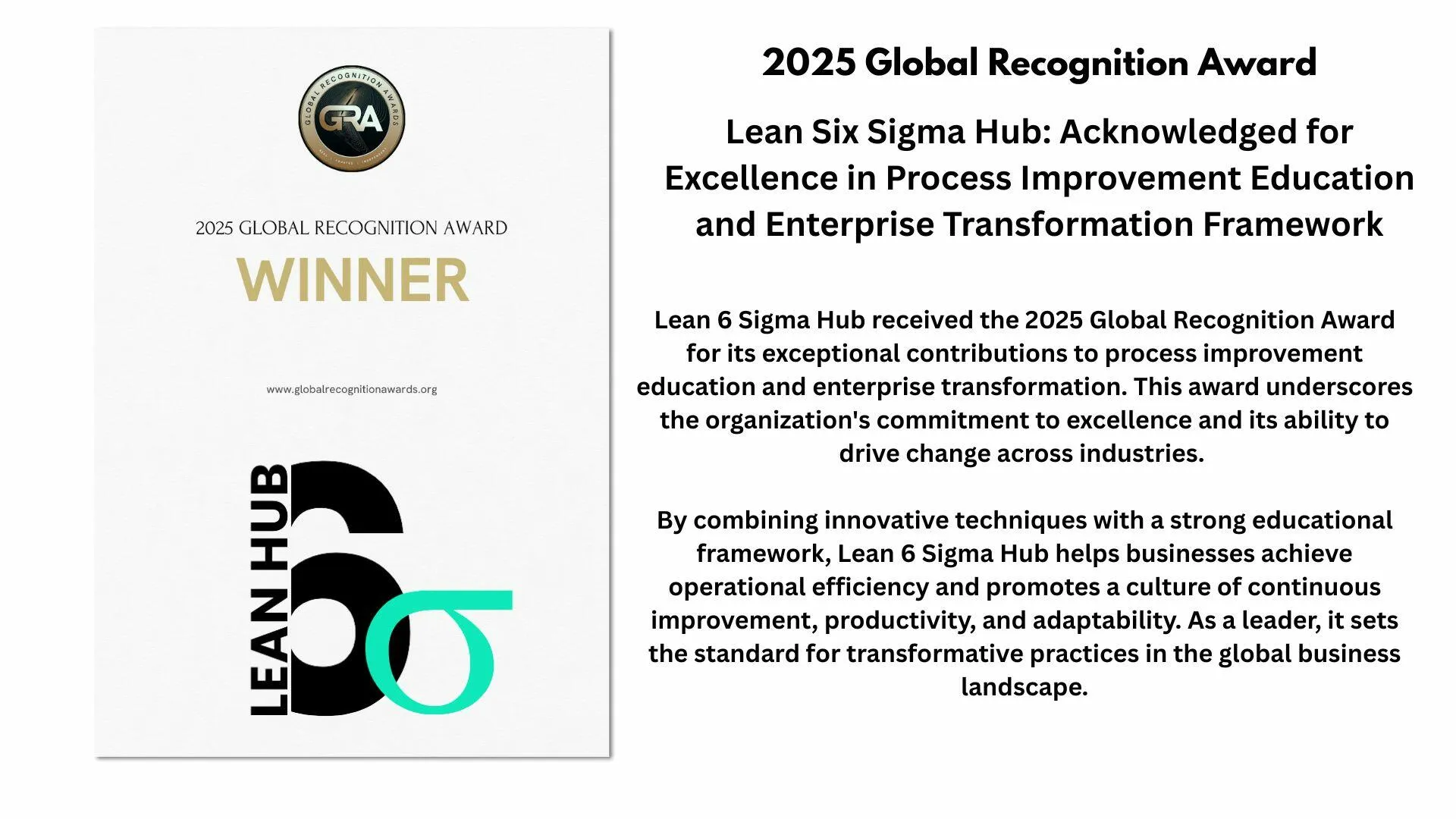
2025 Global Recognition Award for Lean Six Sigma Training
Lean 6 Sigma Hub has been awarded a 2025 Global Recognition Award for its outstanding contribution to Lean Six Sigma training, enterprise transformation and educational innovation.
About usLean Six Sigma Practice Exams, Calculators and Toolkits
Support your online Lean Six Sigma training with free practice exams and calculators for every phase.
Free Lean Six Sigma practice exams
White, Yellow, Green and Black Belt practice exams.
Lean Six Sigma calculators
Project prioritisation, business case, VOC, Kano, SIPOC, CTQ and more.
Formula & Storyboard Toolkits
Lean Six Sigma formula toolkit and project storyboard toolkit.
PowerPoint materials & flash cards
Lean Six Sigma PowerPoint materials and Six Sigma flash cards.
White-label video training
Lean Six Sigma video training under your brand.
Business in a Box
A ready-made Lean Six Sigma business kit.
Lean Six Sigma Online Training Reviews
The Lean 6 Sigma Hub’s training was a game-changer for me. The self-paced modules and real-world examples made complex concepts easy to grasp.Sarah J.Process Analyst
I was impressed by the quality of the Lean 6 Sigma Hub’s materials. The interactive courses and case studies provided a deep understanding of Lean Six Sigma methodologies.Mark T.Project Manager
The practical approach of Lean 6 Sigma Hub’s training helped me improve my team’s efficiency significantly. The downloadable resources were invaluable.Emily R.Operations Manager
NAVIGATE™ Enterprise Transformation Framework
Lean, Six Sigma and other proven methods, combined into one enterprise transformation framework.
Need The Shift
Recognise signals and ignite the case for transformation.
2Assess The Terrain
Understand readiness, resistance and system dynamics.
3Visualise The Architecture
Map the transformation model aligned with strategy.
4Identify The Drift
Expose process gaps and performance breakdowns.
5Generate The Delta
Implement focused improvements with Lean Six Sigma tools.
6Anchor The Change
Embed new behaviours and secure sustainable control.
7Transfer The Culture
Spread wins, activate champions and reinforce rituals.
8Evolve Continuously
Build feedback loops to stay adaptive and future-ready.
Get NAVIGATE™ Certified
Build enterprise transformation capability through three progressive certification levels.
Lean Six Sigma Online Training FAQs
Is there a free Lean Six Sigma online training course?
Yes. The Lean Six Sigma White Belt online training is free. It covers the basics of DMAIC and includes a lifetime certificate, with the exam and certificate included.
Are your Lean Six Sigma courses accredited?
Yes. Our Lean Six Sigma online training courses are accredited by the Council for Six Sigma Certification (CSSC), from White Belt to Master Black Belt.
Is the Lean Six Sigma online training self-paced?
Yes. Training is 100% online, so you can learn at your own pace from anywhere.
How much does Lean Six Sigma certification cost?
White Belt is free. Yellow Belt is AUD $319, Green Belt AUD $419, Black Belt AUD $519 and Master Black Belt AUD $1,519.
Are Lean Six Sigma certifications recognised globally?
Lean Six Sigma certifications are recognised globally, making you an attractive candidate for employers worldwide.
Can I take a free Lean Six Sigma practice exam?
Yes. Free practice exams are available for White Belt, Yellow Belt, Green Belt and Black Belt.
What is CI Flow and how is it used in the training?
CI Flow is our official project execution partner, an operational excellence platform for RDMAICS, A3, Just Do It and Kaizen projects. Our training videos show real tools and real project execution inside CI Flow, and you can try it free for 14 days.
Start Your Lean Six Sigma Online Training Today
Begin with the free White Belt, then progress at your own pace to Master Black Belt.