New to Lean Six Sigma?

A beginner’s guide

New to Lean Six Sigma?

You already know how to run a project. This is how you find and fix the process problem underneath it.

If you are more familiar with PMP, PRINCE2 or change management, you are in the right place. Lean Six Sigma is not another way to write a project plan. It is a practical, data-led way to improve how work actually gets done.

5DMAIC phases
5belt levels
8types of waste
FreeWhite Belt to start
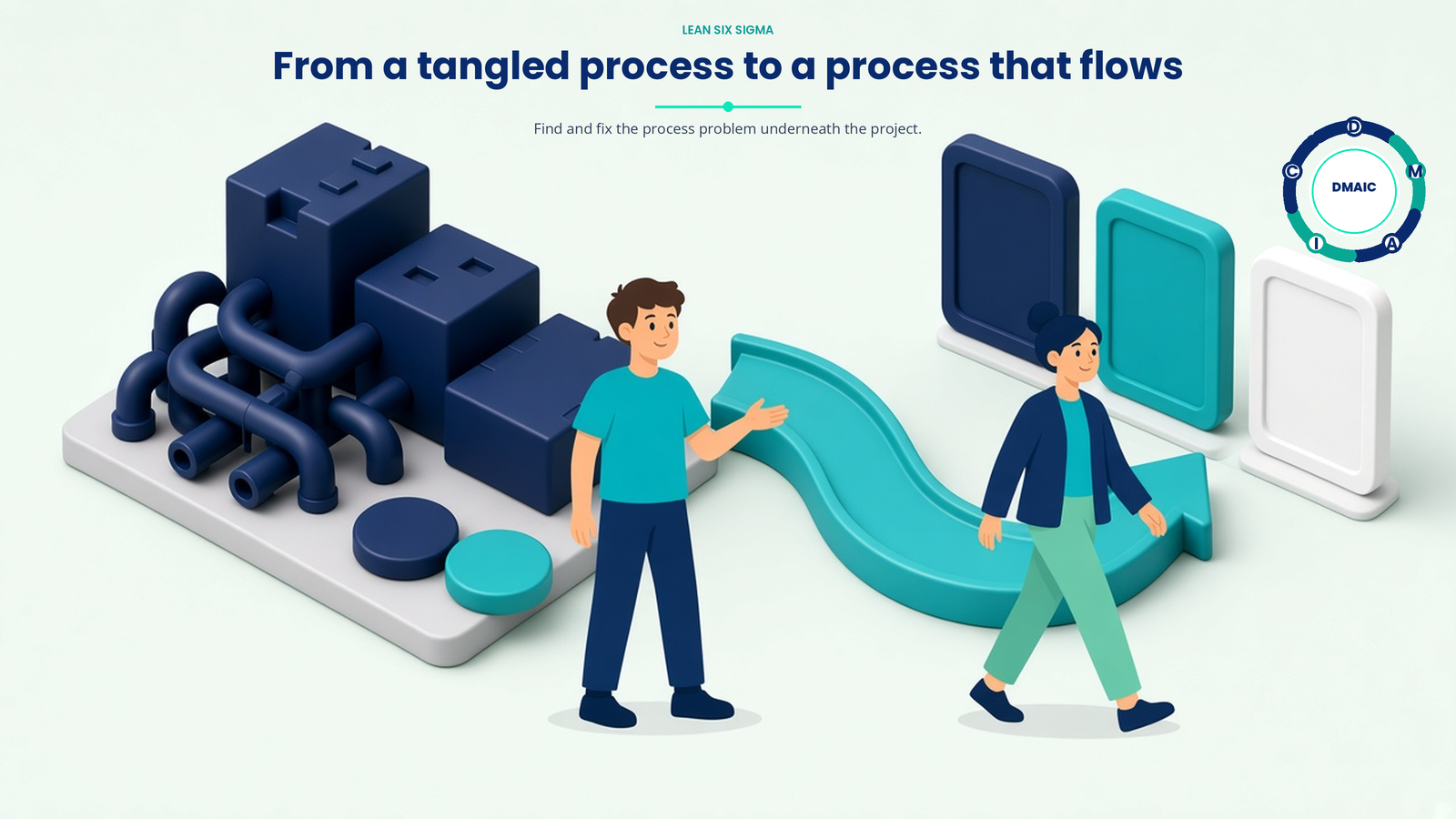
A tangled, delayed process on the left becomes a smooth flowing process on the right, pointing towards quality, speed and cost.
From a tangled process to a process that flows.

2-minute explainer

Watch this first if you like to see the whole picture

A short animated walk-through of what Lean Six Sigma is, how DMAIC works, how the belts are used, and how the method sits beside PMP, PRINCE2 and change management. There is no presenter on camera — only diagrams, words and a voiceover.

About three minutes. Captions are available in the player.

The idea

What Lean Six Sigma is, in plain words

Every organisation is a collection of processes: the path a claim, a patient, an order or a report actually takes, not the path drawn on a tidy slide. When that path is slow, uneven or full of rework, the usual response is to add a new project, a new system or more people. Sometimes that helps. Often the underlying process is still the problem.

Lean Six Sigma is a method for looking at that process with clear eyes. It combines two ideas that grew up separately and are now almost always taught together.

Lean: make the work flow

Lean asks whether each step helps the customer, and whether work is waiting, being moved, piled up, over-processed or done again. The aim is a shorter, clearer path from request to result — less delay, less wasted effort, more value.

Six Sigma: make the work consistent

Six Sigma asks whether the process produces a stable, capable result. It uses measurement and analysis to reduce defects and variation, so customers get the right outcome more often, not only on a good day.

Put together, Lean Six Sigma gives a team a shared language and a disciplined way to improve quality, speed and cost at the same time. It is used in factories, but it is just as useful in a hospital ward, a bank, an insurer, a government service or a software team. For a wider primer you can also read our articles on what Lean Six Sigma is, the fundamentals and a comprehensive beginner’s overview.

A short history, without the mythology

The two strands are older than the combined name. Lean grew from the Toyota Production System — a way of designing work so problems are visible and waste is removed. The word “lean” was popularised in the 1990s, after researchers studied that system and described it for a wider audience.

Six Sigma was developed at Motorola in the 1980s as a disciplined, statistical way to reduce defects. It spread widely in the 1990s, including through large industrial companies such as General Electric. The “sigma” in the name refers to variation: the tighter and more centred the process, the fewer defects.

In the early 2000s the two approaches were increasingly taught and practised as one. That is the form most employers mean today when they ask for Lean Six Sigma, a Green Belt or a Black Belt. The tools have multiplied; the point has not: find the process problem, prove it with data, fix it, and keep the gain.

A project can be delivered on time and still leave the underlying process untouched. Lean Six Sigma starts with the process itself.

The method

DMAIC: a cycle for finding and fixing a process problem

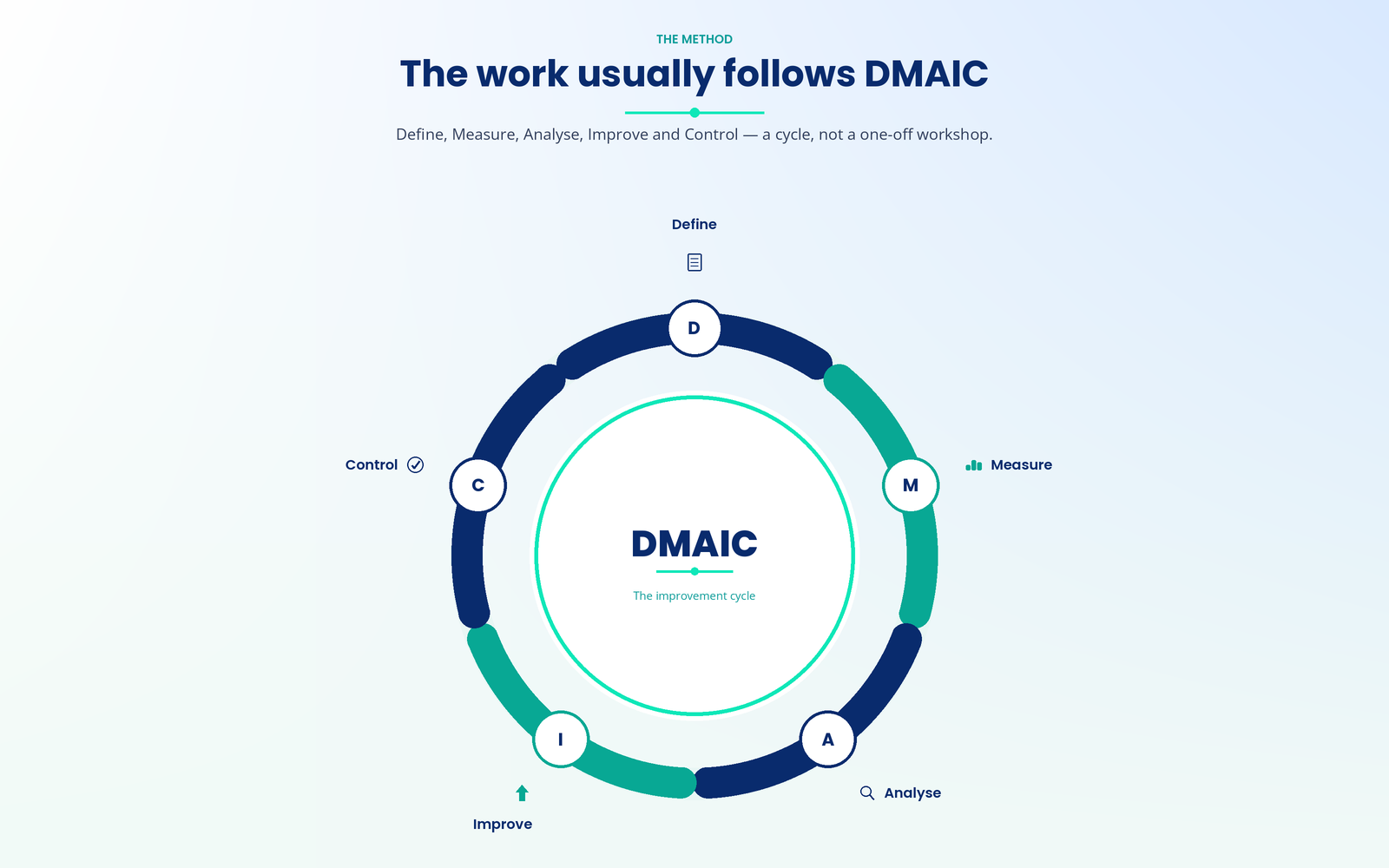
Most Lean Six Sigma projects follow DMAIC — Define, Measure, Analyse, Improve, Control. Think of it as a map, not a form-filling ritual. Each phase answers one question, and you do not jump to a solution before you understand the problem. Open any phase below; every description stays on the page.

D

Define: what problem are we solving, and for whom?

You name the problem in plain language, say why it matters, and set a clear goal. You sketch the process at a high level (often a SIPOC: suppliers, inputs, process, outputs, customers) and agree what is in and out of scope. A good Define phase stops a team from “improving” the wrong thing. Read a longer walk-through in The DMAIC Process: A Step-by-Step Guide.

M

Measure: what does the process really do today?

Opinions are cheap; a measured baseline is not. You collect data on how long work takes, how often it fails, where it waits and how it varies. You check that the measurement itself is trustworthy. The aim is a picture of current performance that everyone can see, not a polished average that hides the bad days.

A

Analyse: what is actually causing the problem?

Here you look for root causes, not symptoms. Teams use tools such as process maps, Pareto charts, cause-and-effect diagrams and the 5 Whys to test ideas against the data. The question is not “what do we already believe?” but “what does the evidence support?” This is usually where a hidden hand-off, a batching rule or a repeated error becomes obvious.

I

Improve: what will we change, and does it work?

Only now do you design and test countermeasures. You might remove a step, change the sequence, error-proof a form, rebalance a workload or set a standard for a hand-off. Small, reversible tests are better than a single grand redesign. You keep the changes that actually move the measure you chose in Define.

C

Control: how will the gain last after the project team moves on?

A process that improves for six weeks and then drifts back is not an improvement. Control means a simple standard, a visible measure, a response if the process slips, and a named owner. This is where Lean Six Sigma meets everyday management — and, often, change management.

The DMAIC cycle: Define, Measure, Analyse, Improve and Control, with a short description of each phase.
The DMAIC cycle. Most serious improvement work walks this loop once; some problems need another pass.

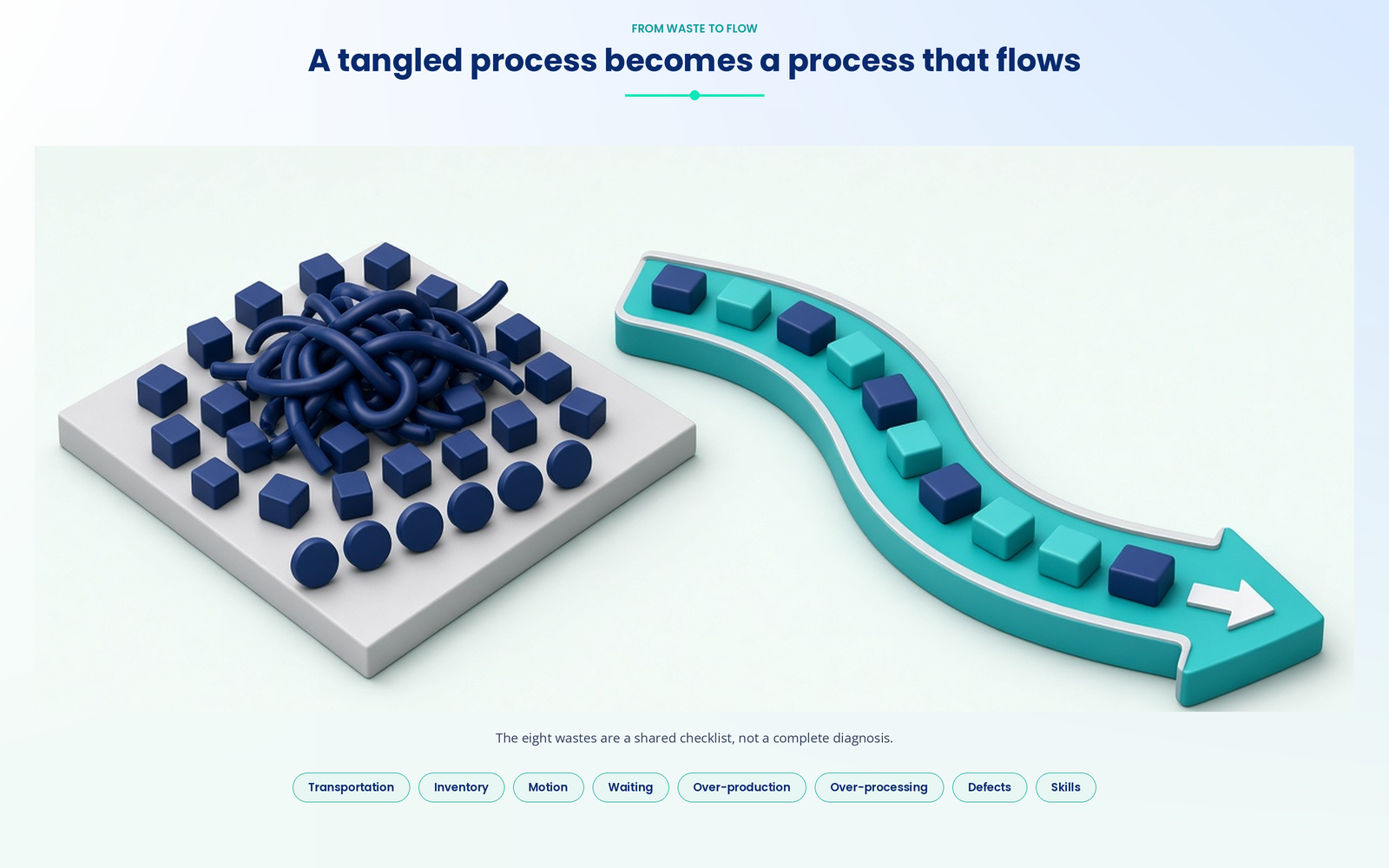
Lean also looks for the eight wastes that slow a process down or add no value: transport, inventory, motion, waiting, over-production, over-processing, defects, and unused skills. Our guide to the eight types of waste explains each one with examples.

Before and after: a tangled process full of waste becomes a process that flows, with the eight Lean wastes listed underneath.
From waste to flow. The eight wastes are a shared checklist, not a complete diagnosis on their own.

A day in the work

What a practitioner actually does: a hospital discharge story

The following scenario is illustrative. It is not a case study of a named hospital. It is the kind of problem Green Belts are asked to take on every week, in healthcare and well beyond it.

On a busy Wednesday in a large city hospital, patients who are medically ready to leave still wait hours for a discharge letter, a pharmacy bag and transport. Beds stay occupied. The emergency department downstairs starts to back up. The delays feel random. They are not.

Maya is a senior nurse and a Green Belt. She is not asked to “run a project” in the abstract. She is asked to look at the discharge process. She does not start by requesting more staff. She starts by defining the problem: medically ready patients are waiting too long to leave, which holds beds and slows the emergency department.

She measures. The data shows that most of the wait is not clinical. It is a pile-up of hand-offs — a discharge summary that cannot be finished until a late consultant ward round, a pharmacy that receives scripts in an afternoon batch, and transport booked only after both are done. Incomplete scripts come back as rework. Some patients are marked “ready” who are not.

She analyses the causes with the ward team, then improves the process: a standard “ready for discharge” checklist before 10 am, a pharmacist on the morning ward round, and transport booked as soon as the checklist is complete rather than at the end of the chain. She controls it with a simple daily board that shows yesterday’s discharge cycle time, and a written standard so the new routine does not fade when the project team moves on.

Waiting time falls. Beds free up earlier. The emergency department starts the afternoon with more capacity. A project manager could have delivered a new discharge module on time and on budget. Maya’s work asked a different question: what in the current process is causing the delay, and what will we change so it stays fixed?

“We did not need a new system first. We needed to see where the work was waiting.” A typical Green Belt conclusion — and the heart of the method.

Before: long waits, hidden hand-offs

  1. The patient is medically ready — but still in the bed.
  2. The discharge summary waits on a late ward round.
  3. Pharmacy receives the script in the afternoon batch.
  4. Transport is booked only after both are done.
  5. The emergency department backs up downstairs.

After: a morning-ready standard

  1. A “ready for discharge” checklist is completed by 10 am.
  2. A pharmacist joins the morning ward round.
  3. Transport is booked as soon as the checklist is complete.
  4. Yesterday’s cycle time is visible on a simple daily board.
  5. Beds free earlier, and the emergency department has more capacity.
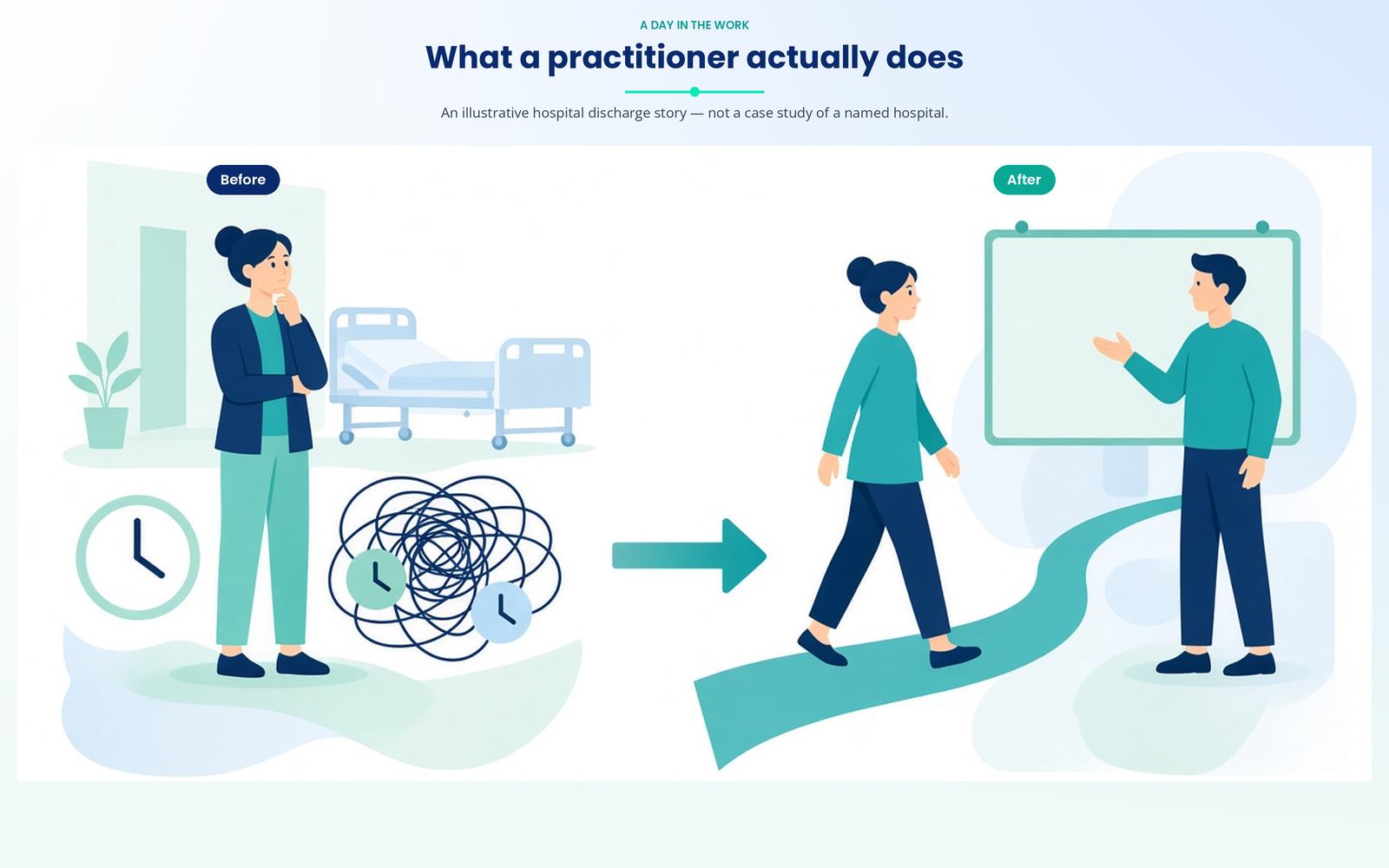
Side-by-side storyboard of a hospital discharge process before and after a Lean Six Sigma improvement.
An illustrative before-and-after. The same pattern appears in insurance claims, factory changeovers and service backlogs.

The people

The belt levels, and what each person does day to day

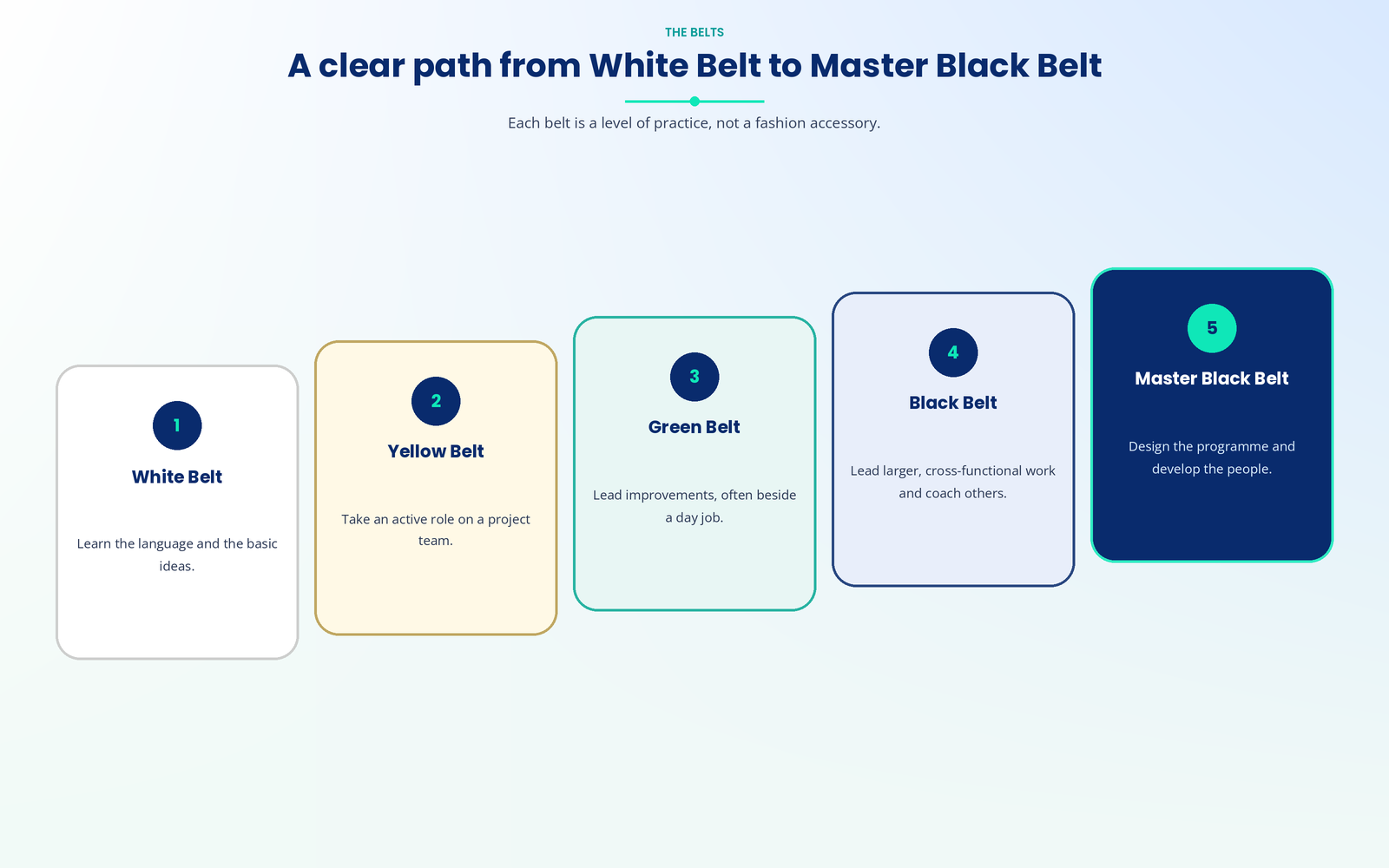
Belts are levels of practice, not costumes and not a rank for its own sake. They describe how deeply someone works with the method, and how much of their week is spent leading improvement rather than only supporting it. Open any belt; every description remains on the page.

White Belt: learn the language and join in

A White Belt understands what Lean Six Sigma is, recognises waste, and can follow a project conversation. Day to day they stay in their current role — a clerk, an operator, a nurse, an analyst — and support a project by collecting simple data, joining a process walk or helping to try a new standard. The free White Belt course is the usual starting point.

Yellow Belt: take an active role on the team

A Yellow Belt uses the basic tools: process mapping, the eight wastes, 5 Whys, a simple Pareto. They still have a “day job”, but they are a useful team member rather than an observer. They might facilitate a short huddle, document a standard, or run a small check on a change. See the Yellow Belt course and our beginner’s guide to obtaining a Yellow Belt.

Green Belt: lead improvements beside your day job

A Green Belt leads a project, often in their own area, while still doing their usual work. They frame the problem, collect and analyse data, run the DMAIC cycle and present results to a sponsor. Typical titles include Continuous Improvement Analyst, Quality Engineer, Operations Analyst or a clinical, finance or service lead with a Green Belt. Our Green Belt explainer and the Green Belt course go deeper.

Black Belt: lead larger work and coach others

A Black Belt often spends most or all of their time on improvement. They lead cross-functional projects, coach Green Belts, and are accountable for a programme of work rather than a single local fix. You will see titles such as Process Improvement Manager, Operational Excellence Lead, Lean Six Sigma Black Belt or Continuous Improvement Manager. Explore the Black Belt course.

Master Black Belt: design the programme and develop the people

A Master Black Belt (sometimes called a Deployment Leader) sits at programme level. They set the method and standards, choose and coach Black Belts, help leaders pick the right problems, and keep the organisation from collecting belts without delivering results. It is a mentoring and governance role as much as a technical one. See the Master Black Belt course and our article on the Master Black Belt advantage.

The Lean Six Sigma belt path from White Belt through Yellow, Green and Black Belt to Master Black Belt, with a short description of what each person does.
A belt describes the work you do, not a costume. Many people stay at Green Belt and have a full, valuable career there.

The work in the world

What Lean Six Sigma practitioners do, industry by industry

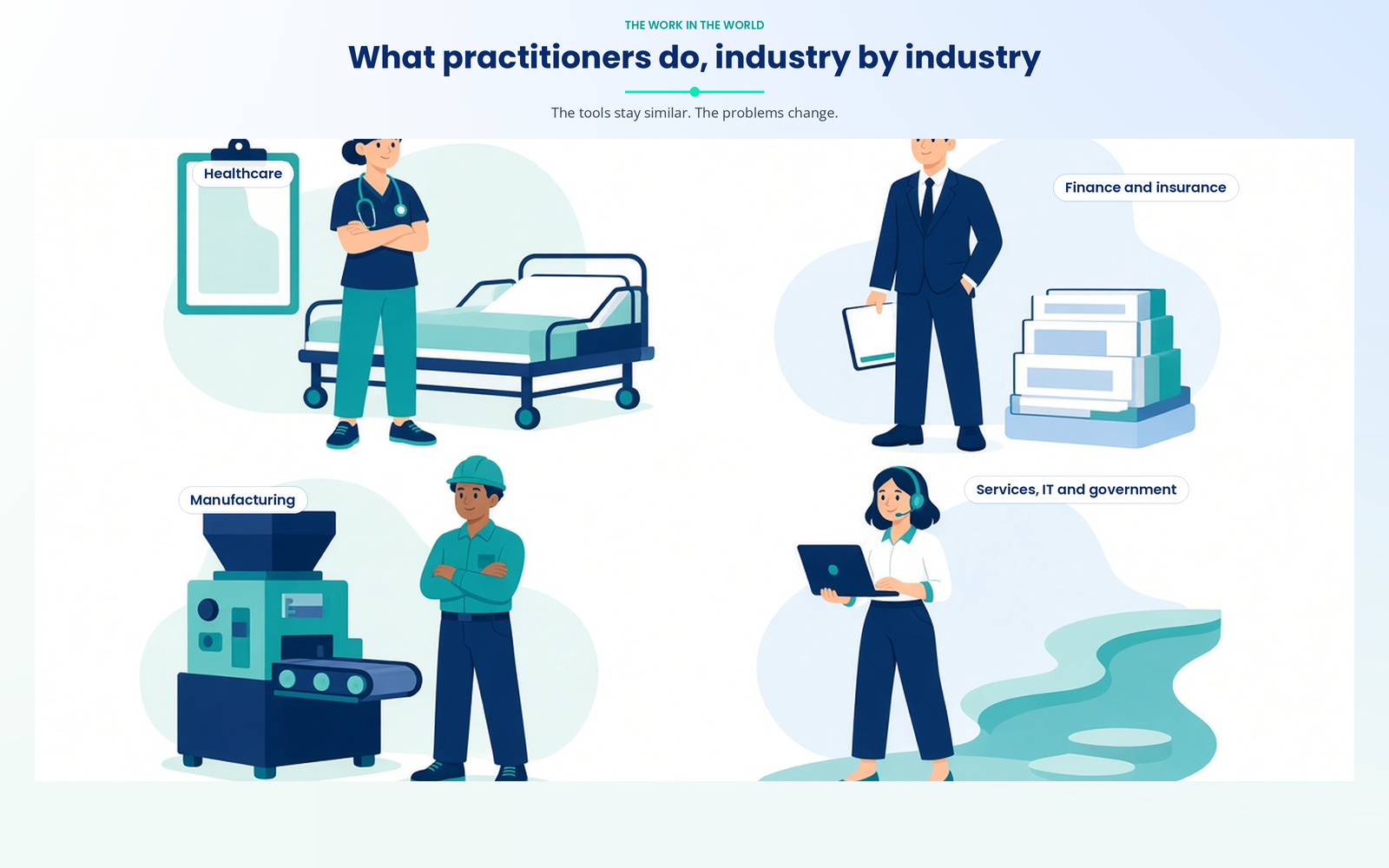
The tools stay similar. The problems change. Here is the kind of work practitioners actually take on.

Four Lean Six Sigma practitioners in healthcare, finance and insurance, manufacturing, and services, IT and government.
The same improvement habit, applied in very different workplaces.

Healthcare

Shortening emergency and discharge waits, reducing medication errors, improving theatre start times, and making clinic flow more predictable. The hospital story above is typical: the delay is often in the hand-offs, not in the medicine.

Finance and insurance

Clearing claims backlogs, reducing rework on incomplete applications, shortening onboarding, and lifting first-time-right processing. A Green Belt in claims does much the same work as Maya: map the path, measure the waits, fix the cause, and hold the gain.

Manufacturing

Lifting first-pass quality, cutting changeover time, reducing scrap and downtime, and making a production line more stable. This is the historic home of both Lean and Six Sigma, and it is still a large employer of Black Belts and quality engineers.

Services, IT and government

Shortening customer journeys, reducing failed demand (work that comes back), improving digital hand-offs, and making public services less of a maze. The waste is often information and waiting, not physical inventory.

You will also find the work in logistics, pharmaceuticals, energy and professional services — anywhere a process is repeated, measured and worth getting right. If you want to try a realistic project in a safe environment, use LSS In Action, our interactive hypothetical project.

How it sits beside other methods

Lean Six Sigma, PMP, PRINCE2 and change management

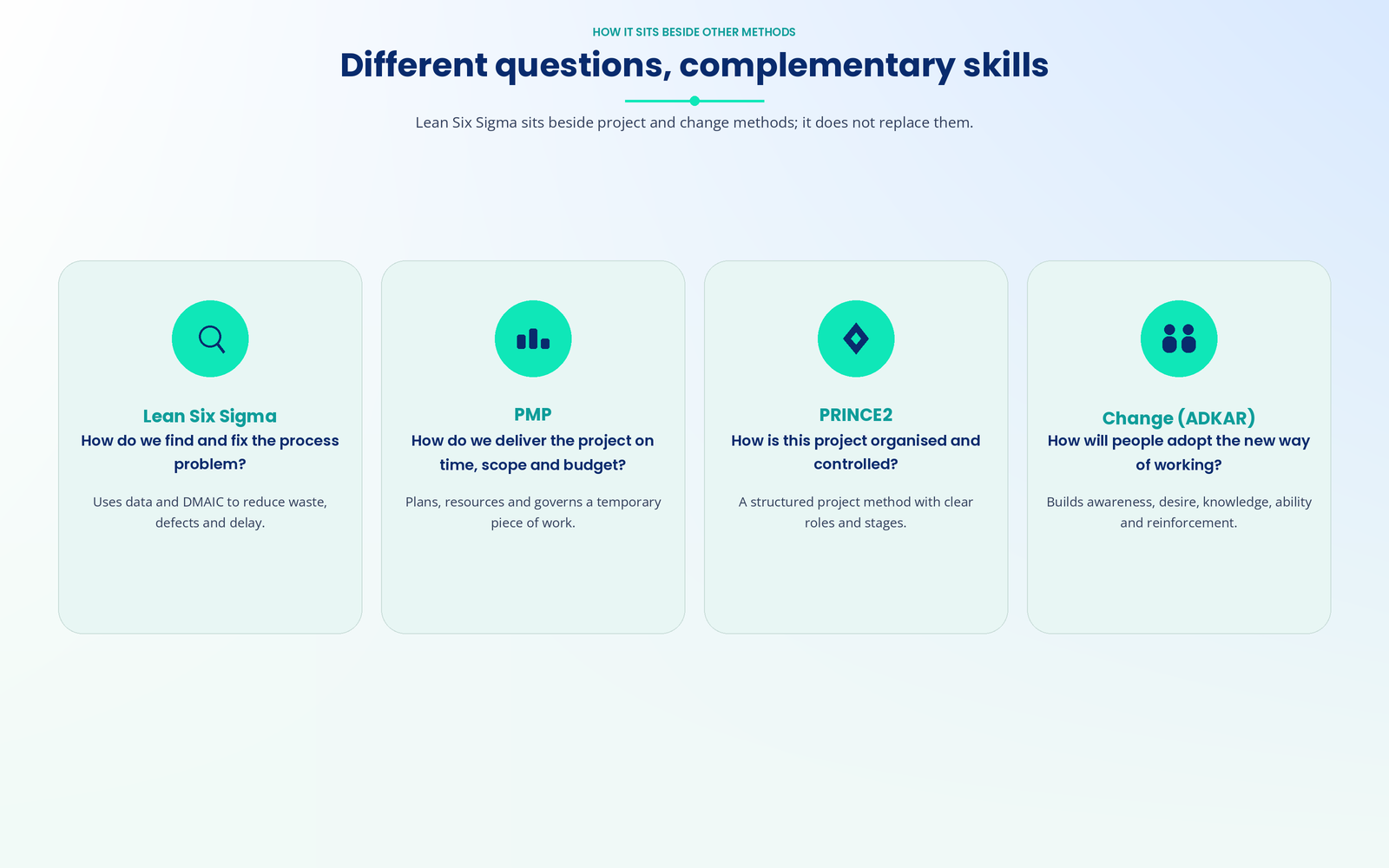
People who already hold a PMP, work in a PRINCE2 environment, or use ADKAR often ask whether Lean Six Sigma replaces what they already know. It does not. Each discipline answers a different question. Used together, they are stronger.

How the four disciplines compare
QuestionLean Six SigmaPMPPRINCE2Change (ADKAR / Prosci)
Primary questionHow do we find and fix the process problem?How do we deliver the project on time, scope and budget?How is this project organised and controlled?How will people adopt the new way of working?
Typical unit of workA process and its performance measuresA temporary project with a defined resultA project, managed in stages, with clear rolesThe people side of a change
Core methodDMAIC, waste reduction, variation reductionProject planning, risk, schedule, cost and stakeholder managementPrinciples, themes and staged processesAwareness, Desire, Knowledge, Ability, Reinforcement
When it is the lead disciplineThe process itself is slow, error-prone or unstableYou must deliver a defined piece of workYou need a controlled project method, often in government or large programmesThe design is known, but adoption is the risk
How it complements the othersFinds the process failure a project is meant to solve, and designs a better wayDelivers the project that implements the process changeProvides governance and decision points around that projectHelps people understand, want, learn and keep the new process
Four columns comparing Lean Six Sigma, PMP, PRINCE2 and ADKAR change management by the main question each one answers.
Different questions, complementary skills. A strong team often has more than one of these in the room.

Which path suits you?

Choose the situation that sounds most like your work. Each choice reveals a short recommendation. The full comparison stays visible above, so nothing is hidden from a search engine or a reader who skips the questions.

1. I have a project I must deliver to a deadline, with a scope and a budget.
2. A process is slow, error-prone or full of rework, and I need to find out why.
3. We already know the new process, but people are not using it.
4. I need both a project plan and a process fix.

Work and pay

Careers in Lean Six Sigma: roles, backgrounds, industries and salaries

A belt is not a job title by itself. Employers hire people to improve processes, lead quality, run operations or deploy a programme — and they often ask for a belt as evidence that you can do that work. Here is how the common roles map to the belts, who typically comes into the field, where they are hired, and what published salary sources currently show.

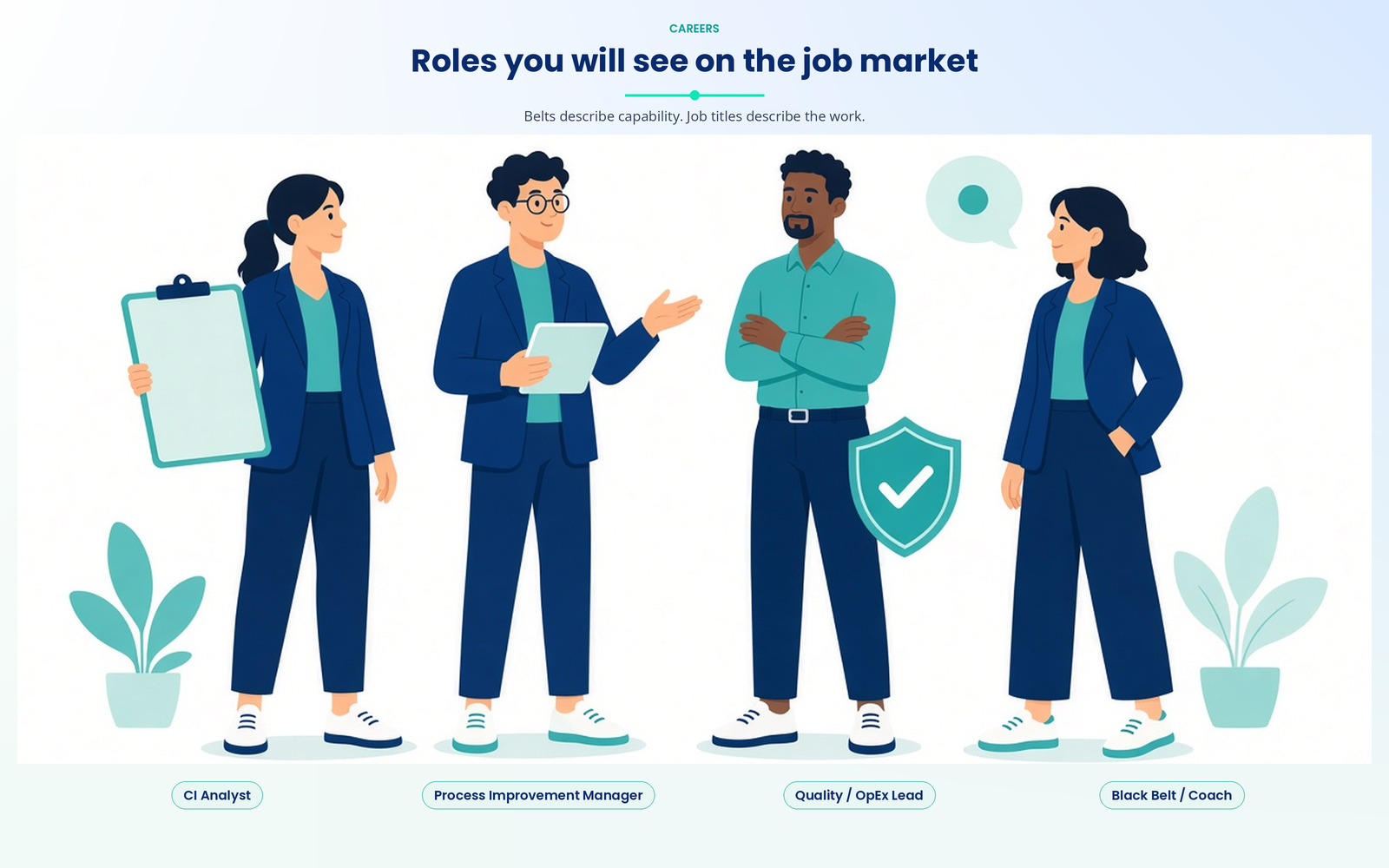
Four typical Lean Six Sigma roles: continuous improvement analyst, process improvement manager, quality or operational excellence lead, and Black Belt or coach.
Belts describe capability. Job titles describe the work.

Types of jobs and roles

Usually Yellow or Green Belt

Continuous Improvement Analyst

Collects and analyses process data, maps workflows, supports Green and Black Belts, and often leads a first local project. A typical early role if you are moving in from operations, quality or business analysis.

Usually Green Belt

Quality Engineer

Looks after capability, defects and standards in a product or process. Uses measurement systems, root-cause analysis and control plans. Common in manufacturing, pharma, medical devices and some digital operations.

Usually Green or Black Belt

Process Improvement Manager

Owns a portfolio of improvements, not a single project. Facilitates teams, reports benefits, and removes blockers with sponsors. In some markets this title is advertised specifically as a Black Belt role.

Usually Black Belt

Operational Excellence Lead

Connects improvement work to how the organisation actually runs. Coaches managers, standardises methods, and keeps day-to-day operations from sliding back after a project ends.

Black Belt

Lean Six Sigma Black Belt

A specialist who leads larger, cross-functional projects and coaches Green Belts. This is often a dedicated role rather than a side-of-desk responsibility.

Master Black Belt

Master Black Belt / Deployment Leader

Designs the programme, develops Black Belts, helps leaders choose the right problems, and holds the standard. This is a senior coaching and governance role, not only a harder exam.

Backgrounds that lead into this work

There is no single required degree, and none is strictly needed for the early belts. People arrive from engineering, operations, nursing and other clinical roles, finance and insurance, quality, IT, logistics, military service, and project management. What they share is a close view of a real process and the patience to measure it.

A bachelor’s degree in engineering, science, business or health is common in Green Belt and Black Belt advertisements, and a master’s degree appears more often at Master Black Belt and programme-lead level. Those preferences are not the same as a rule. Many capable White, Yellow and Green Belts are appointed from the job they already do, then formalise the skill with a belt. If you already hold a PMP or work in a PRINCE2 environment, you already know how to organise work; Lean Six Sigma adds the process diagnosis.

Industries that hire

  • Manufacturing — quality, yield, changeovers, downtime and supply flow.
  • Healthcare — waits, flow, theatre use, medication safety and discharge.
  • Banking and insurance — claims, onboarding, first-time-right processing and rework.
  • Government — service journeys, processing times and failed demand.
  • Logistics — on-time delivery, warehouse flow and damage or error rates.
  • IT and professional services — hand-offs, rework, cycle time and service quality.
  • Pharmaceuticals and medical devices — capability, compliance-friendly standards and deviation reduction.
  • Energy and utilities — reliability, outage work, safety-critical processes and contractor flow.

Indicative salaries around the world

The figures below are in local currency and come from published sources. Use the country selector for a short reading of each market, then scroll the full table, which is always visible. Where a source reports a small sample, that is marked. Figures were checked on 16 November 2026.

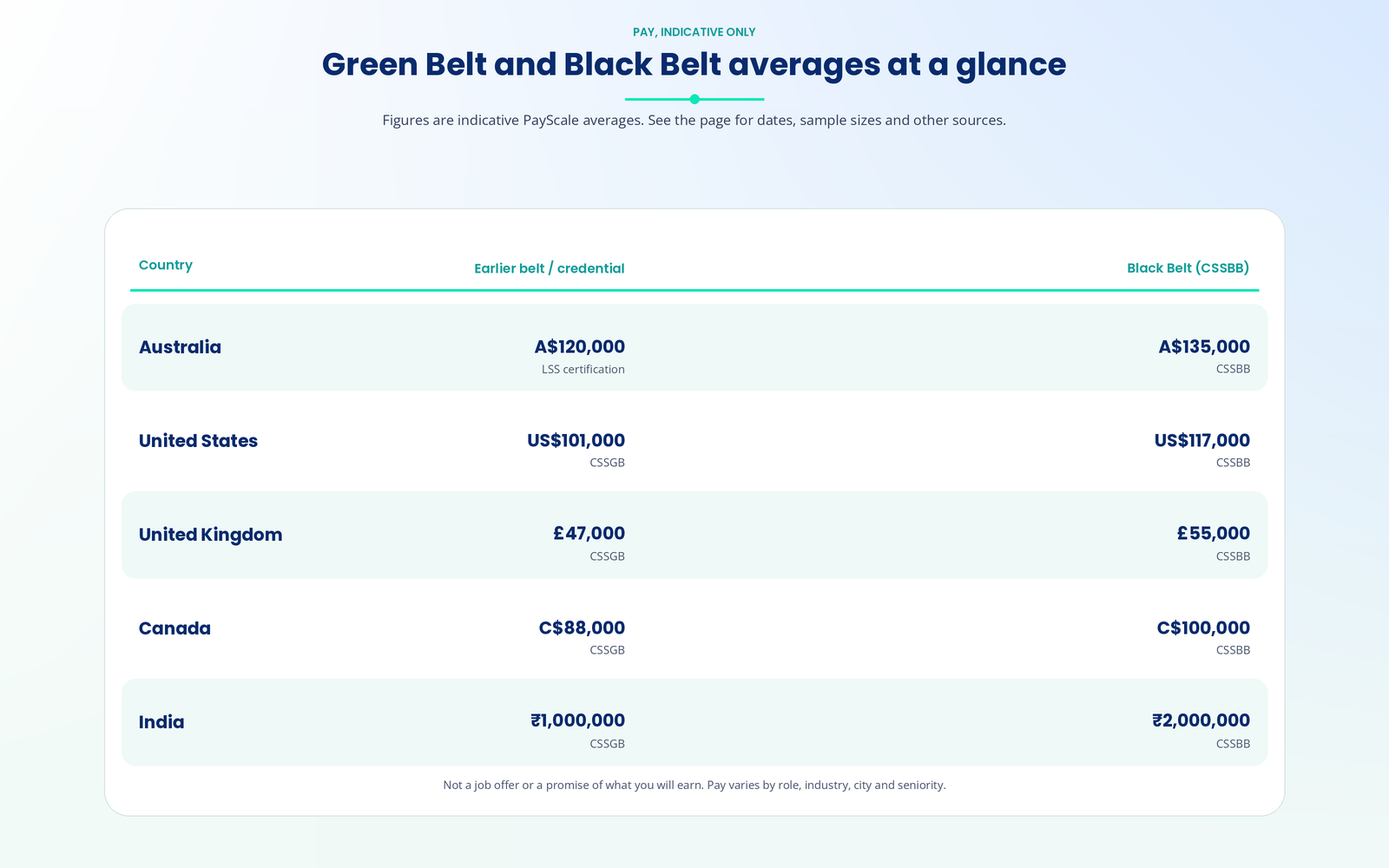
Indicative PayScale averages for earlier-belt credentials and Certified Six Sigma Black Belt in Australia, the United States, the United Kingdom, Canada and India.
Indicative averages only. See the sources, dates and sample sizes below.

These figures are indicative only. They are average or median base salaries unless a source says otherwise, and they are not a job offer or a guarantee of what you will earn. Pay varies by role, industry, city, seniority and whether bonuses or superannuation are included. Always read the original source, because methods differ: PayScale uses self-reported pay, Morgan McKinley publishes recruiter salary guides, StepStone and IT Jobs Watch draw on advertised or quoted job data.

Australia (AUD)

PayScale reports an average base salary of A$120,000 for people with a Lean Six Sigma certification, updated 1 October 2026 (130 respondents). For the Certified Six Sigma Black Belt specifically, PayScale reports an average base of A$135,000, updated 11 April 2024 (125 respondents). Morgan McKinley’s 2026 salary guide for permanent Sydney roles lists a Process Improvement Manager (Black Belt) at A$135,000–A$175,000 with a median of A$155,000, and a Senior Process Improvement Manager (Senior / Master Black Belt) at A$180,000–A$220,000 with a median of A$200,000.

United States (USD)

PayScale reports average base salaries of US$101,000 for Certified Six Sigma Green Belt (updated 20 October 2026, 14,519 people reporting), US$117,000 for Certified Six Sigma Black Belt (updated 15 October 2026, 3,710 reporting), and US$146,000 for Certified Six Sigma Master Black Belt (updated 28 December 2025, 266 reporting). These are among the larger self-reported samples available, especially at Green Belt.

United Kingdom (GBP)

PayScale reports an average base salary of £47,000 for Certified Six Sigma Green Belt, updated 29 June 2026 (314 people reporting), and £55,000 for Certified Six Sigma Black Belt, updated 26 March 2025 (138 respondents). As a check from advertised roles, IT Jobs Watch shows a median quoted salary of £51,500 for vacancies citing a Six Sigma Black Belt in the six months to 15 November 2026, based on 6 quoted salaries among 17 jobs — a small advertised sample, so treat it as context rather than a market census.

Canada (CAD)

PayScale reports an average base salary of C$88,000 for Certified Six Sigma Green Belt, updated 6 February 2026 (755 respondents), and C$100,000 for Certified Six Sigma Black Belt, updated 4 October 2024 (295 respondents). The Black Belt figure is older than the Green Belt figure; both are self-reported base pay.

India (INR)

PayScale reports an average base salary of ₹1,000,000 for Certified Six Sigma Green Belt, updated 20 October 2026 (1,004 people reporting), and ₹2,000,000 for Certified Six Sigma Black Belt, updated 8 July 2026 (238 reporting). As in other countries, actual offers vary widely by city, industry and seniority; PayScale’s own ranges on those pages are broad.

United Arab Emirates (AED)

PayScale reports an average base salary of AED 198,000 for Certified Six Sigma Green Belt, updated 8 August 2025 (156 people reporting), and AED 232,000 for Certified Six Sigma Black Belt, updated 3 March 2025 (53 respondents). The Black Belt sample is small, so the figure should be read as a directional average, not a precise band.

Singapore (SGD)

PayScale reports an average base salary of S$85,000 for Certified Six Sigma Green Belt, updated 20 June 2026 (146 respondents), and S$121,000 for Certified Six Sigma Black Belt, updated 19 January 2025 (56 respondents). The Black Belt sample is relatively small.

Germany (EUR)

StepStone’s 2026 salary page for the job title Six Sigma Black Belt in Germany gives an average gross salary of about €69,300 a year, with a typical range of €60,000 to €80,800. That is advertised-job-title data for Germany, not a certification-holder survey, and it is a useful European reference point. Pay was checked on 16 November 2026.

Indicative Lean Six Sigma pay, by country and source
CountryWhat was measuredFigure (local currency)Source and date
AustraliaLean Six Sigma certification, average baseA$120,000PayScale, 1 October 2026, 130 respondents
AustraliaCertified Six Sigma Black Belt, average baseA$135,000PayScale, 11 April 2024, 125 respondents
Australia (Sydney)Process Improvement Manager (Black Belt), low / median / high, permanentA$135,000 / A$155,000 / A$175,000Morgan McKinley 2026 salary guide
Australia (Sydney)Senior Process Improvement Manager (Senior / Master Black Belt), low / median / high, permanentA$180,000 / A$200,000 / A$220,000Morgan McKinley 2026 salary guide
United StatesCertified Six Sigma Green Belt, average baseUS$101,000PayScale, 20 October 2026, 14,519 reporting
United StatesCertified Six Sigma Black Belt, average baseUS$117,000PayScale, 15 October 2026, 3,710 reporting
United StatesCertified Six Sigma Master Black Belt, average baseUS$146,000PayScale, 28 December 2025, 266 reporting
United KingdomCertified Six Sigma Green Belt, average base£47,000PayScale, 29 June 2026, 314 reporting
United KingdomCertified Six Sigma Black Belt, average base£55,000PayScale, 26 March 2025, 138 respondents
United KingdomVacancies citing Six Sigma Black Belt, median quoted salary£51,500IT Jobs Watch, six months to 15 November 2026, 6 quoted salaries among 17 jobs (small sample)
CanadaCertified Six Sigma Green Belt, average baseC$88,000PayScale, 6 February 2026, 755 respondents
CanadaCertified Six Sigma Black Belt, average baseC$100,000PayScale, 4 October 2024, 295 respondents
IndiaCertified Six Sigma Green Belt, average base₹1,000,000PayScale, 20 October 2026, 1,004 reporting
IndiaCertified Six Sigma Black Belt, average base₹2,000,000PayScale, 8 July 2026, 238 reporting
United Arab EmiratesCertified Six Sigma Green Belt, average baseAED 198,000PayScale, 8 August 2025, 156 reporting
United Arab EmiratesCertified Six Sigma Black Belt, average baseAED 232,000PayScale, 3 March 2025, 53 respondents (small sample)
SingaporeCertified Six Sigma Green Belt, average baseS$85,000PayScale, 20 June 2026, 146 respondents
SingaporeCertified Six Sigma Black Belt, average baseS$121,000PayScale, 19 January 2025, 56 respondents (small sample)
GermanyJob title Six Sigma Black Belt, average gross annual€69,300 (typical range €60,000–€80,800)StepStone, 2026 page, checked 16 November 2026

For a wider discussion of career progression, see Achieve Career Growth with Lean Six Sigma Certification.

Your next step

How to get started

You do not need to decide your whole path today. The most reliable first step is to learn the language and walk through a simple improvement, then choose the belt that matches the work you actually want to do.

  1. Start with the free White Belt. It is online and self-paced. You will learn what the terms mean and how a basic project is structured.
  2. If you already sit on project teams, go on to Yellow Belt. That is the usual point at which you can use the basic tools with confidence.
  3. If you will lead improvements in your own area, look at Green Belt. This is the belt most often asked for in analyst, quality and operations-improvement roles.
  4. If you will lead larger, cross-functional work or coach others, consider Black Belt and later Master Black Belt.
  5. Deepen a specific skill with Kaizen Event Leader, A3 Problem Solving or BPMN 2.0 process modelling.
  6. Practise. Try a free practice exam, explore the calculators, read the glossary, or run a scenario in LSS In Action.

Want more reading first? Start with Lean Six Sigma Basics, Lean Six Sigma to Beginners, or the rest of the Knowledge Base.

Questions

Frequently asked questions

What is Lean Six Sigma in plain words?

Lean Six Sigma is a practical way to improve how work gets done. Lean removes delays, hand-offs and wasted effort so work flows. Six Sigma uses data to reduce defects and variation so the result is consistent. Together they help organisations improve quality, speed and cost.

How is Lean different from Six Sigma?

Lean asks whether a step helps the customer and whether work is waiting. Six Sigma asks whether the process is stable and capable — whether it produces the same good result time after time. Most improvement work needs both: a smoother flow, and less variation in the result.

What does DMAIC mean?

DMAIC is the usual improvement cycle: Define the problem and the goal, Measure what the process really does, Analyse the root causes, Improve the process, and Control the change so it lasts. It is a project method for process problems, not a replacement for PMP or PRINCE2.

Which belt should I start with?

If you are completely new, start with the free White Belt. It teaches the language and the basic ideas. Yellow Belt builds on that so you can take an active role on a project team. Green Belt is the usual point at which people start leading their own improvements. Black Belt and Master Black Belt are for those who will lead larger programmes or coach others.

Do I need a university degree to get started?

No degree is strictly required for the early belts. Many White, Yellow and Green Belts come from the job they already do — operations, nursing, finance, customer service, IT or a trade. Engineering, business and science degrees are common later, especially for Black Belt and Master Black Belt roles, but demonstrated improvement work usually matters more than a particular qualification.

How does Lean Six Sigma compare with PMP?

PMP is a project-management credential. It helps you deliver a temporary piece of work on time, to scope and to budget. Lean Six Sigma asks a different question: what is wrong with the process, and how will we fix it? A project manager can deliver a new system; a Lean Six Sigma practitioner looks for the process failure the system is supposed to solve. The two skills complement each other.

How does it compare with PRINCE2?

PRINCE2 is a structured project method with clear roles, stages and controls. It is widely used in government and large organisations, especially in the United Kingdom, Australia and Europe. It tells you how the project will be organised. Lean Six Sigma tells you how to find and fix the process problem inside or alongside that project.

How does it work with change management and ADKAR?

A better process only helps if people use it. Change management — including the ADKAR model from Prosci (Awareness, Desire, Knowledge, Ability, Reinforcement) — helps people understand, want, learn and keep the new way of working. Lean Six Sigma designs the process change; change management helps it stick with the people who do the work.

Is the White Belt course really free?

Yes. The Lean 6 Sigma Hub White Belt is a free online, self-paced course. It is the most straightforward way to learn the ideas on this page and to see whether you want to continue to Yellow Belt or Green Belt.

Is the training online and self-paced?

Yes. Lean 6 Sigma Hub courses are online and self-paced. You can work through the lessons in your own time. There is no classroom schedule to attend.

What kinds of jobs use Lean Six Sigma?

Typical titles include Continuous Improvement Analyst, Process Improvement Manager, Operational Excellence Lead, Quality Engineer, Lean Six Sigma Black Belt, and Master Black Belt or Deployment Leader. You will also see the skills asked for inside operations, quality, nursing, banking, insurance, logistics, government and IT roles that are not named after a belt.

Are the salary figures on this page a guarantee?

No. The figures are indicative. They come from published sources such as PayScale, Morgan McKinley, StepStone and IT Jobs Watch, and each number is shown with its source, date and, where the source gives one, the sample size. Pay varies by role, industry, city, seniority and whether bonuses are included. Small samples are marked. The figures are not a job offer or a promise of what you will earn.

Ready when you are.

Begin with the free White Belt — online, self-paced, and written for people who are new to the method.