
In the realm of professional training, course production is often treated as a creative sequence rather than an operational value stream. An expert provides a brief, learning designers shape the experience, writers develop the content, media specialists build the assets, reviewers assess quality, and the LMS team prepares the release.
However, the learner experiences only one outcome: a coherent, accurate, accessible course available when promised.
Value Stream Mapping (VSM) makes the entire flow visible. It separates value-adding work from waiting, rework, handoffs, approval delays, and repeated review cycles. For L&D teams, this distinction is essential. A course may contain only 31 days of genuine production work yet require 96 working days to move from expert brief to accredited LMS release.
The objective is not to remove quality assurance or accreditation governance. It is to remove the unnecessary review loop: the repeated clarification, correction, and approval cycle caused by unclear requirements and fragmented ownership.
Scope the Course Production Value Stream
A useful VSM begins with a clearly defined product family and start-to-finish boundary.
For this guide, the product family is one professional online course released through an accredited training portfolio. The scope begins when the SME brief is accepted and ends when the course is published in the LMS and ready for enrolment.
The mapped process includes:
- SME brief and expert content capture
- Learning design and curriculum architecture
- Scriptwriting and instructional content development
- Media build, including slides, narration, video, and downloadable assets
- Assessment authoring
- Accreditation review
- LMS configuration and release
- Supporting handoffs, scheduling, and governance approvals
This boundary is practical because it includes the main departments, information flows, and decision points that influence release lead time.
For each step, capture:
- Processing time
- Queue or waiting time
- Number of handoffs
- Review cycles
- Rework hours
- First-pass acceptance
- Responsible owner
- Required output and acceptance criteria
The Define Phase guide on handoff points is a useful companion when responsibilities are unclear between SMEs, instructional designers, media teams, and accreditation reviewers.
Current-State Map: Where the 96 Days Go
Consider an illustrative training provider releasing eight courses per year. Its current-state VSM shows:
- 96 working days from accepted SME brief to LMS release
- 31 days of value-adding production work
- 65 days of queue and coordination time
- 62 days of queue time concentrated in review and accreditation
- 3.4 review cycles per module
- 19 hours of rework per course
The value-added ratio is:
[
\frac{31}{96} \times 100 = 32.3%
]
This means approximately two-thirds of the elapsed time does not transform the course itself. The largest constraint is not writing, design, or media production. It is the review and accreditation flow.
| Current-state activity | Value-adding time | Queue or waiting time | Primary observation |
|---|---|---|---|
| SME brief and content capture | 3 days | 2 days | Inputs arrive in different formats |
| Learning design | 5 days | 5 days | Learning outcomes are clarified late |
| Scriptwriting | 4 days | 8 days | Writers wait for design decisions |
| Media build | 8 days | 10 days | Production starts before content is stable |
| Assessment authoring | 3 days | 6 days | Questions require repeated SME clarification |
| Accreditation review | 4 days | 31 days | Review batches accumulate in a shared queue |
| LMS configuration and release | 4 days | 0 days | Release is fast once all approvals are complete |
| Scheduling, handoffs, and administration | 0 days | 3 days | Work waits for ownership or meeting availability |
| Total | 31 days | 65 days | 96 working days |
The 62 days of review and accreditation queue time are particularly important. The accreditation review itself may require only four days of active assessment, but work waits for reviewer availability, clarification responses, evidence collation, and resubmission.
A tollgate review should provide governance and decision quality. It should not become a default holding area for incomplete or inconsistent work.

Identify the Eight DOWNTIME Wastes in Course Production
The eight DOWNTIME wastes translate directly into knowledge work and L&D operations.
1. Defects
Examples include incorrect technical explanations, inconsistent terminology, broken links, inaccessible media, assessment questions that do not match learning outcomes, and missing accreditation evidence.
A defect discovered during accreditation can force the course back to scripting, media, and assessment teams.
2. Overproduction
Teams may create extra videos, downloadable guides, quiz questions, or visual assets before the learning need is confirmed. These assets increase review volume without necessarily improving learner outcomes.
3. Waiting
Waiting is often the dominant waste. A course may sit for 12 days while an SME answers a question, 18 days for an accreditation slot, or seven days while a reviewer consolidates feedback.
4. Non-utilised talent
Subject matter experts, learning designers, accessibility specialists, and experienced reviewers lose capacity when they spend time searching for version history or repeating the same clarification.
5. Transportation
In digital work, transportation means unnecessary movement of information. Content may travel through email, shared drives, spreadsheets, ticketing tools, and chat threads before reaching the next owner.
6. Inventory
Work in process includes unfinished scripts, unedited videos, draft assessments, pending review packs, and courses awaiting LMS configuration. Excess WIP conceals ageing and increases the probability of outdated content.
7. Motion
Digital motion includes searching for the latest file, switching between platforms, locating feedback, arranging repeated meetings, and manually reconciling comments from multiple reviewers.
8. Extra processing
Examples include duplicate quality checks, rewriting content to fit inconsistent templates, requesting evidence that was already supplied, and reviewing every module with the same intensity regardless of risk.
The purpose of this analysis is not to criticise teams. It is to expose where the system makes good work difficult.
Build the Future-State Course Value Stream
The future state should preserve expertise and accreditation discipline while creating a smoother pull-based flow.
1. Establish a Definition of Ready
Before learning design begins, the SME brief should contain:
- Target audience and prerequisite knowledge
- Measurable learning outcomes
- Approved terminology
- Regulatory or accreditation requirements
- Source references and evidence
- Assessment expectations
- Media and accessibility requirements
This prevents incomplete inputs from entering the production stream.
2. Create a Definition of Done for Each Module
A module is ready for integrated review only when its script, media, learner activity, assessment, references, accessibility checks, and metadata are complete.
This replaces fragmented reviews with one controlled package.
3. Use Agile Delivery Inside the VSM
Agile’s flexible, iterative approach complements Lean Six Sigma when used with discipline. Instead of building an entire eight-module course before receiving feedback, the team can work in two-week module sprints.
Each sprint should include:
- Planning against available team capacity
- Script and learning design completion
- Media and assessment production
- Integrated quality review
- Demonstration and feedback
- Retrospective and standard-work update
Lean Six Sigma provides the process discipline and performance measurement. Agile provides short feedback cycles and adaptability.
4. Replace Serial Reviews with One Risk-Based Review Gate
Use a single integrated review panel for learning quality, technical accuracy, accessibility, and accreditation readiness. Low-risk standard modules can follow a streamlined route, while high-risk topics receive deeper specialist review.
The objective is not “no review.” The objective is no repeated review caused by preventable ambiguity.
5. Control WIP and Make Delays Visible
Set a WIP limit of two courses in active production per delivery team. Use a visual board showing:
- Current owner
- Days in stage
- Blocker
- Next action
- Review due date
- Accreditation status
An ageing alert should trigger when a module exceeds its service-level expectation. This is the knowledge-work equivalent of an Andon signal.
Current State Versus Future State
| Metric | Current state | Future-state target |
|---|---|---|
| Courses released per year | 8 | 12 |
| Brief-to-release lead time | 96 days | 55 days |
| Value-adding production time | 31 days | 27 days |
| Total queue and coordination time | 65 days | 28 days |
| Review and accreditation queue | 62 days | 22 days |
| Review cycles per module | 3.4 | 1.4 |
| Rework per course | 19 hours | 6 hours |
| First-pass review acceptance | 41% | 82% |
| WIP per delivery team | 5 courses | 2 courses |
These targets represent a 43% reduction in lead time and a 68% reduction in rework hours. They also increase annual release capacity from eight to twelve courses without assuming a proportional increase in staffing.
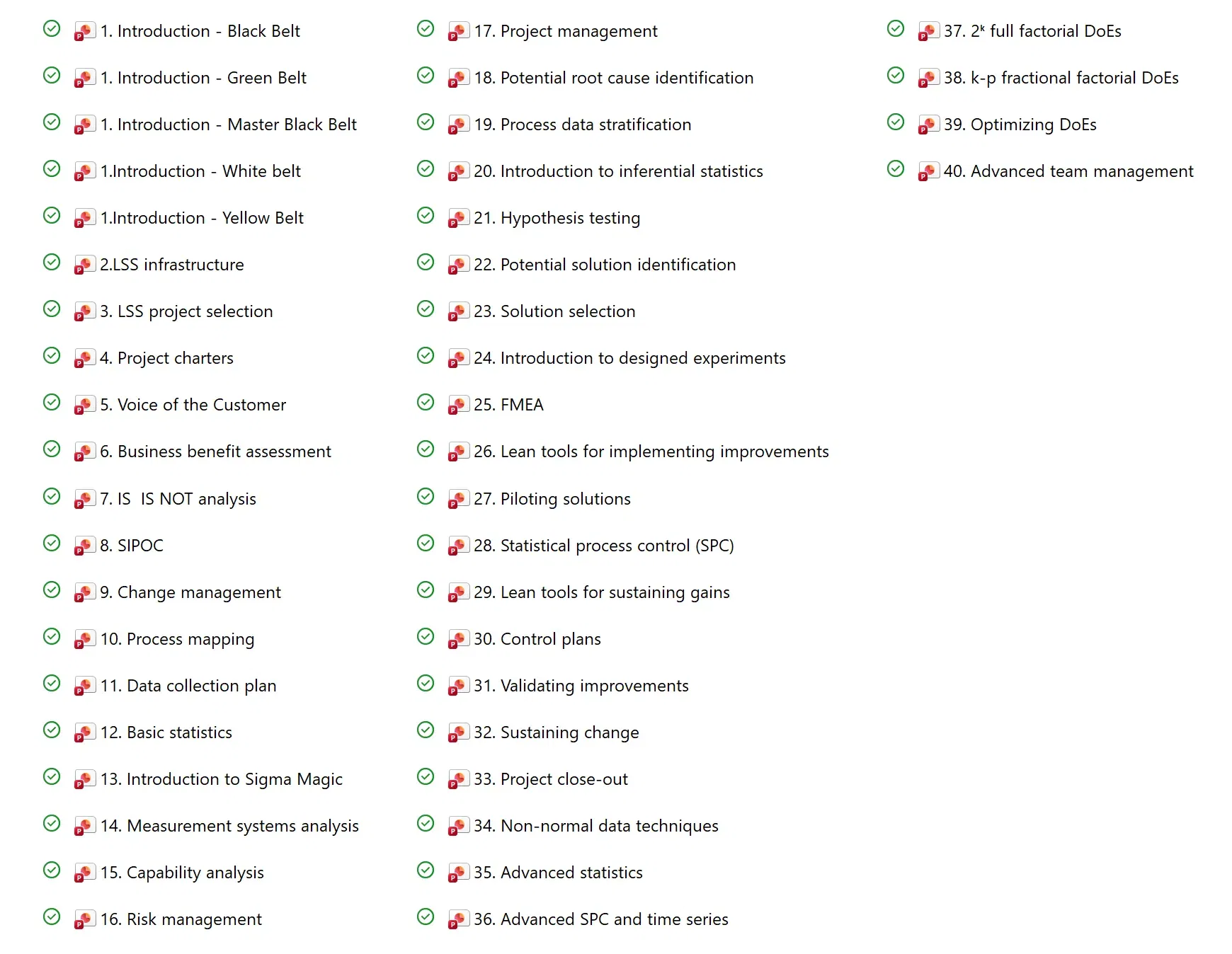
A structured course architecture, such as a consistent belt-level curriculum with defined modules and checkpoints, supports this future state. The Lean Six Sigma course curriculum overview illustrates how standardised module structures can make content completeness visible.
90-Day Kaizen Sequencing Plan
Days 1–15: Define and Measure
- Confirm the product family and VSM boundaries
- Interview SMEs, learning designers, media producers, reviewers, and LMS owners
- Collect lead-time data from the last eight courses
- Record review cycles, rework hours, queue ageing, and approval delays
- Create a SIPOC and current-state map
- Agree on operational definitions for “ready,” “complete,” and “released”
Days 16–30: Analyse the Constraint
- Pareto the reasons for review returns
- Stratify delays by module, reviewer, course type, and handoff
- Identify the top five causes of rework
- Validate whether accreditation delays arise from capacity, incomplete evidence, or unclear standards
- Run a focused kaizen workshop with representatives from every function
Days 31–60: Pilot the Future State
Pilot the redesigned workflow on one course:
- Use the new SME brief
- Apply the Definition of Ready
- Limit WIP to two active courses
- Build content in two-week Agile sprints
- Conduct one integrated review gate
- Use a visual ageing board
- Track first-pass acceptance and rework hours daily
Days 61–75: Improve and Standardise
- Compare pilot performance with the baseline
- Remove unnecessary approval steps
- Update templates, checklists, and accreditation evidence requirements
- Document the standard work for each handoff
- Train participants on escalation and blocker management
Days 76–90: Control and Scale
- Publish the future-state VSM
- Establish weekly flow reviews
- Add lead time, queue time, review cycles, and rework to the L&D dashboard
- Assign process ownership
- Conduct a 30-day control audit
- Extend the method to the next course family
The control plan should be connected to broader DMAIC governance. Review the process at defined tollgates, but keep the governance proportional to risk and focused on evidence.
Turn Course Production into a Measurable Capability
Value Stream Mapping gives L&D leaders a rigorous way to improve course production without reducing educational quality. It reveals the difference between necessary expertise and avoidable delay, between meaningful accreditation and repeated approval, and between productive WIP and hidden inventory.
For professionals who want to lead this type of transformation, Lean Six Sigma certification provides the method, language, and analytical foundation required to move from observation to sustained results.
Lean 6 Sigma Hub offers CSSC-accredited, self-paced online training supported by real-world simulations, worked examples, dummy data, charts, and end-to-end case studies. The Lean Six Sigma Green Belt course is particularly relevant for professionals leading cross-functional improvement projects, while the Master Black Belt programme develops enterprise governance and coaching capability.

Enrol in CSSC-accredited Lean Six Sigma training and learn how to map, analyse, improve, and control the value streams that shape your organisation’s performance.
Kaizen. Kai-Care. Kai-Done. Lean Six Sigma