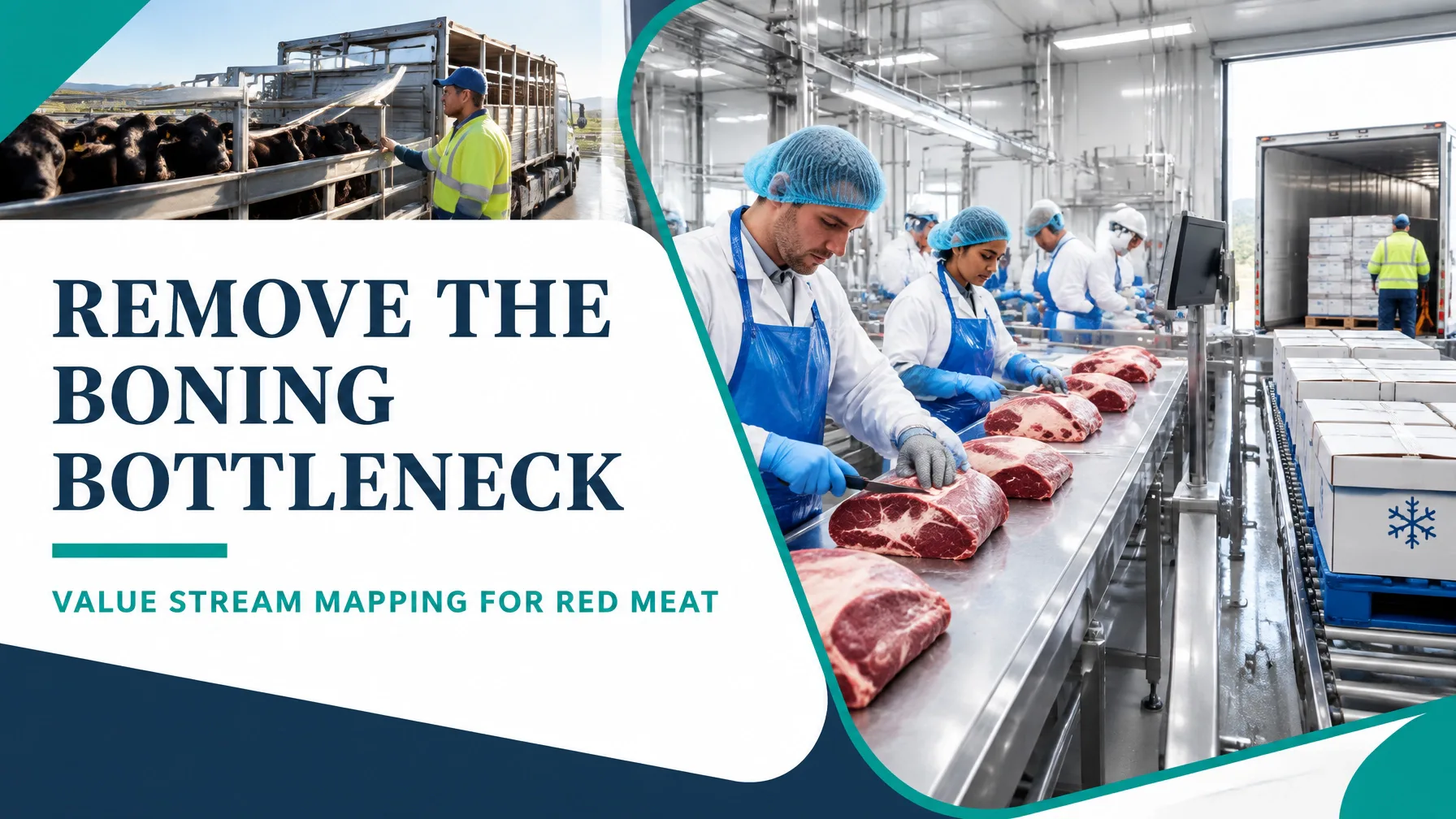
In red meat processing, a value stream does not end when a carcass leaves the kill floor. It continues through chilling, grading, quartering, boning, packing, cold storage and dispatch. Every queue, specification change and delayed carton influences food safety, labour utilisation, yield and customer delivery performance.
This deep guide applies Value Stream Mapping (VSM) to a hypothetical single-shift beef processing plant handling 480 head per day. The objective is to improve flow without compromising animal welfare, regulatory controls, sanitation, temperature requirements or product quality.
The case study focuses on a clear constraint: the boning room chain is running at 180 carcasses per hour against a takt requirement of 205 carcasses per hour, with only 62% OEE. The result is extended chill-floor dwell, excess work in process and chilled carton dispatch DIFOT of just 88%.
The future-state objective is ambitious but structured:
- Reduce lead time from 3.8 days to 1.9 days
- Increase value-added time from 41 minutes to 92 minutes
- Improve boning-line OEE from 62% to 78%
- Increase dispatch DIFOT from 88% to 97%
The supporting AMPC red meat processing report illustrates why slaughter, boning and load-out must be managed as one connected system rather than as separate departments.
1. Define the VSM Scope Before Drawing the Map
The fundamental purpose of VSM is to reveal how material and information move from customer demand to delivered product. Begin with one product family rather than attempting to map every specification simultaneously.
For this case, the scope is:
Chilled beef cartons produced from live receival through dispatch to the customer.
The map includes:
- Live receival, lairage and production scheduling
- Humane stunning, sticking, dressing and inspection
- Carcass chilling and grading
- Quartering and boning
- Primal cutting, trimming and carton packing
- Carton chilling and cold storage
- Order picking, loading and dispatch
The map should show both:
- Material flow: animals, carcasses, quarters, primals, cartons and pallets
- Information flow: customer orders, production schedules, product specifications, changeover plans and dispatch instructions
Animal welfare and food safety controls are not treated as waste. They are essential requirements. For example, the FAO guidance on slaughtering and meat handling emphasises humane handling, hygienic equipment, rapid chilling and cold-chain control.
2. Calculate the Boning Takt Requirement
Takt time defines the required production rhythm:
[
\text{Takt Time}=\frac{\text{Net Available Production Time}}{\text{Customer Demand}}
]
For the constrained boning window, the plant’s planning requirement is 205 carcass-equivalents per hour.
[
\text{Takt Time}=\frac{60\text{ minutes}}{205\text{ carcasses}}
]
[
\text{Takt Time}=0.2927\text{ minutes per carcass}
]
[
\text{Takt Time}=17.6\text{ seconds per carcass}
]
The current chain speed is:
[
\frac{60\text{ minutes}}{180\text{ carcasses}}=20.0\text{ seconds per carcass}
]
Therefore, the current process is approximately 2.4 seconds slower than takt for every carcass. That gap compounds rapidly across the shift, creating queues before the boning room and downstream instability in packing and dispatch.
The 480-head daily volume remains the plant-level demand basis. The 205-per-hour requirement should be validated against actual boning-window duration, product mix and order requirements before implementation. This prevents a common VSM error: comparing a daily average with a short-window constraint without aligning the time basis.
3. Current-State Map: Where Flow Breaks Down

A practical current-state map for this plant would show the following pattern:
Live receival → kill floor → chill floor → boning room → carton packing → carton chill → cold store → dispatch
The data boxes would record:
- 480 head per day
- Boning chain speed: 180 carcasses per hour
- Required boning rate: 205 carcasses per hour
- Boning OEE: 62%
- Changeovers: 11 per day
- Average changeover: 24 minutes
- Total changeover time:
[
11 \times 24=264\text{ minutes per day}
] - Chill-floor dwell: 14 hours
- Target chill-floor dwell: 6 hours
- Dispatch DIFOT: 88%
- Total lead time: 3.8 days
- Value-added time: 41 minutes
The value-added percentage is extremely low:
[
\frac{41\text{ minutes}}{3.8 \times 24 \times 60}\times100
\approx 0.75%
]
In other words, most elapsed time is waiting, storage, movement, inspection delay, batching or schedule interruption rather than transformation that customers value.
The eight DOWNTIME wastes in this value stream
Defects: Incorrect trims, damaged packaging, temperature deviations, labelling errors and specification mismatches create rework or product holds.
Overproduction: Producing cartons ahead of confirmed customer demand increases cold-store inventory and may cause the wrong specification to be processed.
Waiting: Carcasses wait for chill space, boning capacity, product release, carton chilling, order allocation or transport availability.
Non-utilised talent: Operators may have practical knowledge of line balance, recurring stoppages and specification risks that is not captured in standard work or improvement teams.
Transportation: Excessive movement between chillers, quartering areas, boning tables, packing lines and dispatch staging adds time without changing the product.
Inventory: Work in process accumulates as carcasses, quarters, primals, cartons and pallets between functional departments.
Motion: Operators walk for tools, packaging, labels, knives, trays or approvals because point-of-use supplies and layouts are not optimised.
Extra-processing: Repeated scans, duplicate checks, repacking, unnecessary handling and avoidable specification changes consume capacity.
The most visible constraint is the boning room, but the map should not assume that the constraint is caused only by the chain. The 62% OEE may include availability losses, performance losses and quality losses from changeovers, equipment stops, labour imbalance, product variation and downstream carton congestion.
4. Operator Balance: Make the Boning Constraint Visible
An operator balance chart compares the work content at each boning station with takt time. The horizontal reference line should be 17.6 seconds per carcass-equivalent.

A workshop should measure actual work content for each station, including:
- Pick-up and presentation
- Cutting and trimming
- Transfer to the next station
- Inspection and identification
- Tool sanitation and change
- Replenishment and minor adjustments
Any station consistently above takt is a candidate for:
- Task redistribution
- Additional point-of-use support
- Standardised work
- Improved workstation layout
- Cross-training
- Small equipment modification
- Product sequencing or specification redesign
The goal is not simply to make people work faster. It is to create a safe, repeatable and hygienic balance that meets demand while protecting quality and operator wellbeing.
5. Future-State VSM: Design Flow Around the Constraint
The future-state map should be built from customer demand backward. Key design changes include:
-
Create a pacemaker process at boning or carton packing.
This process sets the rhythm for upstream release rather than allowing the kill floor to overproduce into a constrained system. -
Introduce a controlled FIFO lane before boning.
A defined first-in, first-out lane limits WIP while protecting carcass identity, grade and product sequence. -
Reduce changeover losses.
Apply SMED principles to separate internal and external work. Prepare knives, packaging, labels, tools and specifications before the line stops. The initial opportunity is the 264 minutes of daily changeover time. -
Sequence primal specifications intelligently.
Group compatible runs where possible, while maintaining customer commitments, traceability and food safety. -
Use visual signalling and escalation.
Andon-style signals can identify a stopped station, missing material, quality hold or equipment issue in real time. The signal must trigger a defined response, not merely display a problem. -
Synchronise chilling and packing.
The target is to reduce chill-floor dwell from 14 hours to 6 hours without bypassing required temperature controls. Any proposed change must be validated through the plant’s HACCP system and applicable regulatory requirements. -
Connect dispatch planning to production release.
Orders should be prioritised by customer due date, product readiness, age, temperature status and transport availability.
Current versus future performance
| Metric | Current state | Future state | Improvement focus |
|---|---|---|---|
| Daily processing volume | 480 head | 480 head with smoother flow | Level production |
| Boning chain speed | 180 carcasses/hour | 205 carcass-equivalents/hour | Balance work to takt |
| Boning OEE | 62% | 78% | Reduce downtime, speed and quality losses |
| Daily changeovers | 11 | Fewer or better-sequenced runs | SMED and product family planning |
| Average changeover | 24 minutes | 12–15 minutes target | Externalise preparation |
| Chill-floor dwell | 14 hours | 6 hours | FIFO, release discipline and capacity alignment |
| Total lead time | 3.8 days | 1.9 days | Control WIP and synchronise flow |
| Value-added time | 41 minutes | 92 minutes | Remove avoidable waiting and handling |
| Dispatch DIFOT | 88% | 97% | Order readiness and dispatch control |
The future state is not achieved by removing essential inspection or chilling. It is achieved by reducing avoidable delay around those requirements.
6. The 30/60/90-Day Kaizen Wave Plan

Days 1–30: Measure and Stabilise
- Confirm product-family scope and customer requirements
- Validate takt assumptions and available production time
- Complete a detailed time observation study at every boning station
- Measure OEE losses by category
- Establish daily WIP counts between major process steps
- Record actual chill-floor dwell and temperature profiles
- Create a changeover reason code and duration log
- Launch a daily cross-functional tier meeting
- Establish food safety, animal welfare and quality safeguards for every proposed change
Days 31–60: Flow and Balance
- Run a boning-room operator balance workshop
- Pilot standard work at the two highest-load stations
- Apply SMED to one representative primal specification change
- Create FIFO lanes and WIP limits
- Introduce visual production boards and escalation signals
- Improve point-of-use availability for tools, labels and packaging
- Trial a pacemaker schedule linked to customer demand
- Review carton packing and chilling capacity against boning output
Days 61–90: Control and Scale
- Expand the balanced work design across the full boning line
- Lock in revised changeover standards
- Monitor OEE, takt attainment, dwell, WIP and DIFOT daily
- Implement control plans for critical process and temperature measures
- Audit standard work and training effectiveness
- Review the future-state map against actual performance
- Confirm whether the plant has achieved the interim targets of 78% OEE, 1.9-day lead time and 97% DIFOT
- Replicate successful practices across compatible product families
Build Capability Through Lean Six Sigma Certification
A VSM project of this scale requires more than a diagram. It requires disciplined measurement, statistical thinking, structured problem-solving and the ability to lead change across production, quality, maintenance, planning and dispatch.
Lean 6 Sigma Hub’s online training provides self-paced learning across the Belt levels, supported by practical case studies, tools and worked examples.
For professionals leading this type of cross-functional initiative, the CSSC-accredited Green Belt course develops capability in process mapping, data collection, root-cause analysis, hypothesis testing, piloting and control plans. The Black Belt programme is designed for complex projects requiring advanced statistics, leadership and enterprise-level change.
Choose the Lean Six Sigma certification level that matches your role, learn at your own pace, and build the capability to improve flow without compromising safety, quality or respect for people and animals.
Kaizen. Kai-Care. Kai-Done. Lean Six Sigma.