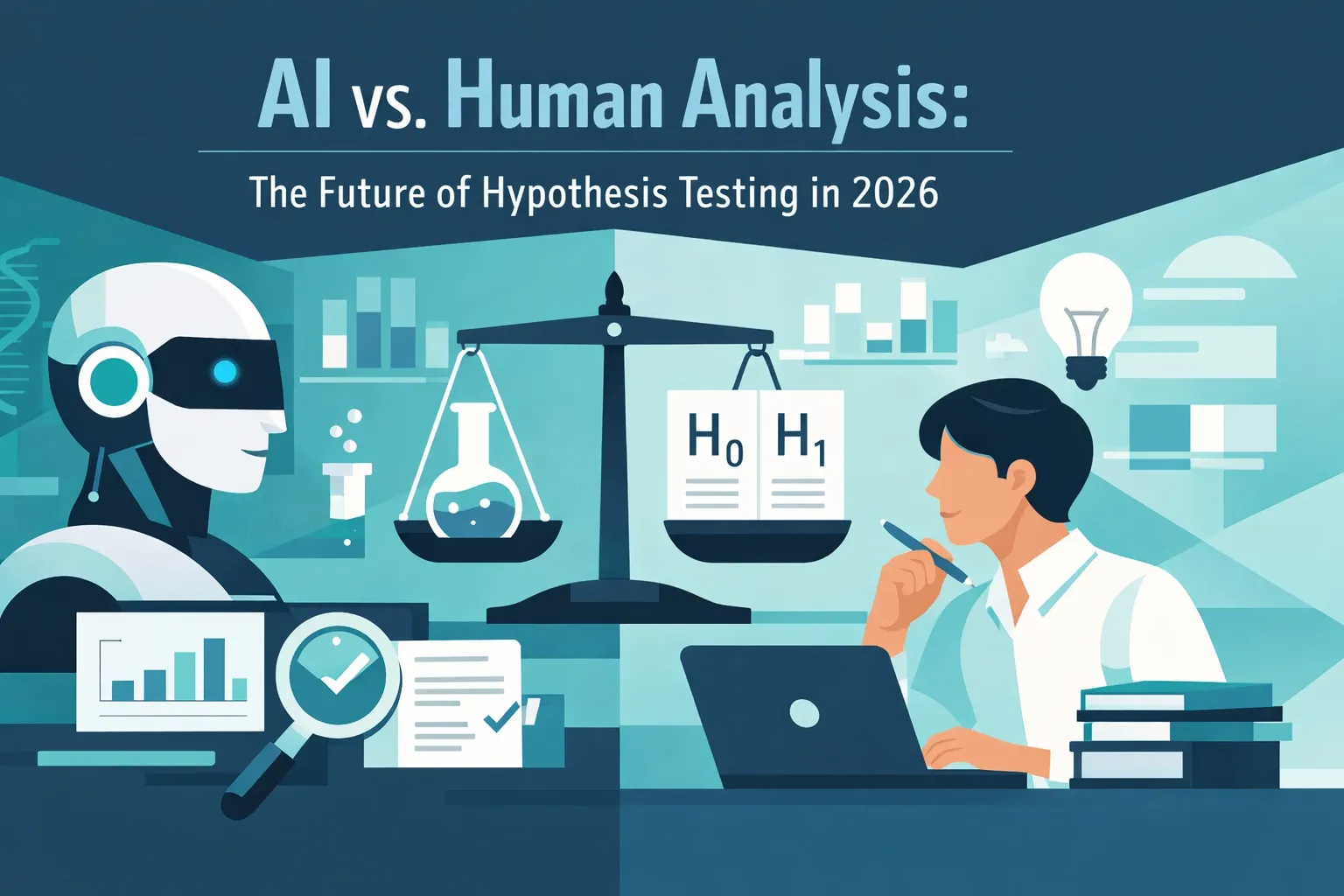
In the realm of operational excellence, the transition from intuitive decision-making to data-driven validation has long been the cornerstone of the Lean Six Sigma methodology. As we navigate the professional landscape of March 2026, a transformative shift is occurring within the Analyze phase of the DMAIC (Define, Measure, Analyze, Improve, Control) framework. The emergence of sophisticated Artificial Intelligence (AI) has fundamentally altered how practitioners approach hypothesis testing, moving from manual statistical computation to automated, high-velocity analytical models.
To fully appreciate this evolution, one must recognize that while the tools have advanced, the fundamental purpose of hypothesis testing remains unchanged: to distinguish between random noise and statistically significant signals. At Lean 6 Sigma Hub, our forward-thinking curriculum integrates these technological advancements, ensuring that candidates pursuing six sigma training are prepared for a world where AI performs the "heavy lifting" while humans provide the indispensable context.
The Evolution of the "Analyze" Phase
Historically, the Analyze phase required Green Belts and Black Belts to spend significant hours cleaning data, selecting the appropriate statistical tests, and manually running calculations in software like Minitab or JMP. Whether it was a T-test to compare means or a Chi-Square test for categorical data, the burden of execution sat squarely on the human practitioner.
In 2026, the paradigm has shifted. AI systems now handle the mechanical aspects of analysis with unprecedented speed. Modern platforms can scan vast datasets, identify outliers, and recommend the most robust hypothesis test within seconds. However, this automation does not render the human expert obsolete; rather, it elevates the practitioner's role from a "number cruncher" to a "strategic validator."
The "Heavy Lifting": What AI Does Best
The primary strength of AI in 2026 lies in its ability to manage "big data" complexities that would overwhelm traditional manual methods. When identifying bottleneck identification and process constraints, AI can simulate thousands of permutations of a process to pinpoint exactly where a delay is likely to occur.
Key areas where AI is automating the heavy lifting include:
- Automated Distribution Fitting: AI instantly determines if data is normal or non-normal, selecting between parametric and non-parametric tests without human intervention.
- Real-time Literature Synthesis: Advanced models can scan internal historical project data to propose novel hypotheses based on past successes and failures.
- Predictive Hypothesis Generation: Instead of waiting for a problem to occur, AI monitors process performance technology to suggest hypotheses about potential future failures.
Recent research highlights the power of these tools. A January 2026 study from the University of Montreal indicated that advanced AI models, such as GPT-4, consistently outperform the average human in divergent creativity tests and structured idea generation. In a Lean Six Sigma context, this means AI can generate a broader list of potential root causes during a brainstorming session than a standard project team might identify alone.
The Human Element: Context, Feasibility, and "Why"
Despite the computational prowess of AI, a critical gap remains: the ability to judge real-world feasibility. A Stanford study conducted recently examined AI-generated hypotheses in complex environments. While the AI could propose technically "novel" ideas, the novelty and feasibility scores dropped significantly: from 5.382 to 3.406 on a 10-point scale: when those ideas were tested in practice. In contrast, human-generated ideas maintained a much higher stability in their practical application.
This is where the lean six sigma certification becomes vital. AI may identify a correlation between two variables, but it cannot understand the "tribal knowledge" or the subtle cultural nuances of a shop floor. It might suggest that reducing batch sizes will improve throughput, but a human Black Belt knows that the current supplier contract makes small-batch procurement financially unviable.
The Validation Burden
The rise of AI has paradoxically increased the cognitive workload for researchers and Lean Six Sigma practitioners. Statistics show that 31% of researchers now spend more time validating AI outputs than they did on manual analysis. This "Validation Burden" requires a deep understanding of analyze phase success criteria.
Practitioners must be able to:
- Sense-check results: Does the AI’s p-value make sense given the operational reality?
- Mitigate Risk: AI often struggles with Alpha and Beta risks (Type I and Type II errors) in non-standard environments.
- Explain the "Why": Stakeholders rarely accept a process change because "the AI said so." A certified professional must translate statistical significance into business value.

Practical Scenarios: AI vs. Human in 2026
To understand the synergy between AI and human analysis, consider the following real-world applications across different industries:
1. Cold Chain Logistics
In cold chain logistics, AI can monitor thousands of IoT sensors in real-time. It might flag a statistically significant temperature deviation in a specific shipping lane. However, a human analyst is required to determine if the deviation is due to a failing refrigeration unit or a driver error during a scheduled stop: a distinction that requires contextual investigation rather than just data points.
2. Banking Compliance
When dealing with banking compliance and regulatory reporting, AI is excellent at detecting outliers in transaction data. But it takes a human expert to understand if an outlier is a sign of a broken process or a legitimate, one-time high-value transaction. Misinterpreting these results can lead to costly regulatory penalties.

The Future of Professional Training
As we look toward the remainder of 2026 and beyond, the most successful organizations will be those that foster collaboration between human specialists and AI tools. The highest-performing hypothesis generation consistently comes from this hybrid approach.
At Lean 6 Sigma Hub, we have updated our curriculum to reflect this reality. We don't just teach you how to calculate a standard deviation; we teach you how to leverage AI to perform those calculations while focusing your expertise on stakeholder analysis and sustainable implementation.
Our courses emphasize:
- Critical Thinking over Rote Calculation: Understanding the logic behind the tests so you can spot when an AI model is "hallucinating" or over-embellishing a hypothesis.
- Data Integrity: Learning outlier detection and treatment to ensure the AI is fed high-quality information.
- Leadership and Mentoring: As AI takes over the technical tasks, the role of a Black Belt shifts toward mentoring Green Belts and shaping organizational strategy.
Conclusion: Staying Relevant in an AI-Driven World
The future of hypothesis testing is not a choice between AI and humans; it is the strategic integration of both. AI provides the speed, the literature synthesis, and the computational power to handle the "heavy lifting" of the Analyze phase. However, the human practitioner remains the ultimate arbiter of truth, feasibility, and context.
Without a solid foundation in Lean Six Sigma principles, practitioners risk becoming overly reliant on automated tools that they do not fully understand. This lack of depth can lead to incorrect root cause validation and failed projects. To remain competitive and effective in 2026, obtaining a recognized lean six sigma certification is no longer optional: it is a prerequisite for leadership in a data-saturated world.
Are you ready to lead the future of process improvement?
Enroll in our CSSC-accredited Green Belt or Black Belt programs today and master the balance of AI-driven analysis and human expertise.