
In the realm of high-stakes business decision-making, the margin for error is often razor-thin. Leaders are frequently faced with a fundamental dilemma: should they implement a new process based on promising data, or maintain the status quo to avoid unnecessary disruption? While intuition has its place, professional frameworks like Lean Six Sigma rely on the rigorous application of hypothesis testing to navigate these choices.
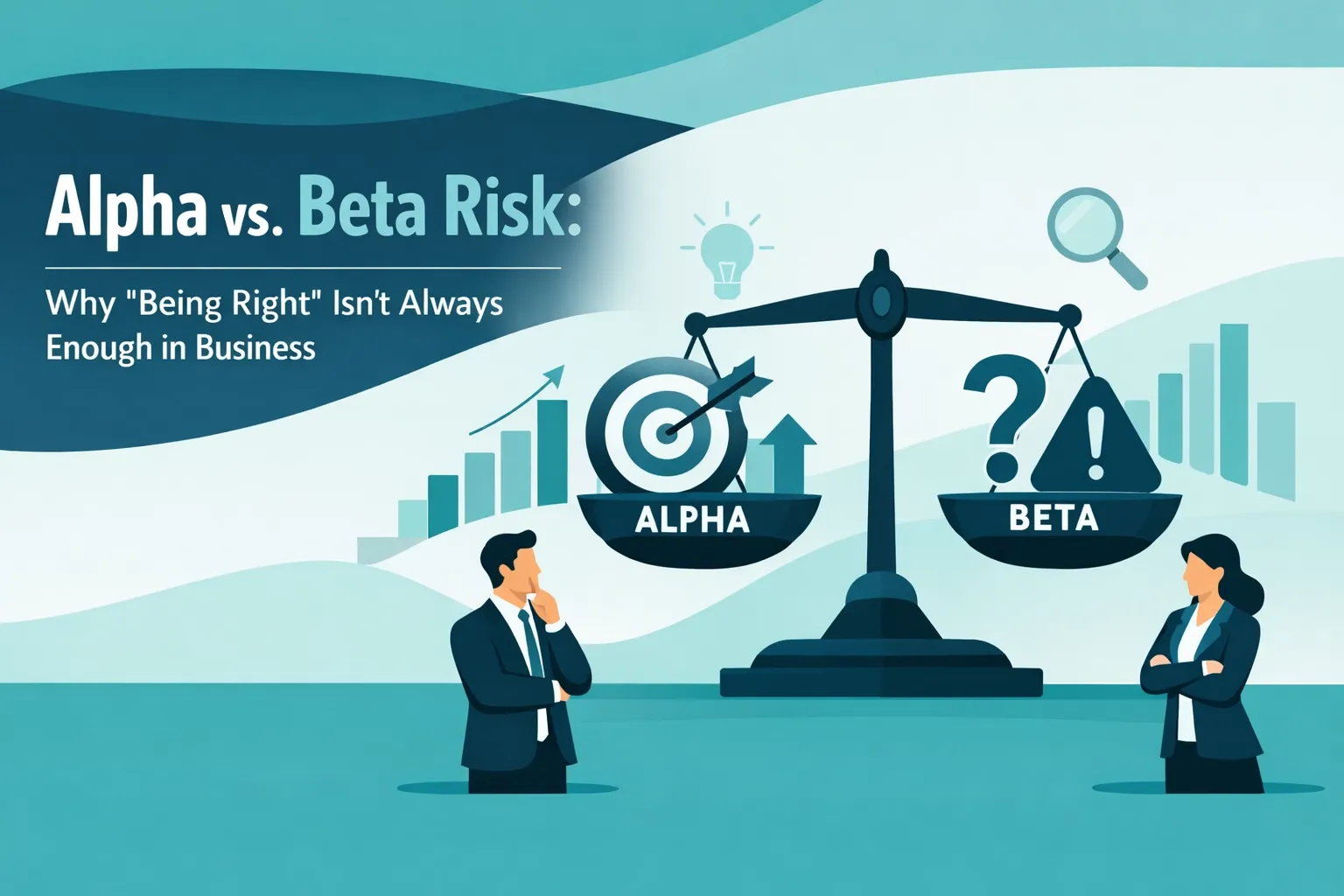
The fundamental purpose of hypothesis testing is to provide a statistical "bullseye" for decision-makers. However, statistics are never a guarantee of absolute truth; they are a management of probability. In every statistical test, two primary types of errors exist that can derail an organization's progress: Alpha Risk and Beta Risk. Understanding the nuance between these two is what separates a novice from an expert holding a lean six sigma certification.
The Statistical Framework: The Null vs. The Alternative
To fully appreciate these risks, one must first understand the foundation of the hypothesis test. Every experiment begins with two competing statements:
- The Null Hypothesis ($H_0$): This assumes that there is no real change, no difference, and no effect. It represents the status quo.
- The Alternative Hypothesis ($H_a$): This claims that there is a significant difference or a specific effect caused by a change.
Alpha and Beta risks represent the two ways we can potentially choose the wrong hypothesis.

Alpha Risk: The "False Alarm" (Type I Error)
Alpha Risk, or Type I error, occurs when we reject the Null Hypothesis ($H_0$) even though it is actually true. In practical terms, this means the data suggests a significant change has occurred when, in reality, the observed difference was merely the result of random variation or "noise" in the system.
In a statistical context, Alpha is the significance level, often set at 0.05 (or 5%). This means there is a 5% chance that we will conclude a process improvement is effective when it is actually not.
The Fire Alarm Analogy
To understand Alpha risk, consider a building’s fire alarm system. An Alpha error occurs when the alarm sounds, causing a full evacuation, but there is no fire. The system "detected" a problem that wasn't there.
In a business environment, this might manifest during the Analyze Phase of a DMAIC project. A team might conclude they have identified a root cause for process delays, only to realize later that the data was skewed by a one-time outlier. To avoid such pitfalls, it is critical to understand analyze phase success criteria and how to validate root causes before committing capital to a solution.
The Business Impact of Alpha Risk
The consequences of a Type I error are usually felt in the form of wasted resources. When a business falls victim to Alpha risk, it:
- Invests in "solutions" that do not actually improve the bottom line.
- Disrupts stable processes in favor of unproven changes.
- Increases operational complexity without a corresponding increase in value.
Beta Risk: The "Missed Opportunity" (Type II Error)
Beta Risk, or Type II error, is the inverse of Alpha risk. It occurs when we fail to reject the Null Hypothesis ($H_0$) even though the Alternative Hypothesis ($H_a$) is actually true. In this scenario, a real, beneficial improvement is occurring, but our statistical test fails to detect it.
The probability of committing a Type II error is denoted by the Greek letter $\beta$. The "Power" of a statistical test is defined as $1 – \beta$. A high-power test is one that is very likely to detect a difference if one truly exists.
The Medical Diagnostic Analogy
Consider a medical test designed to detect a specific illness. A Beta error occurs when a patient who actually has the illness receives a "negative" test result. The test failed to detect the condition, leading the patient to believe they are healthy when they require treatment.
In the corporate world, this is the "silent killer" of innovation. A company might test a new software tool that genuinely increases efficiency, but because the sample size was too small or the data was too messy, the statistical test returns a "non-significant" result. Executives then scrap the project, missing out on millions in potential savings.

The Interplay: Why We Can’t Have It All
A common misconception in business is that we can simply eliminate all risk. Mathematically, this is impossible. Alpha and Beta risks are inversely related; as you tighten your standards to avoid a "false alarm" (reducing Alpha), you inherently increase the likelihood of "missing" a real change (increasing Beta).
To reduce both risks simultaneously, one must increase the sample size or decrease the standard deviation (process noise). This is where lean six sigma training becomes invaluable. Professionals are taught how to calculate the optimal sample size needed to ensure a test has enough "Power" to detect meaningful changes without being so sensitive that it reacts to every minor fluctuation.
For instance, when a company is attempting to measure rework and scrap rates, they must collect enough data to ensure that a 1% reduction in waste is statistically significant and not just a lucky week of production.
Real-World Business Consequences: A Comparative View
To illustrate the severity of these errors, let us look at how they impact different industries:
- Manufacturing: If a plant manager commits an Alpha Error, they might spend $500,000 on new machinery believing it will reduce defects, only to find the defect rate remains unchanged. If they commit a Beta Error, they might reject a $50,000 software upgrade that would have saved them $1M annually in energy costs.
- Finance: In banking compliance, an Alpha error might result in flagging thousands of legitimate transactions as fraudulent, frustrating customers and overloading investigators. Conversely, a Beta error: failing to detect actual money laundering: could lead to billions in regulatory fines.
- Healthcare: In a clinical trial for a new drug, an Alpha error could lead to the approval of a medicine that doesn't actually work, potentially harming patients. A Beta error would mean a life-saving drug is never brought to market because its efficacy wasn't "proven" strongly enough in the initial study.

Mitigating Risk with Lean Six Sigma
The goal of a Six Sigma practitioner is not to be "right" in a vacuum, but to make decisions that maximize organizational value. This requires a balanced approach to risk.
During the transition from the Analyze to the Improve phase, practitioners often conduct a Pilot Study. A pilot is a small-scale implementation designed to gather more data and "power" before a full-scale rollout. Setting clear pilot study success criteria is a primary defense against both Alpha and Beta risks. It allows the team to verify if the observed benefits hold true in a real-world environment before the organization commits significant capital.
Furthermore, advanced practitioners: those pursuing a Master Black Belt: look beyond individual tests. They examine the enterprise-wide strategy to ensure that the cumulative risk of multiple projects does not jeopardize the company's financial stability.
Why Technical Knowledge Matters
Being "right" statistically is a technical achievement; making the right business decision is a leadership achievement. However, you cannot have the latter without a firm grasp of the former. Many organizations suffer from "analysis paralysis" because they do not understand the probability of error. They wait for 100% certainty: which never comes: thereby falling victim to perpetual Beta risk and stagnant growth.
Conversely, aggressive organizations that ignore statistical significance often find themselves in a cycle of "firefighting," reacting to every dip and spike in the data as if it were a permanent trend. This is the hallmark of high Alpha risk.
A comprehensive lean six sigma training program provides the tools: such as Power and Sample Size calculations, ANOVA, and Chi-Square tests: that allow managers to quantify these risks. When you can say, "We have a 95% confidence level that this change will save us $200,000," you are no longer guessing; you are leading.
Conclusion
Alpha and Beta risks are the two sides of the decision-making coin. While Alpha risk warns us against being over-eager and chasing phantoms, Beta risk cautions us against being overly conservative and missing the boat on transformative improvements.
In today’s data-driven economy, understanding these concepts is not optional. It is the difference between a process that thrives and one that merely survives. Whether you are leading a small team or an entire enterprise, mastering the balance of statistical risk is a prerequisite for sustainable excellence.
Empower your career and your organization by mastering the science of decision-making. Enroll in our CSSC-accredited Lean Six Sigma training and certification programs today to transform data into definitive action.