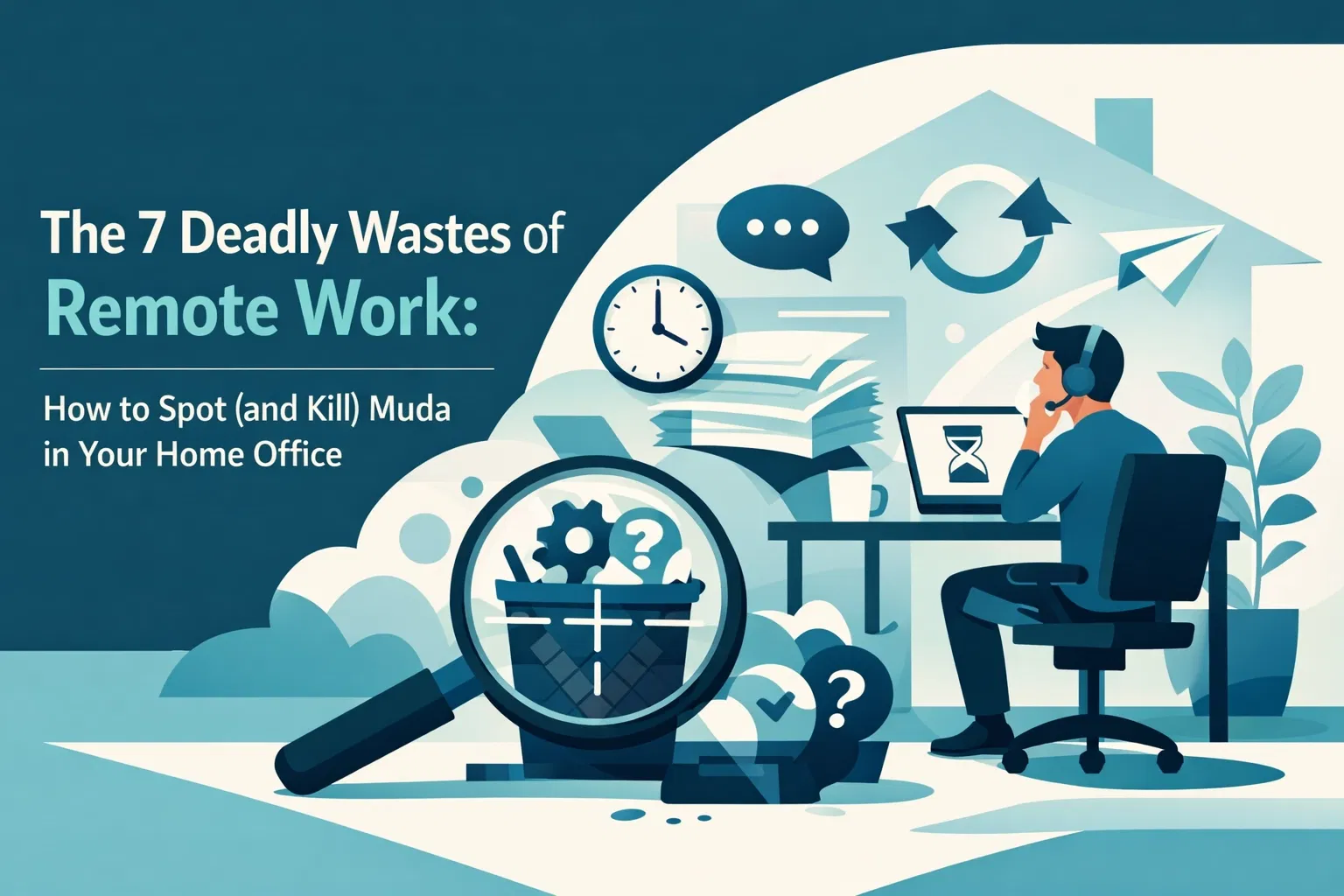
In the "Before Times," process improvement was something we associated with oily machines, assembly lines, and guys in hard hats holding clipboards. If you worked in an office, "waste" was a physical thing, stacks of paper, a long walk to the printer, or a literal pile of defective widgets.
Then 2020 happened. The world went remote, and suddenly, our "assembly line" became a series of Slack notifications, Zoom links, and shared Google Drives. We traded the commute for a ten-foot walk to the kitchen table, and for a minute, we thought we’d peaked in terms of efficiency.
But here’s the cold, hard truth: Waste didn’t disappear; it just went digital.
In Lean Six Sigma, we call waste Muda. It refers to any activity that consumes resources but adds zero value to the end customer. In a remote environment, Muda is a silent productivity killer. It’s the reason you feel exhausted at 5:00 PM despite "only sitting at a desk all day."
To reclaim your time and sanity, you need to apply a Lean lens to your home office. Let’s break down the 7 deadly wastes of remote work, and the "bonus" 8th waste that is likely draining your team's soul.
1. Transportation: The Digital "Hopping" Tax
In a factory, transportation waste is moving parts from one warehouse to another for no reason. In a remote setup, transportation is the unnecessary movement of information.
Think about your last project. Did you have to download a CSV from Salesforce, upload it to a Slack channel, wait for a colleague to save it to SharePoint, and then have someone else move it into a PowerPoint deck? That information just traveled through four different "warehouses."
Every time data moves, there’s a risk of it getting lost, corrupted, or becoming outdated. To kill this waste, remote teams need a "Single Source of Truth." If you’re spending twenty minutes a day just moving files between apps, you are effectively a digital truck driver, except you aren’t getting paid the freight rates.
2. Inventory: The 50-Tab Browser Habit
Inventory waste is "stuff" sitting around waiting to be used. In the home office, this is Digital Overload.
- Open Tabs: Each open tab is a piece of "work in progress" (WIP) that is taxing your brain’s RAM.
- Unread Emails: An inbox with 4,000 messages is a warehouse full of expired goods.
- Unused Software: Paying for five different project management tools when the team only uses one.
Excess inventory hides problems. When your desktop is buried in files named "Draft_v2_FINAL_actually-final.docx," you lose the ability to see what actually needs to be done.

3. Motion: The "Click-and-Search" Fatigue
Motion waste is unnecessary physical movement. In remote work, this manifests as Excessive Clicking.
If you have to click through seven folders to find a basic template, that’s motion waste. If you’re constantly toggling between your email, your calendar, and your task manager because they don’t sync, that’s motion waste.
Lean Six Sigma practitioners use a method called 5S (Sort, Set in order, Shine, Standardize, Sustain) to organize workspaces. Applying 5S to your digital desktop, cleaning up your bookmarks, standardizing file naming conventions, and using keyboard shortcuts, can save you hours of "motion" every week. Before you can improve, you need to establish baseline metrics to see just how much time you're losing to the search.
4. Waiting: The "Slack is Typing…" Anxiety
This is the most visible waste in remote work. You can’t finish the report because you’re waiting for Dave to approve the budget. Dave can’t approve the budget because he’s waiting for the Q3 projections.
Waiting in a remote environment often stems from asynchronous communication gaps. We wait for:
- Slow software/laggy VPNs.
- Approvals stuck in an inbox.
- Feedback on a shared document.
The "fix" here isn't just "working faster." It’s about building better triggers. Instead of waiting for a manual "okay," top-tier teams use automated workflows. If you’re tired of being stuck in the "waiting" phase, pursuing a lean six sigma certification can teach you how to map these value streams and identify exactly where the bottlenecks are hiding.

5. Overproduction: The "Reply All" Monster
Overproduction is making more than is required or making it earlier than needed. This is the "Meeting that could have been an email": or worse, the "Email that should have been a 2-minute Loom video."
We overproduce when we:
- Send CC’d emails to people who don’t need the info.
- Write 20-page reports when the boss only wants the bottom line.
- Build complex spreadsheets with features no one will ever use.
To stop overproducing, you have to understand the Voice of the Customer (VOC). In a remote team, your "customer" is often your manager or your colleague. Ask yourself: "What is the minimum amount of information they need to succeed?" Using a tool like a VOC to CTQ tree helps you translate vague requests into specific, lean outputs.
6. Overprocessing: Death by a Thousand "Syncs"
Overprocessing is doing "extra" work that the customer doesn't care about. This is the king of remote work wastes.
The biggest offender? Too many meetings.
When we spend four hours in "sync meetings" to discuss work we haven't actually had time to do yet, we are overprocessing. We are adding layers of "management" and "alignment" that don't actually improve the quality of the work. Another form of overprocessing is over-formatting internal documents that only your direct team will see. Does that internal memo really need a custom color palette and perfectly aligned icons? Probably not.

7. Defects: The Cost of "What did they mean by that?"
In manufacturing, a defect is a broken part. In remote work, a defect is miscommunication.
A "defect" happens when:
- An instruction is misunderstood, leading to four hours of wasted rework.
- A broken link is sent in a client email.
- The wrong version of a file is uploaded to the production server.
Rework is the most expensive type of waste because you’ve already spent the time and resources to do it once. To kill defects, you need proper process documentation. If everyone knows the standard operating procedure (SOP), the chance of a "defect" dropping into your Slack channel plummets.
The 8th Waste: Unutilized Talent (The Burnout Trigger)
While the original Lean framework focused on 7 wastes, the modern Lean Six Sigma world recognizes an 8th: Non-Utilized Talent.
This is when you hire a brilliant data analyst and then spend 60% of their time having them manually copy-paste data from PDFs into Excel. In a remote setting, this waste leads directly to burnout. When people feel like "cogs in a broken machine," they disengage.
Eliminating the first 7 wastes isn't just about corporate greed or "squeezing more out of the workers." It’s about clearing the administrative "muck" so that talented people can actually do the high-value work they were hired for.
How Lean Six Sigma Training Solves the Remote Mess
You might think, "This sounds great, but I'm just one person. I can't change how my whole company uses Slack."
Actually, you can.
Process improvement is contagious. When one person starts using Lean principles to manage their workload, they become the "Productivity Unicorn" of the team. They get more done, stay less stressed, and their work is higher quality. This is where lean six sigma training comes in. It provides a structured toolkit: DMAIC (Define, Measure, Analyze, Improve, Control): to tackle these invisible wastes systematically.
Whether you start with a foundational White Belt to understand the language of efficiency or go straight for a Green Belt to lead projects, you're learning to see the world differently. You stop seeing "a busy day" and start seeing "a process with excess motion and waiting."

The Muda Audit: Your Home Office Homework
If you’re feeling the remote work slump, try a "Muda Audit" tomorrow. Set a timer for every hour and jot down which of the 7 wastes you encountered.
- Did you wait for a file? (Waiting)
- Did you re-read an email three times because it was confusing? (Defect)
- Did you join a meeting where you didn't say a single word? (Overprocessing)
Once you see the waste, you can't unsee it. And once you can't unsee it, you're halfway to killing it.
Remote work was supposed to give us our lives back. Don't let digital Muda steal it again.
Ready to stop the waste and level up your career? Start your journey toward efficiency and get certified today with our CSSC-accredited Lean Six Sigma training.