In the modern corporate landscape, the ability to make rapid, accurate decisions is often the differentiator between industry leaders and those struggling to maintain market share. However, many organizations still rely on what is colloquially known as "gut feeling" or the "Highest Paid Person’s Opinion" (HIPPO). While experience is valuable, it is frequently biased and statistically unreliable. To achieve operational excellence, professionals must transition from subjective intuition to objective, data-driven certainty.
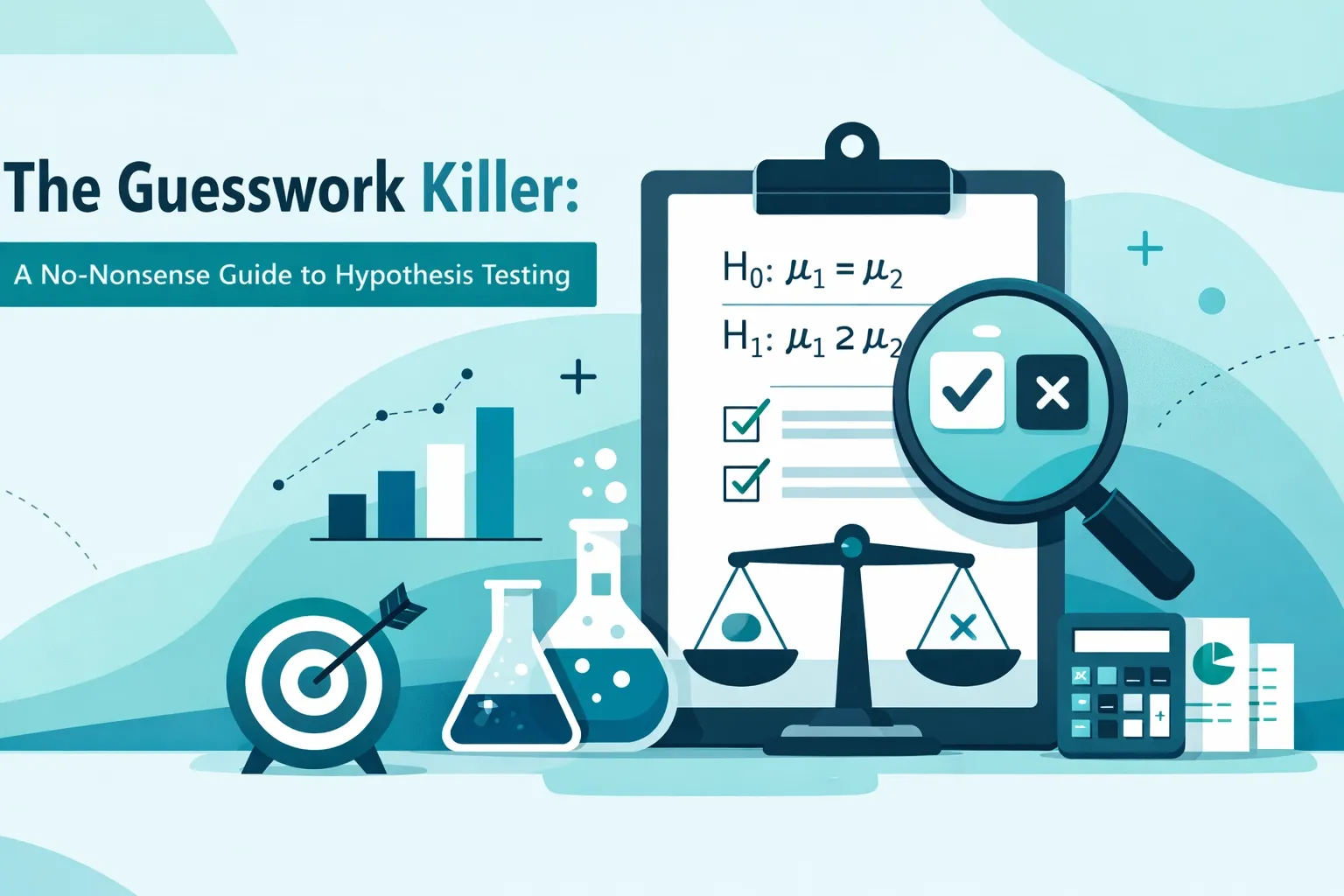
The fundamental purpose of hypothesis testing is to serve as the "guesswork killer." It is a rigorous statistical method used to determine whether a perceived change or difference in a process is real or merely the result of random chance. In the realm of Lean Six Sigma training, mastering this concept is essential for any practitioner looking to validate root causes and implement sustainable improvements.
The High Cost of Guessing
Before delving into the technicalities, one must appreciate the organizational risks associated with intuition-based decision-making. When a manager "guesses" that a specific machine is causing a bottleneck, or "feels" that a new software update will improve productivity, they are gambling with company resources.
If the guess is incorrect:
- Capital is wasted on solutions that do not address the actual problem.
- Morale declines as employees realize management is reacting to symptoms rather than causes.
- Opportunities are lost because the real root cause continues to degrade process performance.
Hypothesis testing eliminates this risk by providing a mathematical "Yes" or "No" to your business questions. It allows you to move past the ambiguity of the Measure Phase and into the definitive clarity of the Analyze Phase.

What Exactly is Hypothesis Testing?
To fully appreciate the impact of this tool, we must break it down into its simplest components. At its core, hypothesis testing is a way to test an assumption regarding a population parameter.
Imagine you are managing a logistics hub and believe that a new routing algorithm has reduced delivery times. You cannot simply look at two or three deliveries and claim victory; you need to prove that the reduction in time is statistically significant and not just a "lucky" day with light traffic.
The Two Competitors: Null vs. Alternative
Every hypothesis test involves two competing statements:
- The Null Hypothesis (H₀): This is the "status quo." It assumes that there is no difference, no change, and no effect. In our logistics example, the Null Hypothesis would be: "The new algorithm has no effect on delivery times."
- The Alternative Hypothesis (H₁): This is what you are trying to prove. It states that there is a significant difference or effect. Here, it would be: "The new algorithm significantly reduces delivery times."
The goal of the test is to see if the data provides enough evidence to "reject" the Null Hypothesis. If the evidence is strong enough, you can confidently state that your improvement was the cause of the change.
Hypothesis Testing Examples in Business
To ground these theoretical concepts in reality, let us examine how different sectors utilize these tests to drive efficiency. Understanding these hypothesis testing examples in business helps bridge the gap between classroom theory and workplace application.
1. Manufacturing: Temperature vs. Yield
A manufacturing plant produces a chemical compound. The floor supervisor believes that increasing the vat temperature by 5 degrees will increase the yield by 10%.
- The Test: A practitioner would run batches at both temperatures and perform a T-test.
- The Result: If the p-value (the probability that the result happened by chance) is less than 0.05, the company can permanently change the temperature settings, knowing the yield increase is guaranteed by data, not luck. This is a critical step in bottleneck identification.
2. Financial Services: Transaction Speed
In the world of payment processing, speed is everything. A bank might test whether a new server configuration reduces the time it takes to authorize a credit card transaction.
- The Test: Comparing the average authorization time of the old server versus the new server using a 2-sample T-test.
- The Outcome: By validating the improvement, the bank justifies the capital expenditure for the hardware upgrade.
3. Healthcare: Patient Wait Times
A hospital implements a new digital check-in kiosk. They need to know if it actually reduces the time patients spend in the waiting room compared to the traditional manual check-in process.
- The Test: Gathering wait time data before and after implementation.
- The Outcome: If the hypothesis test proves a significant reduction, the hospital can roll out the kiosks across all departments, optimizing the hybrid workforce productivity.
The Practitioner's Workflow: How to Test
In the realm of professional process improvement, the protocol for hypothesis testing follows a logical, step-by-step sequence. This ensures that the results are defensible and reproducible.
- State the Practical Question: Start with a business problem. For example, "Does Supplier A provide better quality than Supplier B?"
- Formulate the Statistical Hypotheses: Convert your question into H₀ and H₁.
- Select the Right Tool: Depending on your data type (continuous like time, or discrete like "pass/fail"), you might choose a T-test, ANOVA, or Chi-Square test.
- Collect the Data: Ensure your sample size is large enough to be representative. Inaccurate data collection often leads to skewed results, which is why outlier detection is a vital skill.
- Calculate the P-Value: Use statistical software to find the p-value.
- Make the Decision: If the p-value is low (typically < 0.05), you reject the Null. If it is high, you fail to reject it.
This structured approach is a core component of Analyze Phase success criteria, allowing Belts to validate root causes before investing in the Improve Phase.
Alpha and Beta Risks: The Margin of Error
Even with data, there is always a small margin for error. In Lean Six Sigma training, we teach students to recognize two specific types of risks:
- Type I Error (Alpha Risk): This is a "false positive." You think you found a solution, but you actually didn't. In business, this leads to implementing a change that doesn't work.
- Type II Error (Beta Risk): This is a "false negative." You think your improvement didn't work, but it actually did. In business, this leads to "leaving money on the table" by abandoning a good idea.
By understanding these risks, practitioners can set their confidence levels appropriately, ensuring that the business only moves forward with changes that have a high probability of success.
Moving Beyond Guesswork with Lean 6 Sigma Hub
While the concept of hypothesis testing can be explained simply, the mastery of it requires hands-on application and expert guidance. Identifying the right statistical test and interpreting the results correctly is what separates a beginner from a certified professional.
At Lean 6 Sigma Hub, we help professionals move past the uncertainty of guessing. Our training programs are designed to be practical and immediately applicable to your current role. We focus on the "why" behind the numbers, ensuring you can explain your findings to stakeholders with total confidence.
Whether you are starting with our White Belt to understand the basics or pursuing a Green or Black Belt to lead complex organizational changes, our CSSC-accredited training provides you with the tools to become the "guesswork killer" in your company.
Why Choose Our Training?
- Practical Focus: We don't just teach math; we teach you how to solve real-world problems.
- CSSC Accreditation: Your certification is globally recognized and held to the highest industry standards.
- Flexible Learning: Our courses are 100% online and self-paced, fitting into your busy professional schedule.
- Expert Support: Access to tools and templates that simplify complex statistical analysis.
Conclusion: Lead with Data, Not Opinions
Hypothesis testing is not just a statistical exercise; it is a fundamental shift in leadership philosophy. By adopting a "prove it" mindset, you protect your organization from costly mistakes and ensure that every process improvement project delivers a tangible ROI.
As you progress through the DMAIC stages: from defining stakeholders to training your team to maintain new processes: hypothesis testing remains your most reliable compass.
Stop relying on intuition and start leading with data. The transition from guessing to knowing is the hallmark of a true Six Sigma professional.
Take the first step toward data-driven mastery today. Enrol in a Lean 6 Sigma Hub certification program and transform the way you solve business problems.