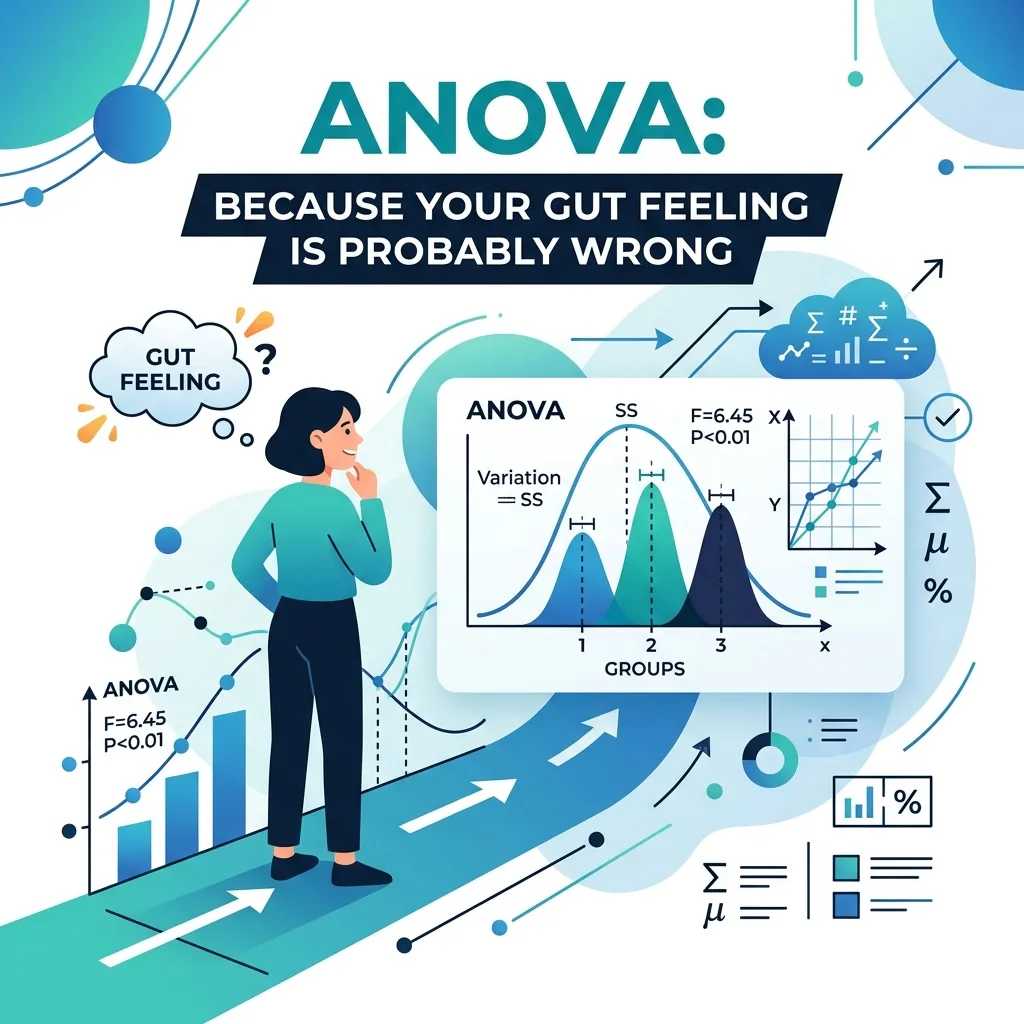
Let’s be brutally honest: your intuition is frequently a liar. In the high-stakes world of process improvement, relying on what you "feel" is happening on the factory floor or in the service center is a one-way ticket to wasted capital and stagnant KPIs. You might think you know why Cycle Time is spiking or why defects are suddenly through the roof, but unless you’ve backed those suspicions up with rigorous data, you’re just a person with an opinion.
In the realm of Lean Six Sigma, we don’t gamble on opinions. We use ANOVA (Analysis of Variance). This statistical powerhouse is the ultimate reality check for any manager or engineer who thinks they’ve "seen it all before." ANOVA is designed to strip away the noise and tell you, with mathematical certainty, whether the differences you see between groups are actually significant or just the result of random chance.
The Myth of the "Expert Gut"
We’ve all met the supervisor who has been with the company for thirty years and claims to "smell" a process deviation before the sensors even pick it up. While experience is valuable, it is also a breeding ground for cognitive bias. Humans are hardwired to find patterns even where none exist. We see a slight dip in productivity on Tuesday and a spike on Wednesday, and our brains immediately invent a narrative to explain it.
The fundamental purpose of ANOVA is to dismantle these narratives. By comparing the means of three or more groups, ANOVA determines if at least one of those groups is performing differently from the others. If you are comparing the output of three different shifts, your gut might tell you that the Night Shift is "obviously" slower. ANOVA will tell you if that difference is statistically significant or if the variation you’re seeing is just noise factors that you need to control.

What Exactly is ANOVA?
To fully appreciate the power of ANOVA, you need to understand what it’s actually doing under the hood. ANOVA stands for Analysis of Variance. It might seem counterintuitive to analyze variance when you’re trying to compare means, but the math is elegant: it compares the variation between groups to the variation within groups.
- Variation Between Groups: How much do the averages of each group differ from the overall average?
- Variation Within Groups: How much do individual data points within a single group differ from that group’s average?
If the variation between the groups is significantly larger than the variation within the groups, the ANOVA test will yield a low p-value. In the language of Lean Six Sigma, a p-value less than 0.05 generally means you can stop guessing and start acting. It means the "effect" you are seeing is real.
Why T-Tests Aren't Enough
A common rookie mistake in process improvement is trying to use multiple t-tests to compare several groups. If you have four different machines and you want to know if they produce the same quality, you might be tempted to compare Machine A to B, B to C, C to D, and so on.
This is a statistical disaster. Every time you run a t-test, there is a 5% chance of a Type I Error (claiming there’s a difference when there isn’t). If you run multiple tests, that error rate compounds faster than high-interest debt. ANOVA solves this by looking at all groups simultaneously, maintaining your alpha level and keeping your conclusions honest.
The Absolute Rules of ANOVA (Ignore These at Your Peril)
You cannot simply dump messy data into a software package and expect ANOVA to save you. Statistics is "garbage in, garbage out." To get results that actually mean something, you must satisfy three core assumptions:
1. Independence
The data points in one group must be independent of the data points in another. If the performance of Machine A somehow influences Machine B (perhaps they share a power source that fluctuates), your ANOVA results are compromised.
2. Normality
Your data must follow a normal distribution (the classic bell curve). Before you even think about running an ANOVA, you need to verify this. We recommend using a formal test like the Shapiro-Wilk test to confirm your data isn't skewed. If your data looks like a mountain range instead of a bell curve, your ANOVA results will be fiction.
3. Homogeneity of Variance
This is a fancy way of saying the "spread" of the data should be roughly the same across all groups. If Machine A has a very tight range of output and Machine B is all over the map, the ANOVA might give you a false reading.

One-Way vs. Two-Way ANOVA: Choosing Your Weapon
In the Improve phase of a DMAIC project, you’ll likely encounter two main types of this tool:
- One-Way ANOVA: You are testing one factor. For example, "Does the type of raw material (Supplier A, B, or C) affect the final strength of the product?"
- Two-Way ANOVA: You are testing two factors simultaneously. For example, "Does the raw material supplier AND the oven temperature affect the product strength?"
Two-way ANOVA is particularly powerful because it can identify interactions. Perhaps Supplier A’s material works great at high temperatures but fails at low temperatures. A one-way ANOVA would miss that nuance. A two-way ANOVA captures it, providing the kind of deep insight that separates a Green Belt from a Master Black Belt.
Case Study: The "Lazy Shift" That Wasn't
Let’s look at a hypothetical (but very common) scenario. A logistics company was seeing a significant delay in package processing times. The Regional Manager was convinced the "Weekend Crew" was lazy and needed more "supervision" (read: micromanagement).
They ran a One-Way ANOVA comparing processing times across three shifts: Day, Night, and Weekend.
- The Gut Feeling: The Weekend Crew is 15% slower. Fire the supervisor.
- The ANOVA Result: The p-value was 0.42.
For those who don't speak math: a p-value of 0.42 means there is a 42% chance the difference was just luck. In the world of Six Sigma, that's a "Fail to Reject the Null Hypothesis." The Weekend Crew wasn't lazy; the variation was simply inherent to the process noise. By using ANOVA, the company saved themselves from a wrongful termination lawsuit and instead focused on the real issue: a faulty conveyor belt that affected everyone.

Stop Guessing, Start Certifying
If you are still making decisions based on "what feels right," you are not practicing Lean Six Sigma; you are practicing wishful thinking. ANOVA is just one tool in a massive arsenal of data-driven methodologies that transform businesses from chaotic to world-class.
At Lean 6 Sigma Hub, we don't just teach you which buttons to click in a spreadsheet. We teach you the high-attitude, brutally honest logic required to lead organizational change. Whether you are looking to master the complexities of variance or lead cross-functional teams through a transformation, our certifications provide the authority you need.
The difference between a manager who "thinks" they know the answer and a Black Belt who proves the answer is often a six-figure salary gap. Don't let your gut feeling hold back your career or your company’s bottom line.