
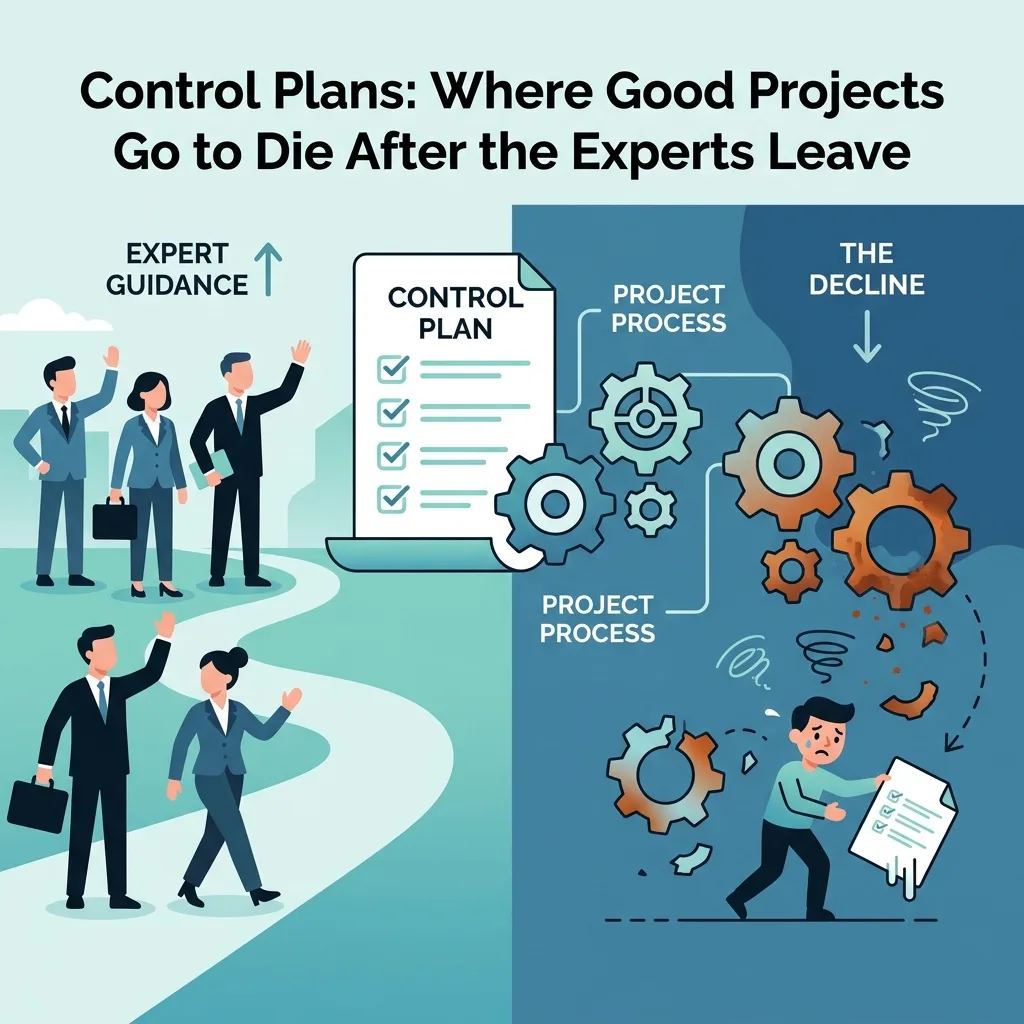
In the realm of Lean Six Sigma, there is a recurring tragedy played out in boardrooms and on factory floors across the globe. A project is launched with fanfare, a dedicated team of "experts" spends months analyzing data, and a pilot program yields spectacular results. The charts are green, the savings are projected in the millions, and the champagne is uncorked. Then, the experts leave.
Six months later, the process has reverted to its chaotic baseline. The savings have evaporated, the team is back to firefighting, and that sophisticated Control Plan, the one that was supposed to "sustain the gains", is sitting in a forgotten folder on a shared drive, unopened since the day the project was formally closed.
The fundamental purpose of the Control Phase in DMAIC (Define, Measure, Analyze, Improve, Control) is to prevent this regression. Yet, most organizations treat the Control Plan as a bureaucratic box-ticking exercise rather than the heartbeat of operational stability. To fully appreciate why projects fail at the finish line, we must confront the brutal truth: a Control Plan that lives outside of daily work is not a plan; it is a tombstone.
The Illusion of Ownership: Why "Everyone" Means "No One"
The most frequent point of failure in any process improvement initiative is the transition of accountability. During the project, the Black Belt or Project Manager is the driving force. They stare at the dashboards, they challenge the deviations, and they push for compliance.
Once the project is handed over, ownership often becomes nominal. On paper, there is a "Process Owner." In reality, that owner is likely a middle manager with three other "top priority" initiatives and zero bandwidth for monitoring a new set of metrics. When ownership is vague or shared across departments, it ceases to exist.
The hard truth is this: Anything owned by everyone is owned by no one.
To avoid the graveyard, accountability must be surgical. A robust Control Plan identifies a single, named individual per critical metric. This person is not just "informed"; they are accountable for the metric staying between predefined upper and lower control limits. If the process drifts, they are the sole individual responsible for triggering the response plan. Without this level of granular accountability, the process is guaranteed to fail.

Metrics Without Teeth: The Failure of Passive Monitoring
In many organizations, Control Plans are built on "vanity metrics", data points that look good in a quarterly report but offer zero insight into the real-time health of the process. Even worse is the "Passive Monitoring Trap," where data is collected, but no one is empowered to act on it.
To sustain a project, metrics must be tied to real-world consequences. If a process falls out of control for two consecutive weeks and nothing happens, no meeting is called, no resource is reallocated, and no one is held responsible, the organization has effectively signaled that the metric does not matter.
Consider the Critical to Quality (CTQ) Tree. If the CTQs defined at the start of the project are not the foundation of the Control Plan at the end, the project was doomed from the Define phase. For a Control Plan to survive the expert handoff, it must integrate these key metrics into the existing business reviews. If the CEO or Operations Director isn't asking about the specific control limits during their weekly huddle, the frontline staff certainly won't care about them.
The Standalone Spreadsheet Trap
If your Control Plan is a separate Excel file that requires manual data entry and a special login, it is already dead. The experts, those who enjoy data and complex spreadsheets, often forget that the people actually running the process have jobs to do.
The fundamental purpose of a control mechanism is to make it harder to do the wrong thing than the right thing. This is where Workplace Organisation (5S) and visual management come into play. A Control Plan should be "baked in" to the daily workflow:
- Automated Alerts: If a metric drifts, the system should flag it automatically.
- Visual Controls: A simple red/green board on the shop floor is worth more than a 20-tab spreadsheet.
- Forced Checks: If the system requires a data input before the next step can be taken, compliance is guaranteed.
When control activities are treated as "extra work," they are the first things dropped when the workload increases. To ensure sustainability, you must minimize manual tracking and leverage the existing infrastructure of the business.

Tribal Knowledge and the Expert Exit
Experts (internal or external) often possess "tacit knowledge", the subtle understanding of why certain decisions were made and how to troubleshoot specific failure modes that don't appear in the manual. When the experts leave, this tribal knowledge usually leaves with them.
The permanent team is often left with a rigid set of procedures but no context. When the environment inevitably changes, a new supplier is onboarded, a machine is serviced, or volume spikes, the team lacks the troubleshooting skills to maintain the process. They begin to "improvise" fixes, unaware that their workarounds are undoing the very improvements the project team spent months implementing.
To combat this, the Control Plan must be more than a list of rules. It must include:
- Response Plans (OCAP): Out-of-Control Action Plans that detail exactly what to do when a specific failure occurs.
- Contextual Documentation: Brief "why" summaries explaining the logic behind specific control limits.
- Shadowing and Handover: The receiving team should lead the process while the experts are still on-site to observe, rather than the experts demonstrating while the team watches.
Resourcing the Landing, Not Just the Launch
Organizations are notoriously bad at budgeting for the "tail" of a project. They will spend $200,000 on a consultant to fix a process but refuse to allocate four hours a week for a supervisor to conduct audits.
Control activities, audits, deep-dive reviews, and refresh training, require resources. If you cannot afford to maintain a control step, you have no business implementing the improvement. A common mistake is assuming that the "new and improved" process will be so efficient it will run itself. This is a fantasy. Every process experiences entropy; without the constant energy of a Control Plan, it will return to a state of disorder.
Before finalizing any project, utilize a Project Closure Checklist to ensure that resources are not just promised, but officially allocated in the department's budget and schedule.

Designing Control Plans That Survive the Real World
To build a Control Plan that actually works once the "smartest people in the room" have departed, you must follow these technical protocols:
1. Co-Creation with the Front Line
Do not design a Control Plan in a vacuum. The people who will live with the process every day must be the ones to help design the controls. If they tell you a specific check is impossible or creates a bottleneck, listen to them. If the people doing the work help build the plan, they are far more likely to defend it when things get difficult.
2. Statistical Process Control (SPC) Integration
A process that is "stable" is not necessarily "capable." Understanding the Normal Distribution of data is essential for setting realistic control limits. If your limits are too tight, the team will suffer from "alarm fatigue" and eventually ignore the signals. If they are too loose, the process will fall apart before you even notice.
3. The Three-Tier Response Strategy
Every deviation in the Control Plan should trigger a tiered response:
- Tier 1 (Immediate): The operator corrects the immediate issue (e.g., resets a machine).
- Tier 2 (Supervisory): If the issue persists, the supervisor investigates the root cause within 24 hours.
- Tier 3 (Managerial/Expert): If the process remains out of control for a set period, a formal mini-DMAIC or Kaizen event is triggered to re-examine the process design.
Inheriting a Dead Control Plan: The Path to Revival
If you have stepped into a role where you are surrounded by the "ghosts" of past projects, defunct dashboards and ignored SOPs, you have two choices: continue the charade or perform a radical audit.
First, determine if the process still adds value. If it does, strip the Control Plan down to its absolute essentials. Identify the 1–3 metrics that truly drive the business outcome and kill everything else. It is better to have one metric that is religiously monitored than ten that are ignored. Re-anchor these metrics in the daily huddles and assign clear, undeniable ownership.
Sustainability is the only true measure of a Lean Six Sigma project's success. If the results don't last, the project was a failure, regardless of how good the final presentation looked. Don't let your hard work end up in the graveyard. Build a Control Plan that lives, breathes, and survives the departure of the experts.
To master the art of sustainable process improvement and lead your organization to long-term success, you must possess the technical skills to build robust control systems. Take the first step toward becoming a leader in operational excellence by enrolling in our professional certification programs today.
Enrol in the Lean Six Sigma Green Belt Certification
Enrol in the Lean Six Sigma Black Belt Certification