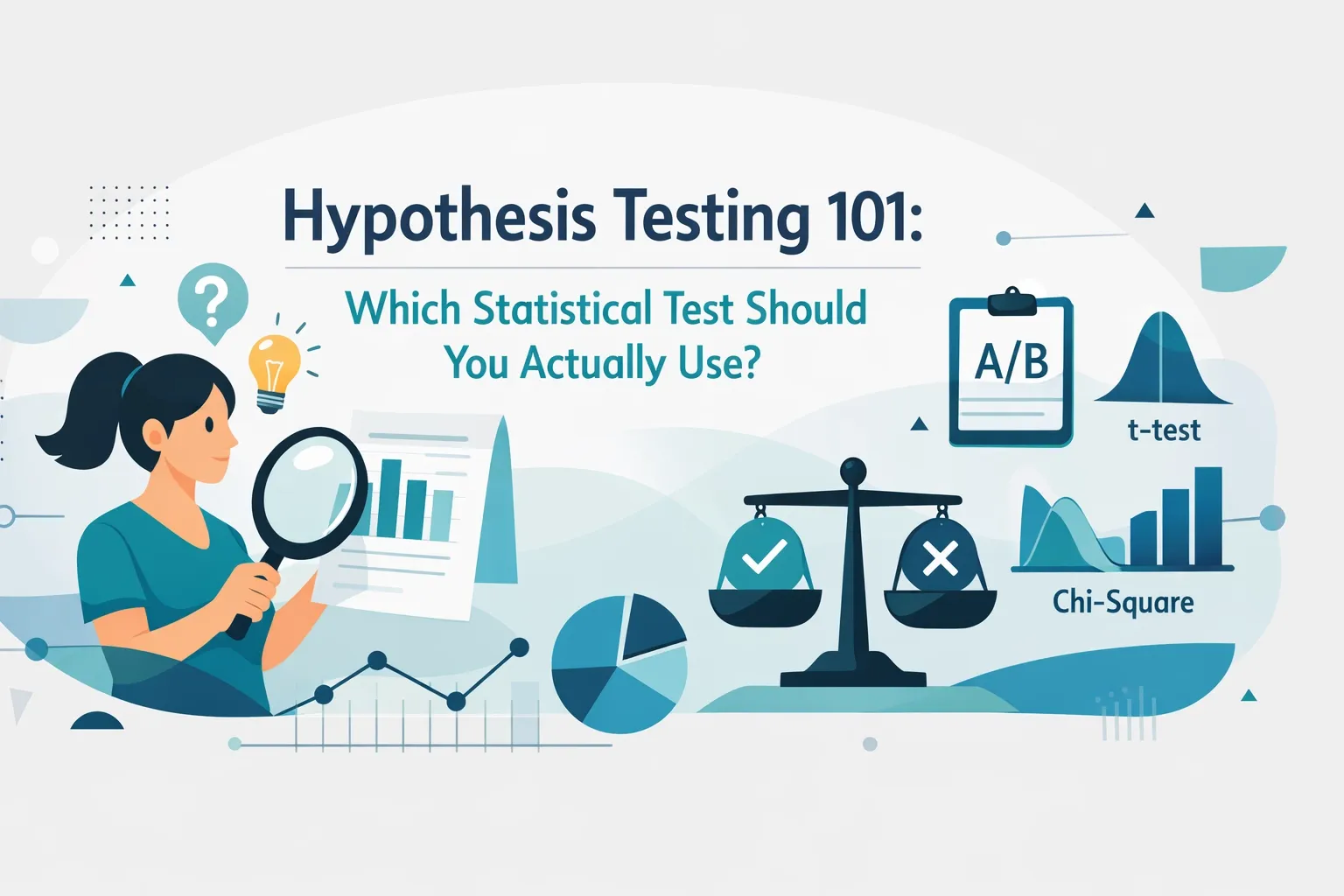
In the realm of process improvement, the Analyse phase of the DMAIC (Define, Measure, Analyse, Improve, Control) methodology serves as the bridge between identifying a problem and implementing a solution. While the Measure phase provides us with the data, the Analyse phase provides us with the truth. The fundamental purpose of this phase is to identify, isolate, and verify the root causes of process waste and variation.
To transition from "gut feel" decision-making to data-driven excellence, Lean Six Sigma practitioners rely on hypothesis testing. This statistical rigor ensures that the improvements we propose are based on substantiated evidence rather than mere coincidence. For those pursuing lean six sigma training, mastering these tests is a non-negotiable step toward becoming a proficient problem solver.
The Foundations of Hypothesis Testing
Before selecting a specific test, a practitioner must understand the underlying logic of inferential statistics. Hypothesis testing is a formal procedure for investigating our ideas about the world using statistics. It is most often used by scientists to test specific predictions, called hypotheses, that arise from theories.
In a lean six sigma hypothetical project, we generally work with two types of hypotheses:
- The Null Hypothesis ($H_0$): This assumes that there is no significant difference or relationship between variables. It represents the status quo.
- The Alternative Hypothesis ($H_a$): This represents the claim that there is a significant effect, difference, or relationship.
The ultimate goal of our statistical analysis is to determine whether we have enough evidence to "reject" the null hypothesis. We make this decision based on the P-value. If the P-value is less than our significance level (typically $\alpha = 0.05$), we conclude that the observed result is statistically significant and not likely due to random chance.

Step 1: Identify Your Data Type
The first hurdle in choosing the right statistical test is identifying the type of data you have collected. In Lean Six Sigma, data is generally classified into two categories:
- Continuous Data: This is data that can be measured on a scale and can infinitely be divided (e.g., time, temperature, weight, or distance).
- Discrete (Attribute) Data: This is categorical or count-based data (e.g., pass/fail, types of defects, or the number of customer complaints).
The selection of your statistical test is almost entirely dependent on whether your input ($X$) and your output ($Y$) are continuous or discrete. This distinction is a core component of lean six sigma black belt online training, as Black Belts are often tasked with analyzing complex interactions between various data types.
Step 2: Comparing Means with T-Tests
When your $Y$ is continuous and your $X$ is discrete (with only two groups), the T-Test is your primary tool. T-tests allow us to compare the means of groups to see if they are statistically different from one another.
1-Sample T-Test
Used when you want to compare the mean of a single group against a known standard or target value. For example, if your process target is a 10-minute cycle time, a 1-sample T-test will tell you if your current sample mean significantly deviates from that 10-minute goal.
2-Sample T-Test (Independent)
Used when you are comparing the means of two independent groups. A common scenario in a Lean Six Sigma project is comparing the performance of "Shift A" versus "Shift B." If the P-value is low, you have proven that one shift performs differently than the other, identifying a potential root cause in labor variation.
Paired T-Test
This is used for "before and after" scenarios. If you measure the same group of items before a process change and again after the change, the paired T-test accounts for the fact that the samples are related. This is highly effective in the Improve phase to validate that a specific intervention actually moved the needle.
Step 3: Comparing Multiple Groups with ANOVA
As projects grow in complexity, you may find yourself needing to compare more than two groups. If you attempt to run multiple 2-sample T-tests, you increase the risk of a Type I error (finding a difference where none exists). To avoid this, we use ANOVA (Analysis of Variance).
The fundamental purpose of ANOVA is to determine if at least one group mean is different from the others when you have three or more discrete groups (e.g., comparing the mean output of four different machines). If the ANOVA test returns a significant P-value, you then use "post-hoc" tests to identify exactly which group is the outlier.

Step 4: Testing Relationships with Chi-Square
What happens if both your $X$ and your $Y$ are discrete? For instance, if you want to know if the type of defect (Scratches vs. Dents) is related to the production line (Line 1 vs. Line 2). In this case, you cannot calculate a mean, so T-tests and ANOVA are not applicable.
Instead, you use the Chi-Square Test of Independence. This test compares the observed frequencies in your data to the frequencies you would expect to see if there were no relationship between the variables. It is an essential tool for identifying patterns in categorical data, which is frequently encountered in service-industry Lean Six Sigma projects.
The Lean 6 Sigma Hub Approach: Sigma Magic
While the mathematics behind these tests can be daunting, modern Lean Six Sigma practitioners do not perform these calculations by hand. At Lean 6 Sigma Hub, we advocate for the use of Sigma Magic.
Sigma Magic is a powerful, user-friendly add-in for Excel that automates the hypothesis testing process. Instead of struggling with complex formulas or expensive, high-end statistical software, Sigma Magic guides you through the selection process. You simply input your data, select your confidence level, and the software provides a clear "Reject" or "Fail to Reject" conclusion along with the necessary charts.
Using professional tools allows Green and Black Belts to focus on what matters most: interpreting the results and making business decisions, rather than getting lost in the arithmetic. For those currently working on a LSS Black Belt sample project, leveraging Sigma Magic can significantly reduce the time spent in the Analyse phase.
Common Pitfalls in the Analyse Phase
To fully appreciate the power of hypothesis testing, one must also be aware of common mistakes that can invalidate your results:
- Ignoring Normality: Most parametric tests (T-tests, ANOVA) assume that your data follows a normal distribution (the bell curve). If your data is heavily skewed, your results may be misleading. In these cases, you must use non-parametric alternatives like the Mann-Whitney test.
- Sample Size Issues: A sample size that is too small may not have enough "statistical power" to detect a real difference, leading to a Type II error. Conversely, an extremely large sample might show statistical significance for a difference so small it has no real-world business value.
- Confusing Correlation with Causation: Just because two variables are statistically related does not mean one causes the other. Always validate your statistical findings with "Genba" (going to the actual place of work) to ensure the logic holds up.

Summary Table: Which Test Should You Use?
To simplify your decision-making process during your next project, refer to this quick-reference guide:
| If your Y (Output) is… | And your X (Input) is… | Use this Statistical Test |
|---|---|---|
| Continuous | Discrete (1 Group vs. Target) | 1-Sample T-Test |
| Continuous | Discrete (2 Independent Groups) | 2-Sample T-Test |
| Continuous | Discrete (2 Related Groups) | Paired T-Test |
| Continuous | Discrete (3+ Groups) | ANOVA |
| Discrete | Discrete | Chi-Square Test |
| Continuous | Continuous | Regression / Correlation |
Conclusion: Proving Your Way to Success
Mastering the Analyse phase is what separates a "problem solver" from a "Six Sigma Professional." By applying the correct statistical tests, you move beyond opinions and provide your organization with the certainty required to invest in process changes. Whether you are conducting a simple 2-sample T-test to compare two machines or a complex ANOVA to evaluate multiple production sites, the goal remains the same: finding the root cause.
If you are ready to elevate your career and gain the skills necessary to lead high-impact organizational transformations, now is the time to formalize your expertise. Our free six sigma calculator and comprehensive training modules are designed to help you navigate these technical challenges with ease.
Enrol in our CSSC-accredited Lean Six Sigma Black Belt online training today to master advanced statistical analysis and start delivering measurable financial results for your organization.