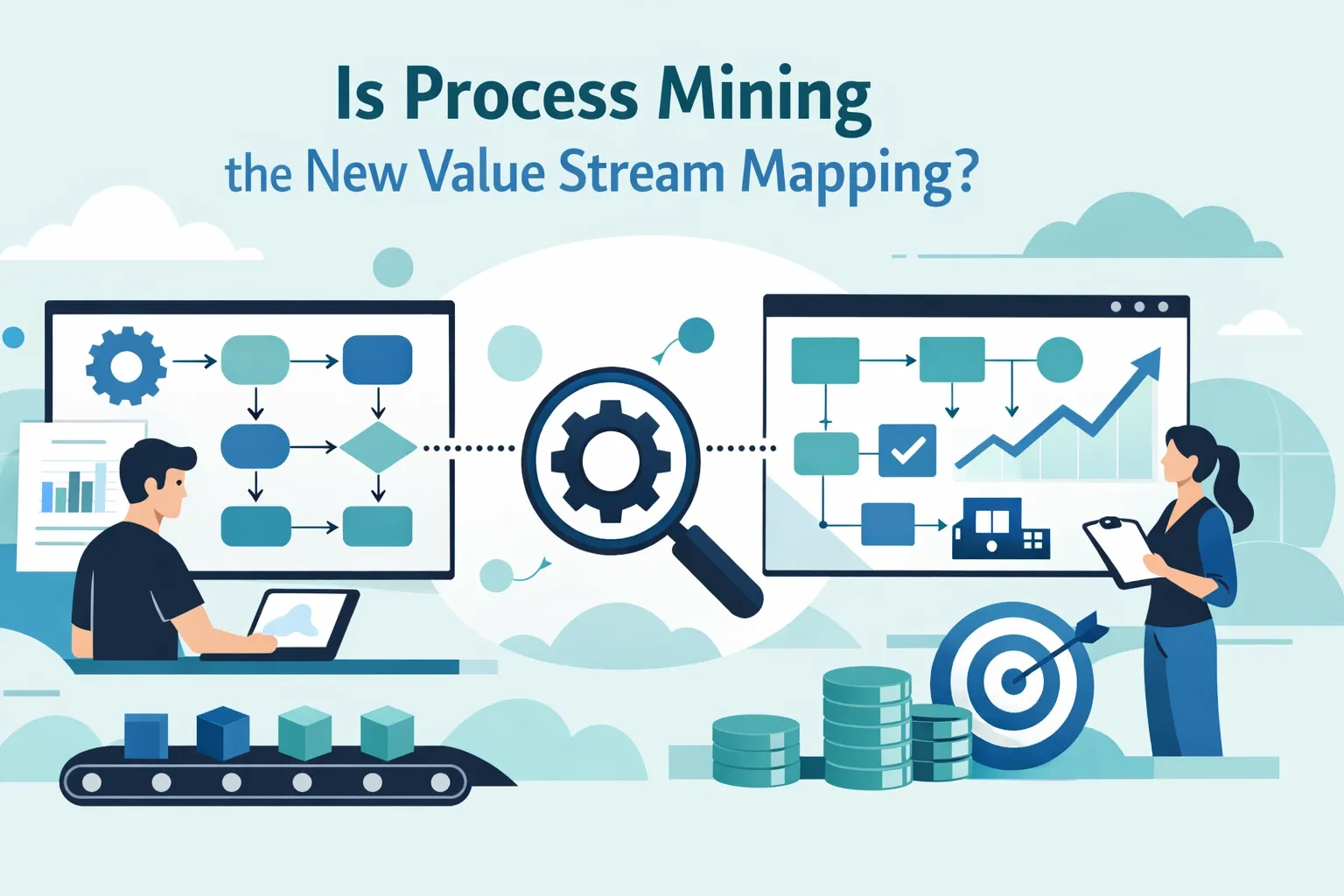
In the realm of continuous improvement, the methodologies we employ to visualize and optimize workflows are undergoing a seismic shift. For decades, the Value Stream Map (VSM) has been the undisputed champion of the Lean Six Sigma toolkit. It is the fundamental blueprint used to identify waste, reduce lead times, and align cross-functional teams toward a common "Future State."
However, a new contender has emerged from the digital landscape: Process Mining. Leveraging the power of big data and algorithmic discovery, process mining promises a level of precision and speed that traditional manual mapping struggles to match. This has led to a burgeoning debate among practitioners: Is process mining the inevitable successor to Value Stream Mapping, or are we comparing two fundamentally different instruments?
To fully appreciate this tension, one must understand that the choice between these tools is not merely technical: it is philosophical. While VSM relies on human observation and consensus, process mining relies on the "digital footprints" left behind in enterprise systems.
The Traditional Power of Value Stream Mapping
Value Stream Mapping is more than a diagram; it is a collaborative exercise in Gemba: the practice of going to the actual place where work happens. The primary strength of a VSM lies in its ability to capture the "human element" of a process. It documents not just what the system says is happening, but what the operators, managers, and customers actually experience.
In a traditional lean six sigma training environment, students are taught that VSM is essential for:
- Capturing Non-Digital Steps: In manufacturing or manual service environments, many critical actions: such as moving a pallet, a verbal handover, or a physical inspection: never touch an IT system.
- Building Consensus: The act of drawing a map on a whiteboard with a cross-functional team forces stakeholders to agree on a single version of reality.
- Strategic Alignment: VSM provides a high-level, end-to-end view of value delivery that helps leaders see the "big picture" rather than getting lost in the weeds of individual transactions.
To facilitate this, tools like the SIPOC complexity score calculator are often used in conjunction with mapping to define the boundaries and complexity of the process before the deep dive begins.

The Rise of Process Mining: The Digital X-Ray
While VSM is built on observation, Process Mining is built on evidence. By extracting event logs from systems like SAP, Oracle, or Salesforce, process mining software can reconstruct a "Digital Twin" of how a process actually functions.
The fundamental purpose of process mining is to eliminate the subjectivity inherent in human reporting. Research indicates that when employees describe their processes, they often describe the "Happy Path": the way things should go. Process mining reveals the "Shadow Process": the thousands of deviations, rework loops, and bottlenecks that occur in reality but are rarely captured in a manual map.
Key advantages of Process Mining include:
- Speed and Scale: Analyzing millions of transactions across a global enterprise can be done in minutes, whereas a manual VSM for the same scope could take weeks of workshops.
- Total Transparency: It identifies every single "variant" of a process. While a VSM might show one or two ways a process flows, process mining might reveal 500 different paths for a single invoice.
- Real-Time Monitoring: Unlike a static VSM, which becomes obsolete the moment it is printed, process mining can provide a live dashboard of process health, aligning perfectly with the Control Phase of DMAIC.
The Controversy: Speed vs. Depth
The debate heats up when we consider the accuracy of data. Critics of VSM argue that manual maps are often "hallucinations" based on the loudest voice in the room or outdated SOPs. Conversely, critics of process mining argue that data alone lacks context. A data log might show a three-day delay between two steps, but it won't tell you that the delay was caused by a broken machine or a staff meeting.
The fundamental limitation of process mining is that it is "blind" to anything that does not generate a digital timestamp. In a heavy manufacturing environment where physical movement and manual assembly are the primary value-drivers, process mining may only capture 20% of the actual value stream.

A Comparative Framework: VSM vs. Process Mining
To help organizations decide which path to take, consider the following technical comparison:
| Feature | Value Stream Mapping (VSM) | Process Mining |
|---|---|---|
| Data Source | Direct observation, interviews, and "Gemba walks." | Event logs from ERP, CRM, and legacy systems. |
| Perspective | Holistic, end-to-end, and strategic. | Granular, transactional, and execution-focused. |
| Strengths | Identifies cultural issues and manual waste. | Identifies digital bottlenecks and process deviations. |
| Weaknesses | Subjective, time-consuming, and static. | Limited to digital activities; lacks "the why." |
| Ideal Use Case | Manufacturing, physical logistics, and new process design. | Finance, IT Service Management, and digital customer journeys. |
When performing a gap analysis in Six Sigma, practitioners must determine if their "Current State" is best understood through human narrative or digital evidence.
The Hybrid Approach: The Future of Lean Six Sigma
The most sophisticated organizations have realized that this is not an "either-or" proposition. Instead, they are adopting a hybrid approach that utilizes both methodologies to create a comprehensive view of operational health.
In a hybrid model, process mining is used to perform the initial "discovery" phase. It provides the data-heavy backbone that identifies where the most significant delays are occurring. Once the "hot spots" are identified, the team conducts a targeted VSM and Gemba walk to investigate the root causes that the data cannot explain.
For instance, in a Six Sigma hypothetical project involving a global supply chain, process mining might reveal that shipping documents are frequently delayed in the "Approval" stage. A subsequent VSM exercise might reveal that the delay is due to a specific office layout that prevents the physical handover of documents between departments: a detail no event log could ever capture.

Integrating Process Mining into the DMAIC Cycle
To truly master the integration of these tools, one must view them through the lens of the DMAIC (Define, Measure, Analyze, Improve, Control) framework.
- Define: Use process mining to validate the scope of the project and ensure the Project Charter ROI is based on actual transaction volumes rather than estimates.
- Measure: Automate the collection of Cycle Time and Lead Time data, providing a more accurate baseline than manual sampling.
- Analyze: Use the "conformance checking" features of process mining to see where reality deviates from the standard operating procedure (SOP).
- Improve: Simulate "Future State" scenarios using digital twins before implementing physical changes.
- Control: Implement automated alerts when process variances exceed established thresholds, ensuring long-term sustainability.
For those pursuing lean six sigma training, understanding this synergy is becoming a critical competency. As businesses become more digitized, the ability to interpret event logs is becoming just as important as the ability to facilitate a brainstorming session.
Conclusion: Evolution, Not Replacement
Is process mining the new Value Stream Mapping? The answer is no: but it is its most powerful evolution. Process mining provides the "what," "where," and "when," while Value Stream Mapping provides the "who" and the "why."
Organizations that cling solely to traditional VSM risk being too slow and subjective in an increasingly digital world. Conversely, those who rely solely on process mining risk missing the human nuances that drive cultural change and sustainable improvement.
For professionals looking to stay ahead of this curve, advanced certification is the most effective pathway. Mastering both the qualitative art of Lean and the quantitative science of Process Mining requires a deep dive into the most rigorous methodologies.
If you are ready to elevate your career and lead high-impact transformations in the digital age, we invite you to explore our Lean Six Sigma Black Belt Certification. Gain the advanced statistical and strategic skills necessary to navigate the complexities of modern process improvement.
Take the first step toward becoming an industry-leading expert by taking our Free Lean Six Sigma Black Belt Practice Exam today.