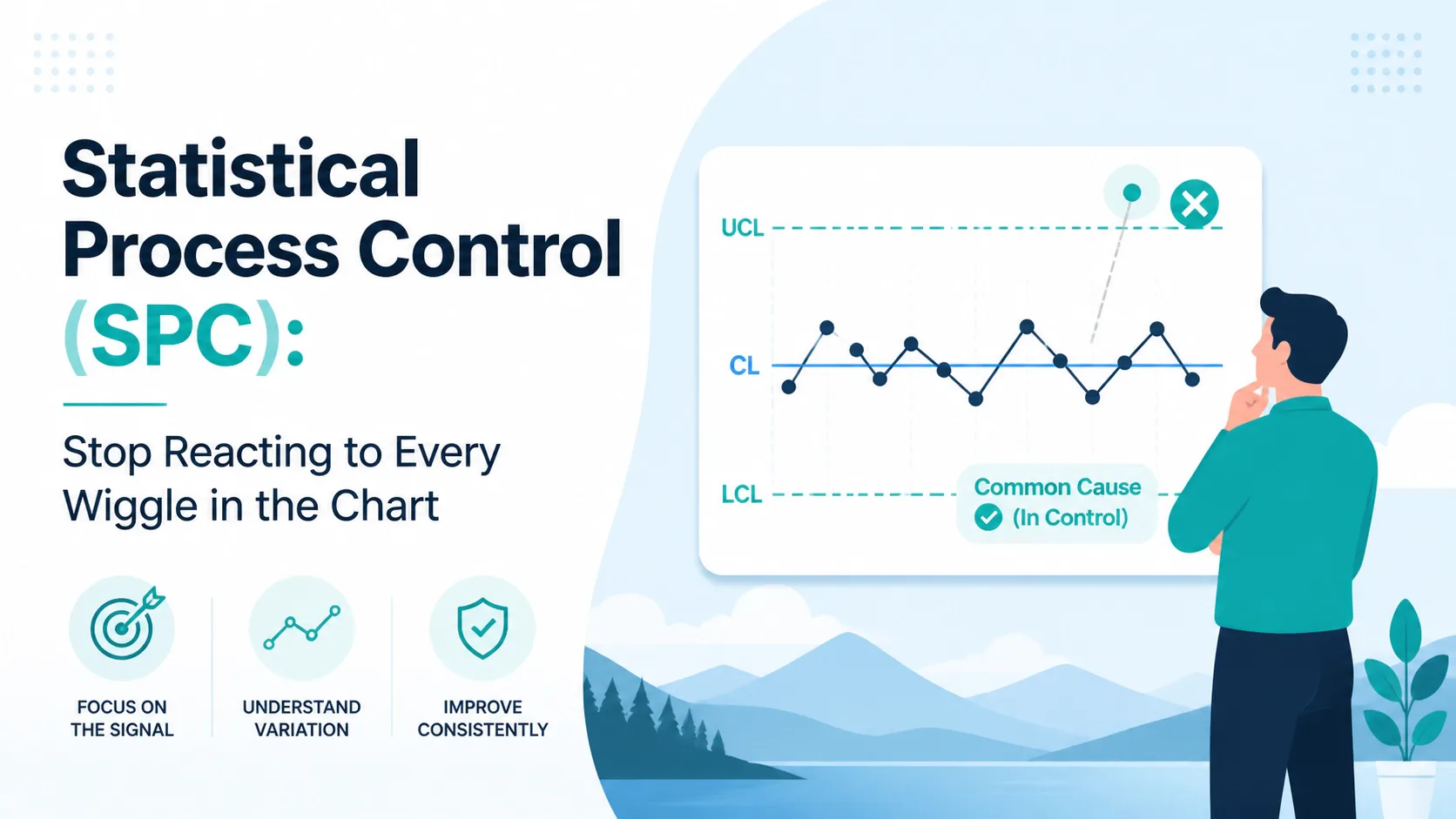
In the realm of process improvement, there is a pervasive and expensive delusion: the belief that every data point represents a call to action.
Every morning, in boardrooms and production floors globally, managers stare at a chart, see a slight dip or a minor spike, and immediately demand an explanation. They call for a "root cause analysis," they assign "corrective actions," and they tinker with machine settings. They believe they are demonstrating proactive leadership. In reality, they are committing one of the most destructive acts in operational management: tampering.
Statistical Process Control (SPC) was not designed to give you an excuse to micromanage your process. It was designed to tell you when to sit on your hands and do absolutely nothing. If you are reacting to every "wiggle" in your chart, you aren’t practicing Six Sigma; you are practicing "Management by Chaos."
The Fundamental Purpose of SPC: Separating Signal from Noise
To fully appreciate the power of SPC, one must first accept a hard truth: all processes vary. There is no such thing as a perfectly stable line in the real world. Whether you are measuring the diameter of a piston, the processing time of an insurance claim, or the pH level of a chemical batch, the output will fluctuate.
The fundamental purpose of an SPC chart is to distinguish between two types of variation:
- Common Cause Variation (Noise): This is the inherent, natural fluctuation of the system. It is caused by the hundreds of small, overlapping variables that are baked into the process: ambient temperature, slight variations in raw materials, or the standard human error margin. If your process only exhibits common cause variation, it is considered statistically stable.
- Special Cause Variation (Signal): This is variation that is not part of the system’s design. It is caused by a specific, assignable event: a tool broke, a new operator wasn't trained, or a batch of material was contaminated.
The crime of modern management is treating common cause variation as if it were a special cause. When you react to a "wiggle" that is merely noise, you are not fixing the process; you are adding more variation to it.

The High Cost of Tampering: Why Your "Fixes" are Making Things Worse
In Lean Six Sigma circles, we refer to the act of adjusting a stable process in response to common cause variation as tampering. To understand why this is catastrophic, one must look at the work of W. Edwards Deming and his famous "Funnel Experiment."
Imagine a funnel suspended over a target on the floor. You drop a marble through the funnel, and it lands near the target. If you move the funnel to compensate for where the last marble landed, you will eventually find that the marbles are scattered in a wide, erratic pattern, far further from the target than if you had simply left the funnel in its original position.
By "correcting" for a random fluctuation, you introduce a new variable into the system. This creates a feedback loop of instability. In a professional setting, this looks like:
- Increasing the frequency of quality checks because of one slightly lower-than-average result, which then slows down the entire line.
- Changing a supplier because of one late delivery that was actually caused by a freak weather event.
- Reprimanding an employee whose performance dipped slightly within the normal distribution of their usual capability.
The hard truth: If the process is stable, you cannot "fix" it by reacting to individual points. To reduce common cause variation, you must change the system itself. This requires a fundamental redesign of the process, not a knee-jerk adjustment to a single data point.
Control Limits vs. Specification Limits: A Critical Distinction
A common mistake made by Green Belts and even some seasoned Black Belts is the confusion between Control Limits (UCL/LCL) and Specification Limits (USL/LSL).
- Specification Limits are the "Voice of the Customer." They represent what the customer will accept. If a part is outside these limits, it is defective.
- Control Limits are the "Voice of the Process." They are calculated statistically (usually at ±3 standard deviations from the mean) and represent what the process is actually capable of doing.
If your process is stable but its control limits are wider than your specification limits, your process is "in control" but not capable. Reacting to a point that is inside the control limits but near a specification limit is still tampering. You don’t need a "corrective action" for that point; you need a Six Sigma project to shift the mean or reduce the overall spread of the process.
https://cdn.marblism.com/Fk3EaaKO8q0.webp
The Rules of Engagement: When Should You Actually React?
So, if you shouldn't react to every wiggle, when should you act? SPC provides us with a set of objective, statistical rules to identify a "signal" (special cause variation). At Lean 6 Sigma Hub, we teach our students to follow the Western Electric or Nelson Rules. If you don't see one of these triggers, keep your hands off the process.
- The "Outlier" (Rule 1): A single point falls outside the Upper or Lower Control Limits (±3 Sigma). This is a 99.73% certainty that something unusual has happened. Investigate immediately.
- The "Shift" (Rule 2): Nine or more consecutive points fall on the same side of the center line. This indicates that the process mean has shifted. Something in the system has fundamentally changed.
- The "Trend" (Rule 3): Six or more consecutive points are steadily increasing or decreasing. This often signals tool wear, fatigue, or a gradual drift in settings.
- The "Oscillation": Fourteen or more points in a row alternating up and down. This often indicates "over-control" or tampering where two different operators or machines are working to different standards.
If none of these rules are violated, the wiggles you see are just the process "breathing." They are expected. They are normal. They are not your problem today.
Stop the "Firefighting" Culture
Implementing SPC correctly requires more than just software that draws charts; it requires a cultural shift from firefighting to systemic thinking.
When a manager asks, "Why was our yield 2% lower yesterday than the day before?" the correct, authoritative answer should be: "Because the process is stable and that variation is within our calculated control limits. Investigating it would be a waste of resources."
This level of confidence only comes from having a deep, data-driven understanding of your process capability. If you are tired of chasing ghosts and want to actually lead transformations that matter, you need to master the advanced statistical tools that separate the amateurs from the experts. You can start by testing your current knowledge with a free Lean Six Sigma Black Belt practice exam.
https://cdn.marblism.com/v_Ja_FqQFRB.png
Moving Beyond the Chart
SPC is not a passive activity. It is a diagnostic tool. Once you have used SPC to achieve a stable process, your next task is to use the DMAIC methodology to shrink those control limits.
Reducing variation is the heart of Six Sigma. But you cannot reduce variation if you don't understand where it comes from. If you are constantly reacting to noise, you will never have the clarity to see the system-level flaws that are actually costing your company money.
Stop treating your charts like a daily drama and start treating them like a scientific instrument. The "wiggles" aren't your enemy: your reaction to them is.
If you are ready to stop guessing and start leading with statistical authority, it is time to formalize your expertise. Pursue your professional certification with Lean 6 Sigma Hub today and learn how to drive real, sustained organizational change.