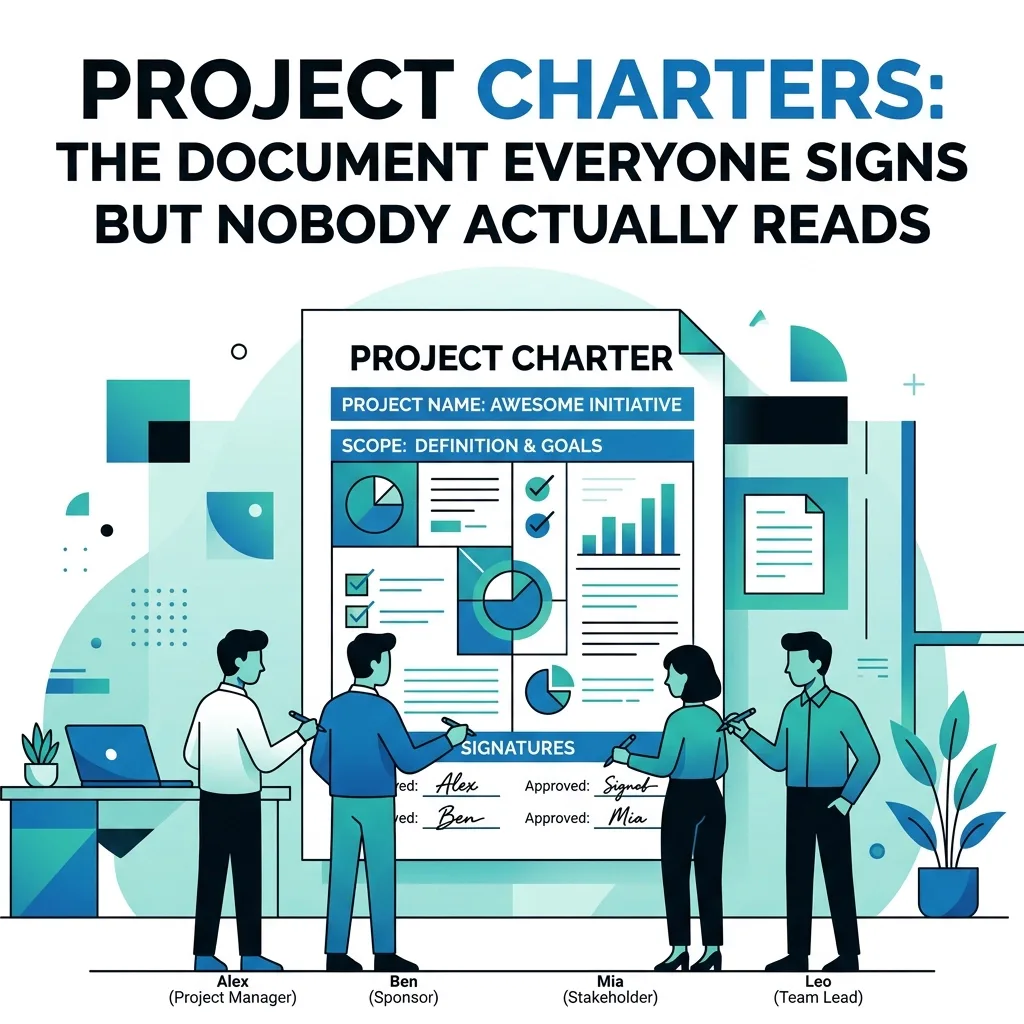
In the realm of process improvement, there is a document that sits in almost every project folder, gathering digital dust. It’s called the Project Charter. If you are a Green Belt or a Black Belt, you know exactly what I’m talking about. It’s that bureaucratic hurdle you jumped over at the beginning of the Define phase just so you could get permission to start the "real work."
But let’s be brutally honest: most project charters are garbage.
They are treated as permission slips: meaningless administrative requirements signed by a sponsor who didn't read it, drafted by a project lead who doesn't understand it, and ignored by a team that thinks it’s just another piece of corporate fluff. If your charter is just a box-ticking exercise, your project is likely already failing; you just haven’t noticed the crash yet.
The Illusion of Alignment
The fundamental purpose of a Project Charter is to serve as a contract between the project team and the organization. It is the project’s "Constitution." Yet, in practice, it’s often closer to a wish list.
When a project is initiated, everyone has a different idea of what "success" looks like. The Sponsor thinks the project will save $2 million by Christmas. The Process Owner thinks you’re just there to fix their broken printer. The Project Lead thinks they are finally going to implement that expensive software they saw at a conference.
Without a rigorous charter, these conflicting expectations are never reconciled. You end up with "scope creep" on steroids. You start with a simple goal: like reducing defects in a manufacturing line: and three months later, you’re trying to redesign the entire supply chain. This is why projects stall. This is why budgets vanish. This is why people get frustrated and quit.
To fully appreciate the gravity of this document, you must realize that a project without a charter is a ship without a rudder. You’re moving, sure, but you have no idea where you’re going or who is actually in charge.
Why Most Charters Are Worthless Before the Ink Dries
If we look at the typical Lean Six Sigma project, the failure points of a charter are predictable and entirely avoidable.
- Written in a Vacuum: One person (usually the Project Lead) sits in a cubicle and drafts the charter alone. They then email it around for "electronic signatures." No conversation happens. No debate occurs. No one challenges the assumptions. A charter written in isolation is not a commitment; it’s an opinion.
- The "Hand-Wavy" Problem Statement: "Our process is slow and customers are unhappy." That isn't a problem statement; it’s a complaint. A real problem statement requires data, impact, and a clear "so what?" If you can't define the gap between the current state and the desired state in measurable terms, you shouldn't be allowed to spend a single dollar of company money.
- Ambiguous Scope: If your scope doesn't explicitly state what is out of scope, you’ve failed. Defining boundaries is more important than defining the playground. Without "out of scope" definitions, your project will bloat until it dies under its own weight.
- No Direct Link to Strategy: If your project doesn't move the needle on a Key Performance Indicator (KPI) that the CEO cares about, it’s a hobby, not a project.

The Anatomy of a Real Project Charter (Not Your PMO’s Fluff)
To be effective, a charter must be grounded in reality and backed by data. It must be concise: usually between one and five pages. If it’s 50 pages long, no one will read it. If it’s one paragraph, it’s not a charter.
In any Lean Six Sigma environment, whether you are following the Lean Six Sigma hypothetical project structure or a real-world transformation, your charter must contain these core elements:
1. The Problem Statement and Business Case
You need to answer the question: "Why do we care?" This is where you ground the project in financial reality. If you are struggling to quantify the impact, use a Project Charter ROI Calculator to get real numbers. "Saving time" isn't enough. You need to know exactly how much that time is worth to the bottom line.
2. Goals and Success Metrics
Stop using words like "improve," "optimize," or "streamline." Use numbers. "Reduce Cycle Time from 14 days to 4 days by Q3 2026." This is a goal. It’s measurable, time-bound, and leaves no room for "interpretation" when the project ends. You can't hide from a number.
3. Voice of the Customer (VOC) and Critical to Quality (CTQ)
Who are you doing this for? If you haven't identified the Critical to Quality (CTQ) requirements, you are just guessing what the customer wants. The charter should be the anchor for these requirements, ensuring the project doesn't drift into building features or processes that the customer never asked for and won't pay for.
4. SIPOC and High-Level Process Map
Before you dive into the weeds, you need the 30,000-foot view. A SIPOC (Suppliers, Inputs, Process, Outputs, Customers) ensures everyone agrees on where the process starts and where it ends. If you skip this, you’ll find out mid-way through the "Analyze" phase that half your team thinks the process starts at "Order Received" and the other half thinks it starts at "Lead Generated." Use a SIPOC complexity score calculator to see if you're taking on more than you can handle.
The "Business Case" Trap: If You Can’t Prove ROI, Stop Working
One of the most frequent mistakes made by Green Belts is selecting projects based on "gut feeling" or because a manager is screaming the loudest. This is a recipe for wasted resources.
In a high-maturity organization, projects are selected based on a Project Selection Scoring Calculator. The charter should reflect this selection logic. If the ROI doesn't make sense, the charter should be the tool that kills the project before it consumes hundreds of man-hours.
Brutally honest truth: It is better to spend two weeks failing to get a charter signed than to spend six months failing a project because the charter was a lie. If the Sponsor won't sign it because they don't agree with the scope or the budget, that is a win. It means the charter did its job. It surfaced a fundamental disagreement before you spent the money.
Stakeholder Impact: Who Are You Going to Annoy?
Every project changes something. And every change has victims. If your charter doesn't address who is affected and how you will manage them, you’re setting yourself up for sabotage.
A project lead who ignores the "people" side of the process is just a technician. A Black Belt is a leader. Use a Stakeholder Impact Assessment Calculator to identify who will be the "bottleneck" in your change management process. These people shouldn't just be listed in the charter; they should be in the room when the charter is being drafted.
If the people doing the work haven't seen the charter, they won't support the change. It's that simple.

Turning Your Paperweight into a Power Tool
How do you make sure people actually read and use the charter?
- Co-Creation is Mandatory: Do not draft it alone. Bring the Sponsor, the Process Owner, and key stakeholders into a room. Spend three hours arguing over the scope. If there is no conflict during the charter phase, you aren't doing it right. Conflict now prevents catastrophe later.
- Keep it Visible: The charter shouldn't live in a folder. It should be the first slide of every project update. When a stakeholder asks for a "quick favor" that is out of scope, you point to the charter. "That’s a great idea, but as per our signed charter, it’s out of scope for this phase."
- The "Living Document" Myth: Be careful with the idea of a "living document." While you might refine minor details, the core mission, scope, and metrics of a charter should be fixed. If the charter changes fundamentally, you don't have a "living document": you have a new project. Stop the current one, close it out using a Project Closure Checklist, and start a new one.
The Professional Standard
At Lean 6 Sigma Hub, we don't teach people how to fill out forms. We teach people how to lead transformations. Whether you are aiming for a Green Belt or a Black Belt, the charter is your primary tool for establishing authority and ensuring strategic alignment.
If you are tired of running projects that go nowhere, or if you are sick of "signing off" on documents that mean nothing, it’s time to level up your expertise. Professional certification isn't about the certificate; it's about the discipline to do things the right way, even when it's uncomfortable.
A Project Charter is only as good as the person who wrote it. If you want to stop being a "document filler" and start being a process expert who delivers $100k+ in savings per project, you need to master the foundations.
Don't be the person who signs a document they haven't read. Be the person who writes the document that everyone has to read.
Take the next step in your career and master the Define phase and beyond. Enroll in our accredited certification programs today.