
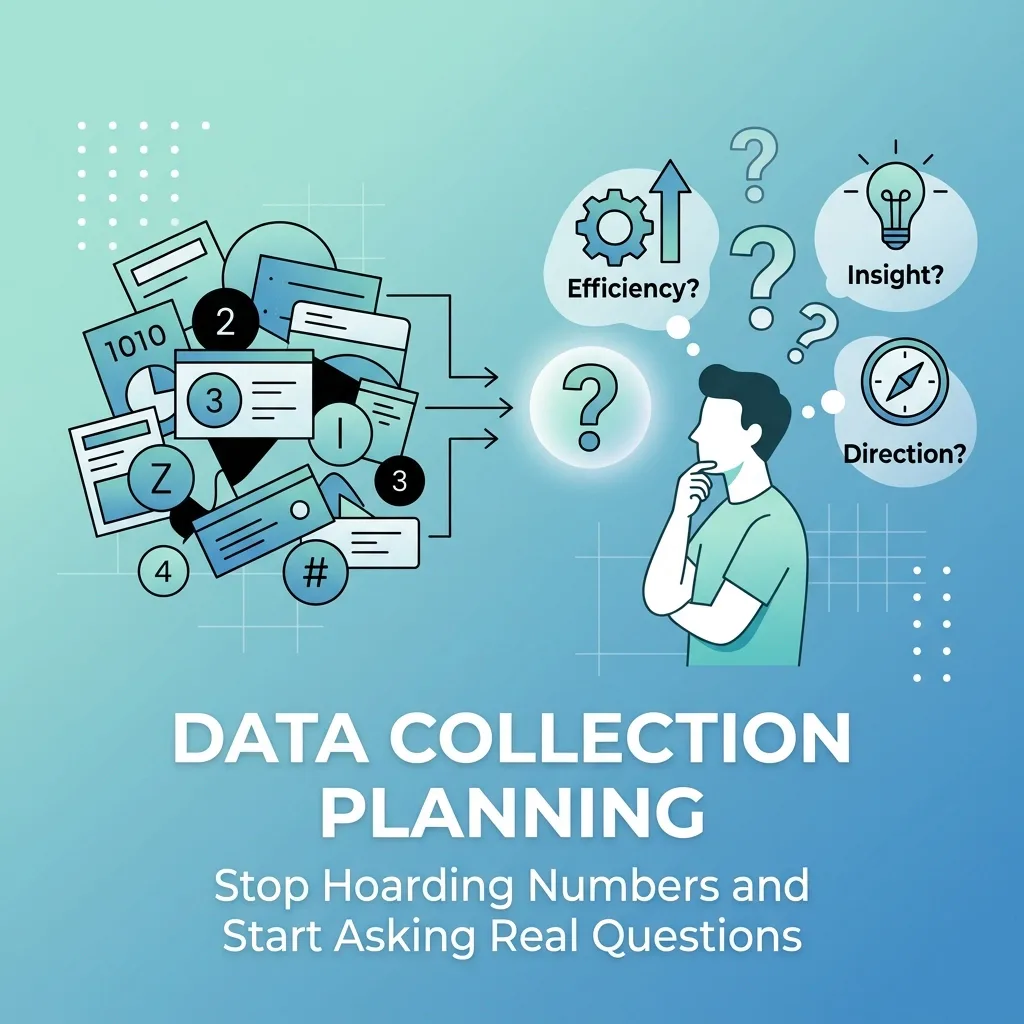
In the realm of process improvement, there is a pervasive and expensive delusion: the belief that volume equates to value. We live in an era of "Big Data," where managers mistakenly believe that the more rows they have in a spreadsheet, the closer they are to the truth. The reality is far more sobering. Most organizations are not "data-driven"; they are data-drowned. They hoard metrics like digital packrats, filling servers with "nice-to-know" figures while the "need-to-know" answers remain buried under the noise.
Effective Data Collection Planning (DCP) is not about gathering everything; it is about the surgical extraction of specific information required to make a high-stakes decision. If your dashboards are overflowing but your process outcomes remain stagnant, you do not have a data problem, you have a fundamental failure in planning.
The Delusion of "More is Better"
The fundamental purpose of the Measure phase in Lean Six Sigma is to establish a baseline and identify the root cause of variation. However, many project leads treat this phase as an exercise in sheer endurance. They collect data because it is available, not because it is applicable. This is a violation of Lean principles, it is "Over-processing" at its most academic.
To fully appreciate the gravity of this waste, one must understand the cost of bad data. Every data point collected represents a cost: the time of the person recording it, the storage costs of the system holding it, and the cognitive load on the analyst trying to interpret it. When you collect data without a specific question in mind, you are not being "thorough"; you are being irresponsible with your organization’s resources.
Start with Decisions, Not Databases
The professional approach to data collection begins at the end. Before a single data point is harvested, the practitioner must ask: What specific decision will this data inform?
If you cannot name a concrete action that will change based on the results of your data, then you must stop. Data without a decision path is merely trivia. In the context of a Lean Six Sigma hypothetical project, the objective is usually to reduce defects, cycle time, or cost. Therefore, the data collection plan must be built backwards from those goals.
The Essential Question Hierarchy
To move away from hoarding, you must translate vague business desires into essential questions:
- The Vague Desire: "We need to look at our shipping performance."
- The Essential Question: "Which specific carrier has the highest variance in delivery times for Zone 4 customers during peak hours?"
The latter leads to an actionable insight. The former leads to a 40-page PDF that everyone ignores. To help prioritize these questions, professionals often utilize tools like the Voice of Customer Priority Matrix Calculator to ensure they are focusing on what truly matters to the end user.
Technical Foundations: The Data Collection Plan (DCP)
A professional DCP is a rigorous document that leaves zero room for interpretation. It serves as the "Contract of Truth" for the Measure phase. A standard, high-attitude DCP must include the following components for every single metric:
- Operational Definition: This is the most critical element. If you ask three people to measure "Cycle Time," you will likely get three different answers. Does the clock start when the order is placed, or when it hits the warehouse floor? An operational definition removes ambiguity by providing a precise, measurable description.
- Data Source: Where exactly is this coming from? Is it a manual log, an ERP export, or a sensor? If the source is untrustworthy, the data is useless.
- Sample Size and Frequency: Statistical significance is not a suggestion; it is a requirement. You must determine how much data is needed to represent the population. For those struggling with these concepts, understanding normal distribution in process data is a prerequisite for any serious data collection effort.
- The "Who": Assigning clear roles and responsibilities. If "the team" is responsible for data collection, then nobody is responsible.
Integrating Lean Six Sigma Frameworks
You cannot plan data collection in a vacuum. It must be tethered to the broader architectural frameworks of Lean Six Sigma.
For instance, the SIPOC (Suppliers, Inputs, Process, Outputs, Customers) diagram is often the first place to identify where data collection points exist. By analyzing the "Process" steps, you can identify the chokepoints that require measurement. Professionals use the SIPOC Complexity Score Calculator to determine which segments of the process are most likely to hide waste and thus require more granular data.
Furthermore, the Critical to Quality (CTQ) Tree is essential for translating broad customer needs into measurable requirements. If you haven't quantified what "good" looks like using a CTQ Tree Calculator, you are essentially measuring in the dark.

The Brutal Truth: Decide What You Won’t Collect
The hallmark of a seasoned Black Belt is the courage to say "no." Data hoarding is often a defensive mechanism, managers collect everything so they can never be blamed for missing something. This "just-in-case" mentality is the death of efficiency.
Intentionally exclude data that:
- Requires excessive manual effort for low-value returns. If a technician has to stop work for five minutes to record a data point that is only checked once a year, you are destroying your own productivity.
- Duplicates existing information. Stop asking customers for their ID number if it’s already in your CRM.
- Cannot be acted upon. If the process is legally mandated to take 48 hours, measuring why it takes 48 hours is a waste of time.
Instead, focus your energy on bottleneck identification. Measure the constraints, not the scenery.
Measurement System Analysis (MSA): The Integrity Check
Before you begin analyzing your data, you must analyze the way you collect it. If your measurement system is flawed, your data is a lie. This is where many Green Belts fail, they jump straight into the "Improve" phase with data that has a 20% error rate due to gauge R&R (Repeatability and Reproducibility) issues.
Are your sensors calibrated? Are your staff members interpreting the categories consistently? If two people look at a defect, do they categorize it the same way? If the answer is "no," your data is noise. You must validate the measurement system before you trust the numbers.

Capacity and Reality: The "Data Graveyard"
Without a plan for usage, you are simply building a "data graveyard." This is the server where numbers go to die, never to be seen by a decision-maker. To avoid this, your Data Collection Plan must include a Usage Plan:
- Review Frequency: Will this be reviewed daily, weekly, or monthly?
- Thresholds for Action: What is the "red line"? If the defect rate hits 4%, who is notified, and what specific protocol is triggered?
- Ownership: Who owns the dashboard?
If you lack the capacity to analyze the data, do not collect it. It is better to have three metrics that you monitor religiously than 300 that you ignore.
Conclusion: Stop Measuring, Start Leading
Data collection planning is the bridge between chaotic guesswork and professional process management. It requires the discipline to prioritize quality over quantity and the honesty to admit when data is being collected for the wrong reasons. If you want to move beyond the surface level of process improvement, you must master the technical rigor of the Measure phase.
The difference between a technician and a leader is the ability to look past the numbers and see the process. However, you cannot see the process clearly if your vision is obscured by a mountain of irrelevant data.
If you are ready to stop hoarding numbers and start delivering actual business results, it is time to formalize your expertise. Whether you are aiming for a Green Belt to master the basics or a Black Belt to lead enterprise-wide transformations, the path to data-driven authority starts with accredited training.
Pursue your professional certification today at the Lean 6 Sigma Hub and learn how to turn data into a competitive weapon.
- Enroll in the Green Belt Certification
- Advance to the Black Belt Certification
- Achieve Master Black Belt Status