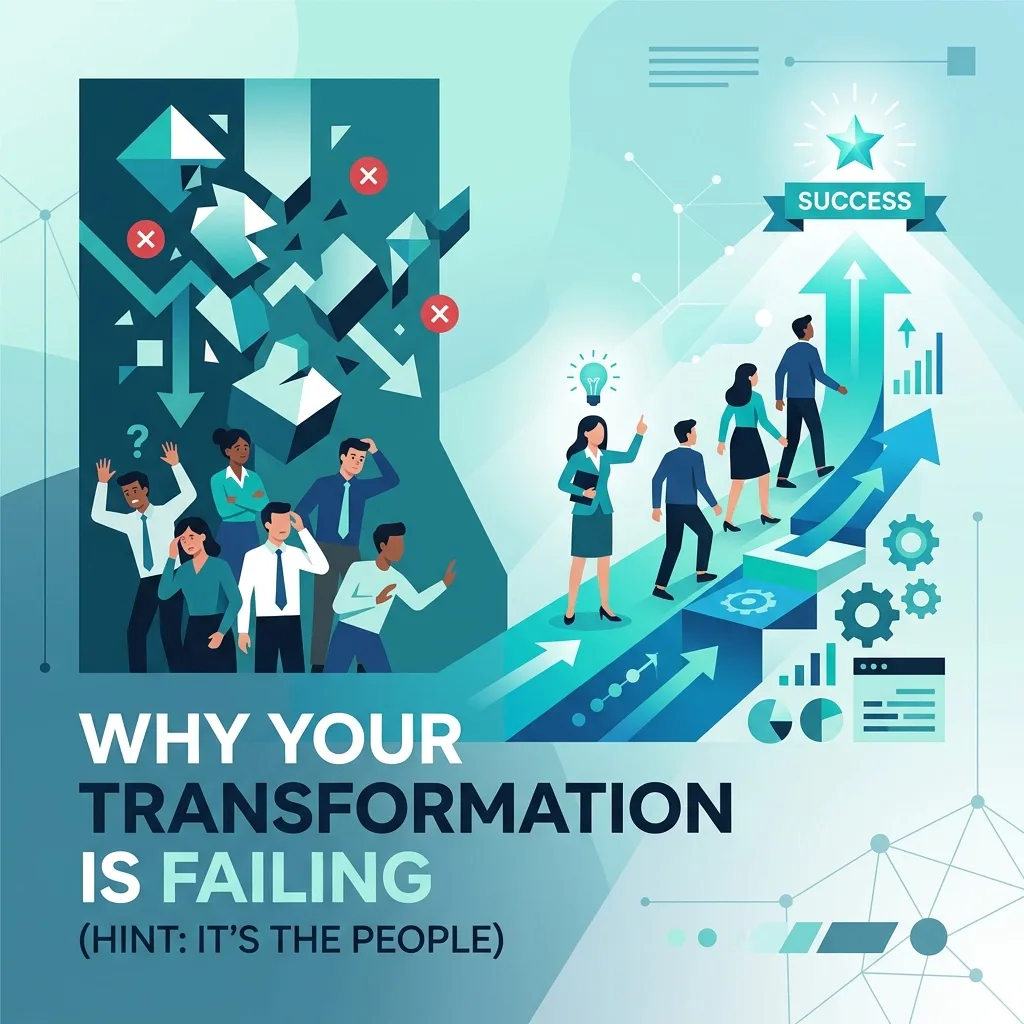
In the realm of organizational excellence, there is a recurring tragedy: a company spends millions on Lean Six Sigma deployments, hires top-tier consultants, and builds intricate process maps, only to see the entire initiative collapse under its own weight within eighteen months. When these "transformations" fail, leadership typically blames the technology, the budget, or the methodology itself. They are wrong.
The hard truth that many executives are unwilling to face is that transformation doesn’t fail because of the process; it fails because of the people. You can have a statistically perfect process, but if the human beings responsible for executing it are disengaged, confused, or actively resistant, your ROI will remain firmly at zero.
To fully appreciate why your change initiatives are stalling, we must move beyond the superficial and look at the fundamental psychological and structural barriers that turn "Continuous Improvement" into a corporate buzzword that employees learn to ignore.
The Strategy-Execution Gap: Compliance vs. Commitment
Most Lean Six Sigma projects are technically sound but socially bankrupt. Leaders are excellent at defining the "what" and the "why" from a 30,000-foot view. They understand the market pressure and the need for cost reduction. However, they almost always skip the "how for whom."
In the Lean Six Sigma framework, we utilize the SIPOC Complexity Score Calculator to understand process intricacies. Yet, how often do we apply the same rigor to the human element? Organizations frequently settle for surface compliance: where employees click through an e-learning module or attend a mandatory town hall: while failing to secure genuine commitment.
When you demand change without participation, you create a workforce that performs the "new way" only when the Black Belt is in the room. The moment the project reaches the "Control" phase and the experts move on, the process reverts to the path of least resistance. If your project isn't driving a shift in mindset, you haven't improved a process; you've just rented a temporary behavior.

Resistance is Data, Not Disobedience
One of the most significant mistakes in Change Management is treating resistance as a problem to be "crushed" or managed away. In a high-performance Lean Six Sigma culture, resistance is viewed as data.
People do not resist change because they are inherently "difficult." They resist because they perceive a threat to their status, their competence, or their security. If an operator has been doing a job for twenty years and you suddenly introduce a new workplace organisation strategy, their first thought isn't "efficiency"; it's "Are they trying to replace me with a machine?"
Instead of pathologizing resistance, elite practitioners use tools like the Stakeholder Impact Assessment Calculator to quantify the human risk. If you are facing significant pushback, it is a signal that your communication has failed or that your "solution" ignores a critical tribal knowledge point. Resisters are often your best source of information regarding process gaps that your fancy charts missed. Ignore them at your own peril.
The Plague of Change Fatigue
We must address a fundamental reality: your people are not change-resistant; they are change-exhausted. In the modern corporate environment, "transformation" is constant. When employees are subjected to a "flavor of the month" every quarter, they develop a survival mechanism: cynical waiting. They know that if they wait long enough, the current leadership will get bored, a new initiative will be launched, and the "mandatory" changes will fade into the background.
In Lean terms, this is a form of Muri (overburden). Just as a machine has a maximum capacity, so does the human psyche. When you launch a Lean Six Sigma hypothetical project on top of three other active transformations, you are essentially creating a bottleneck in your organization's cognitive bandwidth.
To combat this, leadership must treat change capacity as a finite resource. You cannot simply add more requirements to a team that is already struggling to maintain its baseline. If you want to implement something new, you must have the courage to stop doing something old.
When Culture Collides with Strategy
"That’s not how we do things around here." This phrase is the death knell of transformation. It represents a culture–strategy mismatch. If your Lean Six Sigma initiative requires data-driven transparency, but your culture rewards "heroic firefighting" and hiding mistakes, the culture will win every single time.
Culture is the set of unwritten rules that dictate behavior when no one is watching. If your Project Selection Scoring doesn't align with what the company actually promotes and rewards, your staff will quickly learn that the "new way" is a career risk.
For a transformation to take root, you must align your systems and symbols. This means updating performance reviews, changing bonus structures, and: most importantly: having leadership model the new behaviors consistently. If a Master Black Belt preaches about bottleneck identification but the CEO continues to reward the loudest voice in the room rather than the person with the data, the transformation is dead on arrival.
The "Control Phase" Delusion: Why Projects Die Post-Implementation
In the DMAIC methodology, the 'Control' phase is where the most significant failures occur. This is where the strategy-execution gap becomes a canyon. Most project leads focus on technical controls: automated alerts, updated SOPs, or Six Sigma Flash Cards for training. While these are necessary, they are insufficient for long-term sustainability.
Real "Control" is a social function. It requires the frontline to take ownership of the new process. If the frontline feels the change was "done to them" rather than "done with them," they will actively look for workarounds.
A project is not finished when the technical goals are met; it is finished when the new behavior becomes the new norm. This requires a robust Project Closure Checklist that specifically accounts for the hand-off to the "process owner" and the verification of sustained behavior change months after the official close-out.
Communication: Moving Beyond the "Cascade"
Most corporate communication is loud but not clear. Leadership "cascades" information down the org chart like a game of telephone. By the time it reaches the shop floor, the message is distorted, vague, and stripped of its relevance.
To succeed, communication must be targeted and two-way. Employees don't want to hear about "synergy" or "shareholder value." They want to know: "How does this affect my shift on Tuesday?"
Utilizing tools like a Voice of Customer Priority Matrix can help you identify the true requirements of your internal stakeholders. If you cannot explain the change in concrete terms that relate to their daily work, you haven't understood the change well enough to implement it.
The Path Forward: Leading with Authority
If your organization is serious about transformation, you must stop treating Change Management as a "soft skill" or an afterthought. It is a rigorous, technical discipline that is just as critical as understanding normal distribution or calculating DPMO.
The failure of most Lean Six Sigma programs is a failure of leadership courage. It takes courage to admit that the "people problem" is actually a "leadership problem." It takes courage to stop a project that has high technical merit but zero cultural buy-in.
If you are a professional tasked with leading change, you cannot afford to be a spectator. You need the advanced skills required to navigate the complex intersection of process math and human psychology. The difference between a failed experiment and a global transformation is the presence of a leader who understands both the Project Charter ROI and the human heart.
Stop making excuses for why your projects aren't sticking. The tools exist, the data is clear, and the path to excellence is paved with disciplined, human-centric leadership. Whether you are aiming for your Green Belt or moving toward the executive level as a Master Black Belt, your ability to manage the "people side" of the equation will define your career.
Take the next step in your professional journey and master the art of organizational transformation. Enroll in our industry-leading certification programs today.
Enrol in the Lean 6 Sigma Green Belt Course
Master the Complexities with our Black Belt Certification
Reach the Pinnacle: Apply for the Master Black Belt Program