
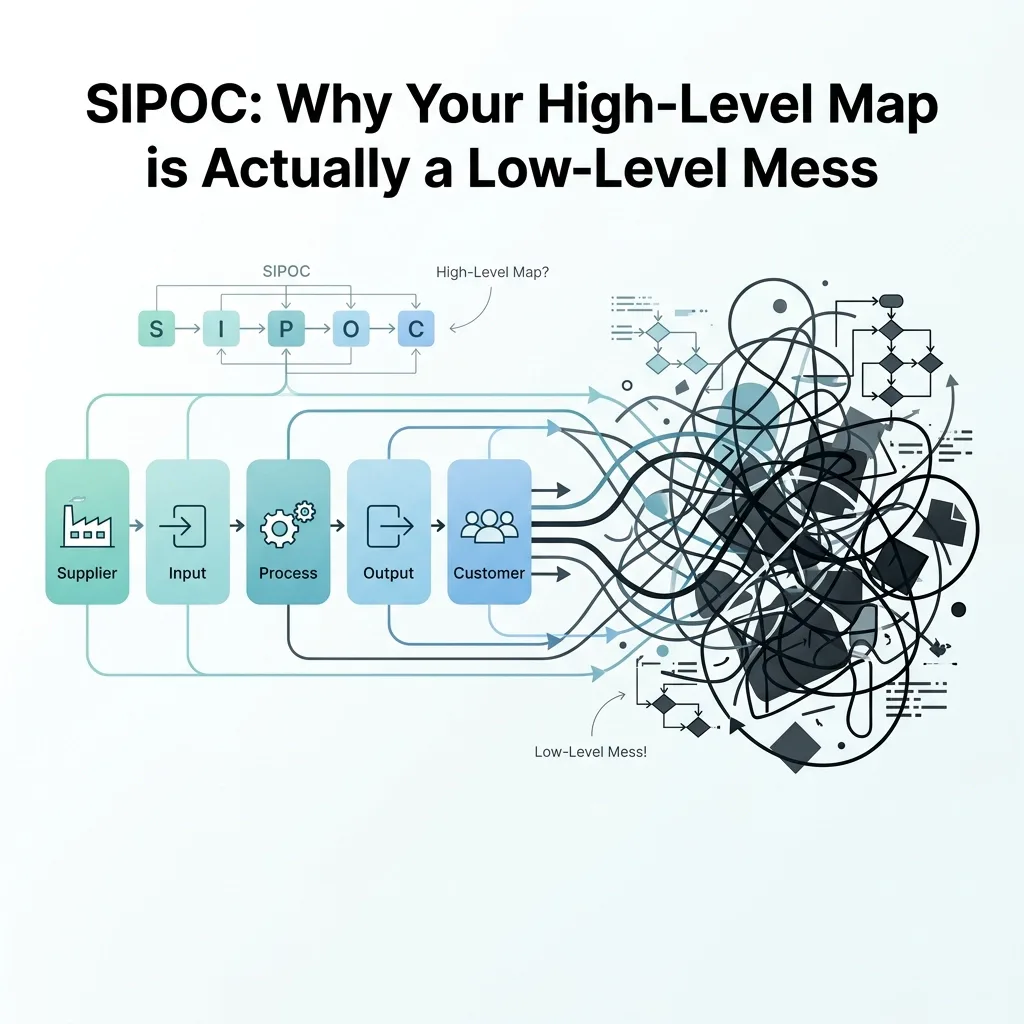
In the realm of process improvement, the SIPOC (Supplier, Input, Process, Output, Customer) diagram is often championed as the ultimate high-level scoping tool. It is designed to be the 30,000-foot view that aligns stakeholders and defines the boundaries of a Six Sigma project. However, in practice, most SIPOCs are not high-level maps; they are low-level messes. They are cluttered, over-complicated spreadsheets that look more like an exploded view of a jet engine than a strategic overview.
If your SIPOC requires a magnifying glass or a 20-minute explanation just to identify the core process, you haven’t built a mapping tool: you’ve built a monument to your own inability to prioritise. At Lean 6 Sigma Hub, we see this mistake constantly. Professionals confuse "detail" with "value," and in doing so, they sabotage their projects before they even leave the Define phase. To fully appreciate the utility of a SIPOC, one must first learn the brutal discipline of exclusion.
The "I Can't See the Forest for the Trees" Syndrome
The fundamental purpose of a SIPOC is to provide a snapshot. Yet, many project leads fall into the trap of "micro-mapping." They believe that if they don’t include every single action: from "opening an email" to "clicking a submit button": the map is somehow incomplete.
In a professional Lean Six Sigma environment, a SIPOC should contain between four and seven major process steps. Once you cross the ten-step threshold, you are no longer doing a high-level map; you are drifting into a detailed process flowchart. When you cram 15 steps into the "Process" column, you lose the ability to see the macro-level handoffs where most waste and bottlenecks actually occur.
Consider a standard "Process Customer Order" stage. A messy SIPOC would break this down into: Receive call, enter data, verify address, check credit score, confirm inventory, and send confirmation. A professional, high-level SIPOC simply states: Process Customer Order. The granularity belongs in the Measure phase, not here. If leadership cannot grasp the entire story of your process in under two minutes, your map has failed its primary mission.
Your Process Column is Not a Flowchart
One of the most egregious errors in SIPOC construction is the inclusion of decision diamonds, loops, and rework cycles. SIPOC is a linear tool. It is a straight line from Supplier to Customer.
If your "Process" column contains phrases like "If X then go to step 3, else reject," you have fundamentally misunderstood the tool's architecture. Branching logic and complex rework loops belong in a detailed swimlane diagram or a Value Stream Map. By forcing decision logic into a SIPOC, you create a visual tangle that obscures the "Critical to Quality" (CTQ) path.
To rectify this, you must treat the process as a singular, value-adding stream. Save the exceptions for later. If you find yourself struggling to keep it linear, you can use our SIPOC Complexity Score Calculator to determine if you’re over-engineering your map.

Input and Output Overload: The Data Hoarding Trap
A "low-level mess" is often characterized by an exhaustive list of every minor document, digital field, and notification involved in a process. We see SIPOCs where the "Inputs" column includes things like "Internet connection" or "Employee login." This isn't helpful; it's noise.
In a sophisticated SIPOC, Inputs and Outputs should be meaningful categories, not an inventory. Instead of listing "Quote PDF," "Quote Email," and "Quote ID," simply list "Validated Customer Quote."
When you list 50 inputs, you bog the team down in data detail before you’ve even agreed on what the process is. This lack of focus leads to "analysis paralysis" during the Measure phase. Professionals understand that the SIPOC should only highlight the critical inputs that directly impact the quality of the output. If you are struggling to prioritise which inputs matter most, utilizing a Voice of Customer Priority Matrix Calculator can help you focus on what actually drives value for the end user.
The Org Chart Trap: Suppliers and Customers
Another symptom of a failing SIPOC is a "Suppliers" or "Customers" column that reads like a company directory. Listing individual names (e.g., "John from Finance") is a rookie mistake. Individuals change roles, leave companies, or go on holiday. The process, however, remains.
Suppliers and Customers must be defined as entities or roles. Use "Finance Department," "External Vendor," or "Regional Sales Manager." Furthermore, a messy SIPOC often lists every person who touches the process rather than those who supply the critical inputs or consume the final output.
If a supplier’s performance doesn’t materially impact the process output, they don’t belong on the map. If a "customer" is just someone who gets copied on a FYI email once a month, they aren’t a customer of this process. They are a bystander. Keep your list focused on the stakeholders who have skin in the game. For a deeper dive into managing these relationships, review our Stakeholder Impact Assessment Calculator.
The "Lying to Yourself" Problem (As-Is vs. To-Be)
Perhaps the most dangerous way to create a low-level mess is to map the process as you wish it worked, rather than how it actually works today. This is the "To-Be" trap.
When teams gather to create a SIPOC, there is a natural tendency to smooth over the ugly parts. "Manual re-entry of data into three different systems" magically becomes "Data Synchronization." When you do this, you aren't mapping; you’re fantasizing.
A professional SIPOC must be a brutally honest "As-Is" document. It should highlight the awkward handoffs and the redundant steps. If a process is currently a mess, the SIPOC should reflect that mess at a high level. If you skip this step, you lose your baseline, and your Project Charter ROI Calculator results will be based on fiction rather than fact.

SIPOC as a Gateway, Not a Destination
The final reason SIPOCs become messy is that teams try to make them do jobs they weren't designed for. A SIPOC is a scoping tool. It is the gateway to more detailed analysis. It is not:
- A tool for Root Cause Analysis.
- A staffing or workload balancing tool.
- Standard Work for training new employees.
When you try to use a SIPOC for root cause analysis, you inevitably add more detail to try and "find" the problem. This is a strategic error. Use the SIPOC to define the boundaries, and then move to a more appropriate tool, such as bottleneck identification or a detailed process map.
How to Rescue a Messy SIPOC: A Professional Protocol
If you’ve realized your current SIPOC is an unusable tangle, don’t delete the file: refactor it. Follow this professional protocol to clean up the mess:
- Collapse the Process: Take your 15+ steps and merge them into 5 broad buckets. Use strong Verb-Noun pairings (e.g., "Execute Contract," "Dispatch Goods").
- Sanitize the Inputs/Outputs: Group similar items. If you have five different types of reports, categorize them as "Operational Metrics."
- Role-Based Identification: Replace all individual names with departmental roles or external entity names.
- Remove the Logic: Strip out all "if/then" statements. If the process is complex, acknowledge it, but keep the SIPOC linear.
- Verify the Scope: Ensure the start and end points of the process are clearly defined. If your process starts with "Customer thinks of a product" and ends with "Customer retires 20 years later," your scope is too wide.
A clean SIPOC is a sign of a disciplined project lead. It shows that you understand the process well enough to simplify it. As the saying goes, "If you can't explain it simply, you don't understand it well enough."
Take the Next Step in Your Professional Development
Process mapping is just the tip of the iceberg. To truly master the art of organizational transformation, you need a structured, data-driven approach that goes beyond basic diagrams. Whether you are looking to validate your current knowledge or climb the corporate ladder, Lean 6 Sigma Hub provides the world-class training and CSSC-accredited certification you need.
Stop guessing and start measuring. Test your skills today with our Free Lean Six Sigma Green Belt Practice Exam or challenge yourself with the Free Lean Six Sigma Black Belt Practice Exam.
Commit to your professional growth and secure your certification through Lean 6 Sigma Hub to lead high-impact projects that deliver real bottom-line results.