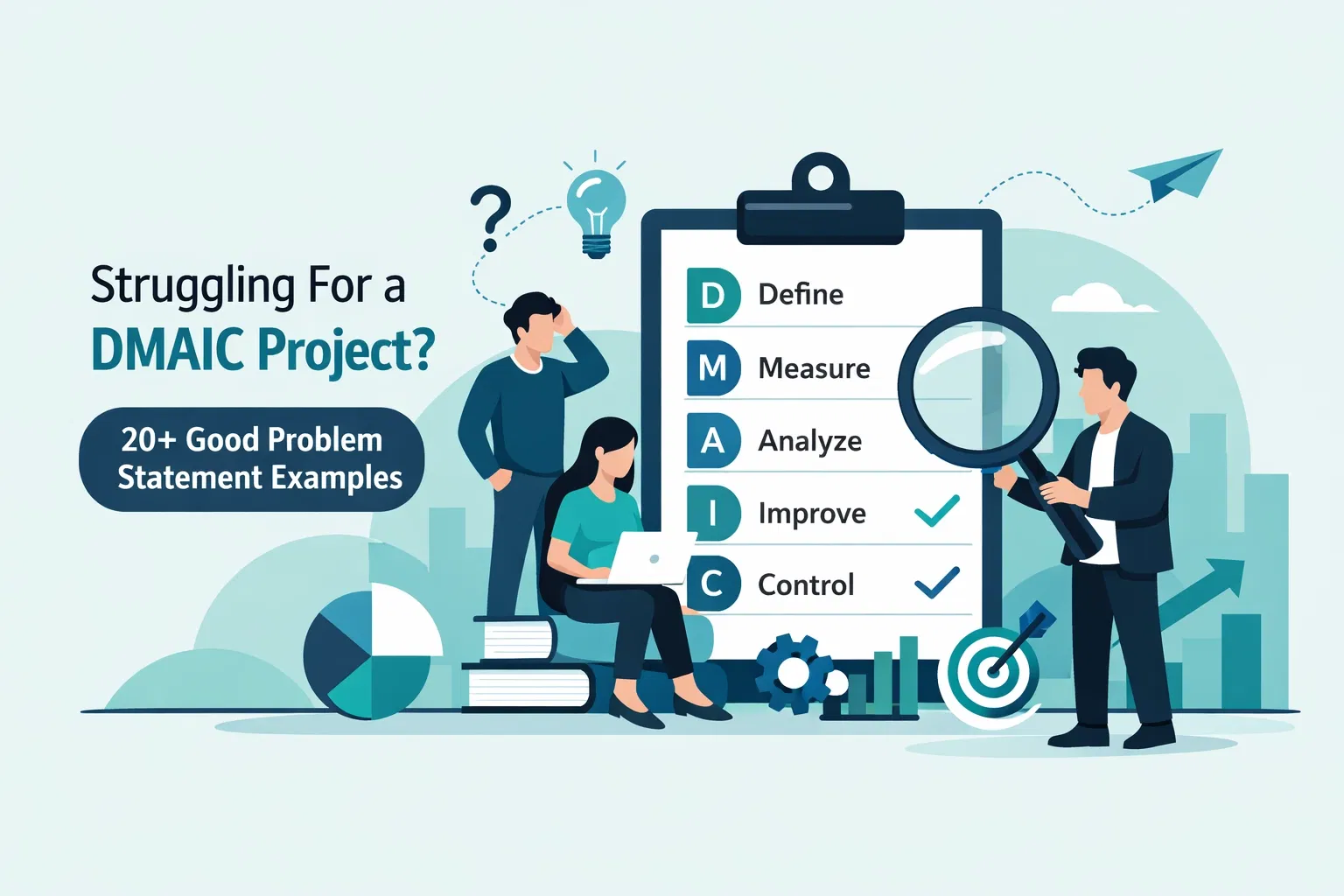
In the realm of process improvement, the success of a Lean Six Sigma project is often determined before the first piece of data is even collected. The Define Phase of the DMAIC (Define, Measure, Analyze, Improve, Control) methodology serves as the cornerstone of the entire endeavor. If the foundation is weak: specifically, if the problem statement is vague or poorly defined: the subsequent phases will likely drift, leading to wasted resources and negligible results.
The fundamental purpose of a problem statement is to provide a clear, concise, and quantified description of the issue at hand. It serves as a North Star for the project team, ensuring everyone is aligned on what exactly needs to be fixed. However, many practitioners struggle to transition from a general feeling of "things aren't working" to a rigorous, data-driven statement.
To help you overcome this hurdle, we have compiled a comprehensive guide on the anatomy of a perfect problem statement, followed by over 20 good problem statement examples across various industries to inspire your next Lean Six Sigma hypothetical project.
The Anatomy of a High-Quality Problem Statement
A professional problem statement does more than just complain about a process; it quantifies the pain. To ensure your project starts on the right foot, every statement should address the following five components:
- What: The specific problem or defect that is occurring.
- Where: The specific process, geographic location, or department where the problem exists.
- When: The timeframe during which this problem has been observed (e.g., over the last 6 months).
- How Much: The quantified magnitude of the problem (the gap between the current state and the ideal state).
- Impact: The financial, operational, or customer-related consequence of the problem.
A useful mnemonic for this is SMART: Specific, Measurable, Actual, Relevant, and Time-bound. Critically, a problem statement should never include a suspected cause or a proposed solution. It must focus entirely on the "what" and the "so what."

20+ Good Problem Statement Examples by Industry
1. Manufacturing & Operations
In manufacturing, problems usually manifest as defects, downtime, or excessive lead times.
- Example 1 (Defect Rates): During the Q3 and Q4 period of 2025, the assembly line in the Austin plant produced a 4.5% defect rate in the "Model X" circuit boards. This is 3% above the target threshold, resulting in $120,000 in scrap costs and rework labor.
- Example 2 (Lead Time): Over the past six months, the average lead time for custom furniture orders has increased from 14 days to 22 days. This 57% increase has led to a 15% drop in customer satisfaction scores and approximately $50,000 in cancelled orders.
- Example 3 (Equipment Downtime): In the last 90 days, the primary injection molding machine has experienced a 12% increase in unplanned downtime due to hydraulic failures. This has resulted in a production shortfall of 5,000 units and an estimated loss of $80,000 in gross margin.
- Example 4 (Inventory): As of March 2026, the warehouse in Sydney is carrying 30% more dead stock than the allocated limit. This excess inventory ties up $200,000 in capital and incurs $5,000 per month in additional storage fees.
- Example 5 (Safety): Over the last fiscal year, the bottling department has seen a 20% increase in "slip and fall" incidents compared to the previous three years. These incidents have resulted in 45 lost workdays and $30,000 in worker's compensation claims.

2. Healthcare & Medical Services
Healthcare projects often focus on patient safety, wait times, and administrative accuracy.
- Example 6 (Patient Wait Times): For the past four months, the average wait time for patients in the Emergency Room has been 145 minutes, exceeding the hospital's target of 90 minutes. This delay is linked to a 10% "Left Without Being Seen" (LWBS) rate, impacting both revenue and patient outcomes.
- Example 7 (Medication Errors): In the surgical wing, medication reconciliation errors have occurred in 8% of patient discharges over the last quarter. While no permanent harm has been recorded, these errors lead to an average of 1.5 days of additional hospitalization for observation, costing the facility $2,500 per instance.
- Example 8 (Lab Turnaround): Over the last six months, 25% of stat blood test results have exceeded the 60-minute turnaround time window. This delay prevents physicians from making timely diagnostic decisions, increasing the average length of stay by 4 hours per patient.
- Example 9 (Billing Accuracy): A recent audit revealed that 15% of patient invoices issued in the last year contained coding errors. This has led to a 20% insurance claim rejection rate and a 45-day delay in cash flow.
- Example 10 (Appointment No-Shows): The outpatient clinic has experienced a 22% no-show rate for specialist consultations over the last two quarters. This represents an estimated $140,000 in lost revenue annually and decreases the efficiency of medical staff.
3. Finance & Accounting
Efficiency in finance is often measured by cycle times and error rates in transactional processes.
- Example 11 (Accounts Payable): In the last three months, 12% of supplier payments were processed 45 days late. This has resulted in the loss of early-payment discounts totaling $15,000 and strained relationships with three key vendors.
- Example 12 (Invoicing Errors): During the 2025 fiscal year, 18% of invoices sent to corporate clients contained pricing discrepancies. Resolving these errors requires an average of 4 hours of labor per invoice, costing the accounting department $40,000 in annual productivity.
- Example 13 (Expense Reimbursement): The current cycle time for employee expense reimbursements is 21 days, compared to the industry benchmark of 7 days. This delay has led to a 30% increase in employee complaints and administrative overhead.
- Example 14 (Tax Compliance): Over the last two audit cycles, 5% of international transactions were misclassified for VAT purposes. This exposes the organization to potential regulatory fines of up to $100,000.
- Example 15 (Loan Processing): The mortgage department currently takes 35 days to move a loan from application to approval, while competitors average 22 days. This gap has resulted in a 12% decrease in the "pull-through" rate of high-credit-score applicants.
4. IT & Software Development
IT projects frequently address system uptime, bug density, and service desk responsiveness.
- Example 16 (Service Desk): Over the last 90 days, the IT Service Desk has seen a 25% increase in ticket resolution time for "Priority 2" issues. This delay affects the productivity of 400 internal users and has lowered the department's internal NPS from 70 to 45.
- Example 17 (Software Defects): In the last three software releases, the number of post-production "critical" bugs has increased by 15%. Patching these bugs post-release costs 10x more than fixing them during development, totaling $60,000 in unplanned labor.
- Example 18 (System Uptime): The customer-facing web portal experienced 4.5 hours of unplanned downtime in February 2026. This exceeded the 99.9% SLA, resulting in $25,000 in service credits issued to clients.
- Example 19 (Server Provisioning): The current process for provisioning new virtual servers takes 5 business days, while the target is 24 hours. This bottleneck delays software deployment cycles and reduces the speed-to-market for new features.
- Example 20 (Cybersecurity): In the last six months, unauthorized access attempts on the internal database have increased by 40%. While no breaches have occurred, the manual investigation of these alerts consumes 20 hours of security analyst time per week.
5. Logistics & Supply Chain
Logistics projects often focus on transportation costs and delivery precision.
- Example 21 (Delivery Delays): Over the last quarter, 14% of "Last Mile" deliveries in the Sydney metro area were delivered outside the 24-hour window. This has resulted in a $10,000 increase in customer service call volume and a 5% churn rate among premium subscribers.
- Example 22 (Fuel Consumption): Analysis of the fleet data from the last six months shows that fuel consumption is 12% higher than the manufacturer’s specifications. This inefficiency costs the logistics department $8,000 per month in avoidable fuel expenses.
- Example 23 (Warehouse Picking): The picking error rate at the Melbourne distribution center has risen to 3.5% over the last year. These errors lead to $4,000 per month in return shipping costs and administrative rework.

Moving Beyond the Problem Statement
Once you have identified a strong problem statement, the next logical step in the DMAIC journey is to quantify the variables. This often involves moving into the Measure Phase, where you will need to understand statistical sampling plans and decide between manual vs. automated data gathering.
To ensure your project remains focused, consider using our SIPOC Complexity Score Calculator or the Project Charter ROI Calculator to validate the financial feasibility of your initiative.
Common Pitfalls to Avoid
When drafting your own statement based on these good problem statement examples, beware of these common mistakes:
- Assigning Blame: "The warehouse staff is lazy" is not a problem statement. "Picking errors have increased by 20%" is.
- Including the Solution: "We need a new ERP system" is a solution, not a problem.
- Being Vague: "Quality is down" is useless. "The defect rate on line 4 has increased from 1% to 4% since January" is actionable.
- Lack of Impact: If you can't state why the problem matters (money, time, or customer satisfaction), it might not be a project worth pursuing.
Elevate Your Career with Certification
Mastering the art of the problem statement is a fundamental skill for any Lean Six Sigma practitioner. Whether you are aiming for your Green Belt or looking to lead enterprise-wide transformations as a Black Belt, the ability to define a problem clearly is what separates the experts from the amateurs.
At Lean 6 Sigma Hub, we provide the tools, templates, and world-class training you need to solve complex problems and drive significant organizational value. Our CSSC-accredited programs are designed to be practical, data-driven, and results-oriented.
Take the next step in your professional development. Explore our certification programs and start leading projects that deliver real impact today.