


This is the first article in our series on AI in Lean Six Sigma across industries.
Consider a packaging plant where quality inspectors record a 2.7% defect rate every month, for three years. The team has statistical process control charts, but they signal only after a shift is underway. Its FMEA is updated during an annual review, and root-cause information is scattered across spreadsheets.
The issue is not a lack of analysis tools. It is the delay between a process signal and an opportunity to act.
Artificial intelligence can change that time axis: from reporting problems after they occur to identifying patterns that may signal a problem ahead. But a prediction is not an improvement. To deliver customer value, an AI insight still has to be tested, acted on, and sustained through disciplined process improvement.
What AI adds to the DMAIC framework
AI is not a replacement for Lean Six Sigma, statistical thinking, or the people who understand the work. It is an additional analytical and operational capability: one that can help teams collect, combine, and interpret more data than they could handle manually.
A systematic review of research on Industry 4.0 technologies in Lean Six Sigma found that AI applications are concentrated in the Analyse phase, with less comprehensive support across the full DMAIC cycle. That matters: finding a useful pattern is only one step in improving a process. Read the review.
Here is how AI can support each phase:
- Define: Natural language processing can sort complaints, maintenance notes, survey responses, and incident descriptions into themes. That can help teams frame a problem and identify potential customer requirements, but project scope and priorities still need human validation.
- Measure: Automated data capture can draw information from sensors, cameras, transaction systems, and process logs. Combining data sources can provide a richer view of process performance. Measurement definitions, data quality, and measurement-system analysis remain essential.
- Analyse: Machine learning can identify patterns, interactions, and anomalies that are difficult to see in large datasets. Teams can use those findings to generate hypotheses, then test likely causes with appropriate statistical methods and process knowledge.
- Improve: Simulation and digital twins can help teams explore possible process changes before applying them in live operations. Promising options still need a pilot or designed experiment to confirm their effects.
- Control: Predictive alerts and automated monitoring can help teams detect changing conditions earlier. Control plans still need clear thresholds, response actions, process ownership, and checks for model drift.
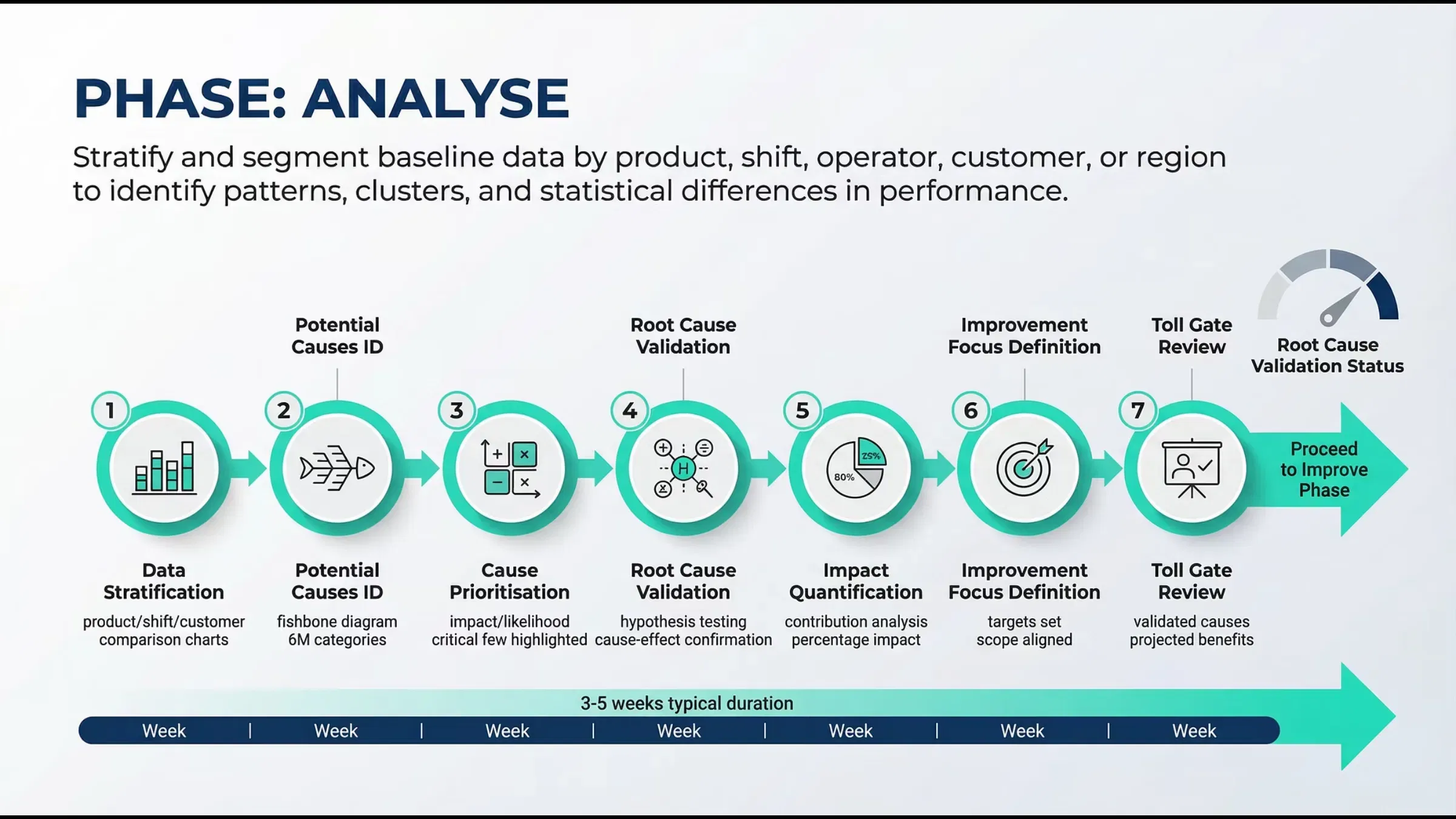
This distinction is fundamental: AI can accelerate DMAIC, but it does not remove the need for measurement discipline, cause validation, or controlled implementation.
Five industry examples: AI process improvement in practice
The following vignettes are illustrative scenarios, not reported customer results. Their figures show how a team might quantify a pilot; actual outcomes depend on the process, data, operating conditions, and implementation.
1. Manufacturing: predicting quality drift on an injection-moulding line
The problem: A plant produces 80,000 components per month, with a 4.8% scrap rate. Inspectors discover dimensional defects at end-of-line checks, after a substantial batch may already be affected.
AI capability: A machine-vision model assesses component dimensions and surface features, while a prediction model combines those results with machine temperature, cycle time, pressure, material lot, and tool information. The system flags a developing pattern 40 minutes before the line is expected to produce out-of-spec components.
Illustrative pilot result: After engineers use the alert to check the process and adjust a validated setting, the scrap rate falls from 4.8% to 2.9% across a four-week pilot. At 80,000 units per month, that is 1,520 fewer scrapped components per month, if production volume remains constant.
Limitation: A model can flag a relationship without proving what caused it. The team must check the measurement system, investigate the process, and verify corrective action. A model can also become less reliable if materials, equipment, or operating conditions change.
A published manufacturing study offers a useful but specific example of AI within DMAIC. Researchers reported using 320 observations and nine input variables in a Turkish textile-manufacturing case; after optimization, the reported average defect count fell from 13 to 3 per roll. That is a case study, not a universal forecast for other plants. Read the study.
2. Healthcare: anticipating emergency department bottlenecks
The problem: An emergency department experiences uneven arrivals and limited bed availability. Patients may wait longer during demand surges, while staffing and downstream capacity are difficult to adjust quickly.
AI capability: A forecasting model estimates near-term arrivals, admission likelihood, and expected demand for beds. The improvement team combines those forecasts with a process map of triage, assessment, decision, and transfer steps. A daily review can then focus on the predicted constraint, for example, slow bed turnover or a recurring handoff delay.
Illustrative pilot result: During an eight-week pilot, the department tests forecast-informed staffing and escalation rules. The 90th-percentile time from triage to first clinical assessment falls from 54 to 43 minutes, while the team monitors patient safety, workload, and performance across patient groups.
Limitation: A forecast does not make a clinical decision or create capacity by itself. Healthcare models also require careful attention to data quality, privacy, fairness, and changes in patient mix. A 2025 systematic review of machine learning for predicting inpatient admission from ED triage found that the strongest studies reported in-silico AUC values of 0.81–0.93, but the review found no included study demonstrating real-world implementation effects. Read the review.
3. Logistics: coordinating routes and dock schedules
The problem: A distribution centre receives 120 trucks each day. Arrival peaks create queues at the gate and docks, while late departures affect delivery schedules.
AI capability: A model combines estimated arrival times, shipment priority, dock availability, and route information to recommend appointment slots and flag likely conflicts. The team uses a current-state map to identify where waiting builds up, then pilots revised slotting and dispatch rules.
Illustrative pilot result: Over six weeks, average truck dwell time falls from 96 to 73 minutes, and on-time departures rise from 82% to 90%. The team tracks both measures alongside overtime and missed delivery windows to ensure that one improvement is not shifting the constraint elsewhere.
Limitation: Recommendations depend on reliable and timely information from carriers, warehouses, and transport systems. A logistics review notes that many last-mile studies rely on simulation; in the reviewed sample, 75% used computer simulation and 25% used real-case validation or empirical operational data. Read the review.
4. Finance: reducing invoice-processing exceptions
The problem: A finance team processes 10,000 invoices per month. Around 18% require manual investigation because of missing fields, mismatches, duplicate submissions, or coding questions.
AI capability: Optical character recognition and machine learning extract invoice details, compare them with purchase orders and receipts, and classify exceptions by type. High-confidence, low-risk cases can follow standard workflows; uncertain or high-value cases are sent to a person for review.
Illustrative pilot result: After a ten-week pilot, the exception rate falls from 18% to 11%, reducing manual reviews by 700 invoices per month at the same volume. The team also tracks payment accuracy, rework, and the time required to resolve exceptions.
Limitation: Correctly reading an invoice is not the same as verifying that its contents are correct. The system still needs checks for duplicate payments, agreement with purchase terms, receipt of goods, and appropriate approvals. Human review remains important where the cost of an incorrect decision is high.
5. Food processing: predicting yield on a bottling line
The problem: A bottling line fills 150,000 litres per month. Changes in product temperature, filler performance, stoppages, and start-up losses contribute to variation in saleable yield.
AI capability: A model combines filler settings, temperature readings, line speed, downtime events, and product data to estimate expected yield and identify conditions associated with avoidable losses. The team tests changes to start-up procedures and operating ranges in a controlled pilot.
Illustrative pilot result: Saleable yield improves from 94.2% to 96.0% over six weeks. At a constant monthly volume of 150,000 litres, the 1.8 percentage-point increase represents 2,700 additional saleable litres per month.
Limitation: Food safety and product specifications are non-negotiable constraints, not variables to optimise away. The team must verify that a yield improvement preserves quality and compliance, and check whether model performance changes between products or seasons.
Where Ci Flow fits: connecting insight to improvement work
An AI prediction can be valuable, but teams need a practical way to connect it to project scope, evidence, decisions, actions, and follow-up. Otherwise, the insight can remain detached from the daily work of improvement.
This is where Ci Flow comes in. Ci Flow is a separate AI-powered continuous improvement platform designed to operationalise improvement work through connected project workflows. It provides DMAIC-aligned project tracking, digital process workspaces, and CI pipelines that help teams move from evidence to action.
Its capabilities include AI-assisted root-cause suggestions, real-time KPI tracking, CI project pipelines, and integration with daily management boards. These features support the workflow around an improvement project: documenting what the team knows, reviewing progress, assigning actions, and keeping performance visible.

A platform does not validate an AI model, prove a cause, or guarantee an improvement. Those responsibilities stay with the project team. Its value is in helping make the work more visible and connected, so an insight can enter a governed improvement process rather than sit in a separate dashboard.
How to bring AI findings into the Control phase
The Control phase is where teams determine whether an improvement holds, and how they will respond if performance changes. AI monitoring can strengthen this work, but it needs to sit alongside a clear control plan, not replace one.
For each AI-supported change, agree on:
- The process outcome: Define the primary measure, such as defect rate, waiting time, yield, or invoice exception rate, alongside relevant customer and safety measures.
- The baseline and target: Document the measurement period, data source, operational definition, and desired performance.
- The alert and response: Specify what happens when a metric, prediction, or data-quality check crosses an agreed threshold, and who owns the response.
- The model checks: Monitor prediction errors and changes in input data. Set rules for review, retraining, fallback procedures, and when to pause automated recommendations.
- The sustainment review: Compare results with the baseline and check that gains persist without creating new waste or risk elsewhere.
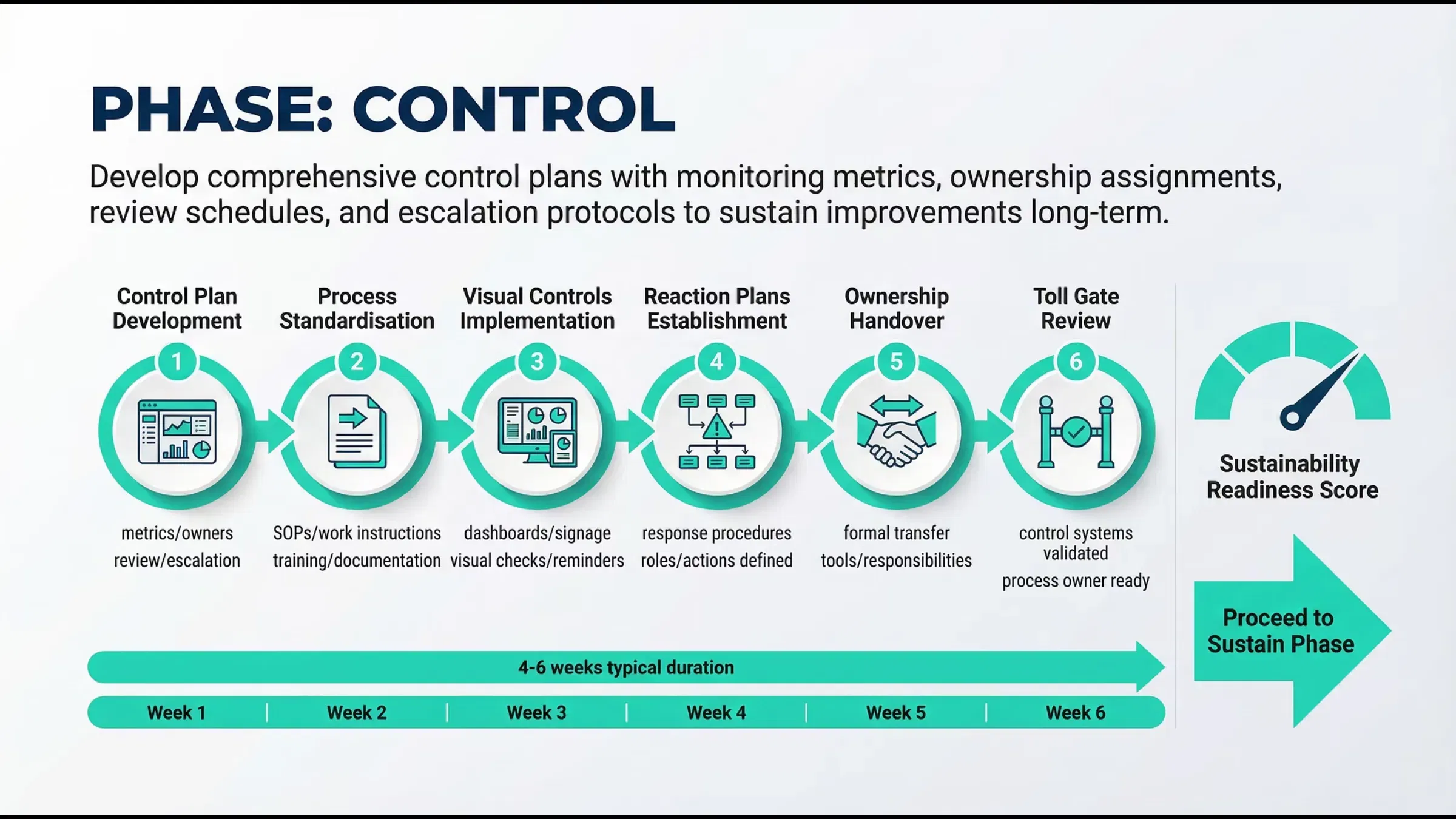
The goal is not simply to make a model accurate in testing. It is to build a control system that helps people maintain the right process performance and act responsibly when conditions change.
Where AI can mislead a Lean Six Sigma project
AI adds analytical capacity, but it cannot compensate for weak project foundations. Four checks help keep its use grounded:
- Start with usable data. Missing records, inconsistent timestamps, shifting definitions, and inaccurate labels can make predictions unreliable. Confirm how data is collected before increasing its volume.
- Keep process understanding in the loop. A model may identify a pattern that reflects a real cause, a hidden confounder, or a feature of how the data was recorded. Use process knowledge and investigation to distinguish between them.
- Do not skip Measure. More sensors do not automatically mean better measurement. Define the metric, verify the measurement system, and establish a sound baseline before interpreting outputs.
- Treat AI output as a hypothesis, not a root cause. A feature ranking or correlation can guide further investigation. It does not, on its own, establish causality. Validate the suspected cause with appropriate analysis, experiments, or a controlled pilot.
A useful standard is to ask: What decision will this output support, what evidence makes that decision credible, and how will we know whether the process improved?
Build the skills to use AI with confidence
AI in Lean Six Sigma is most useful when it strengthens a disciplined improvement system: better problem framing, faster data capture, richer analysis, well-tested changes, and a control plan that keeps people accountable. The examples in this article show potential applications, not guaranteed outcomes. Every organisation should establish its own baseline and validate results in its operating context.
For practical guidance on measurement and root-cause analysis, explore our articles on data collection methods and root-cause analysis in Six Sigma.
Explore Ci Flow for AI-augmented continuous improvement management, and build the statistical foundation to apply AI responsibly with Lean 6 Sigma Hub’s CSSC-accredited, self-paced Lean Six Sigma certifications, from White Belt through Master Black Belt. AI amplifies skill; it does not replace it.
Kaizen. Kai-Care. Kai-Done. Lean Six Sigma
Further reading
- Integration of Industry 4.0 technologies into Lean Six Sigma DMAIC: A systematic review
- Machine learning and deep learning based predictive quality in manufacturing: A systematic review
- Predictive Six Sigma for Turkish manufacturers: Utilization of machine learning tools in DMAIC
- Predicting Inpatient Admissions From Emergency Department Triage Using Machine Learning: A Systematic Review
- Artificial Intelligence Applied to Last-Mile Logistics: A Systematic Review


