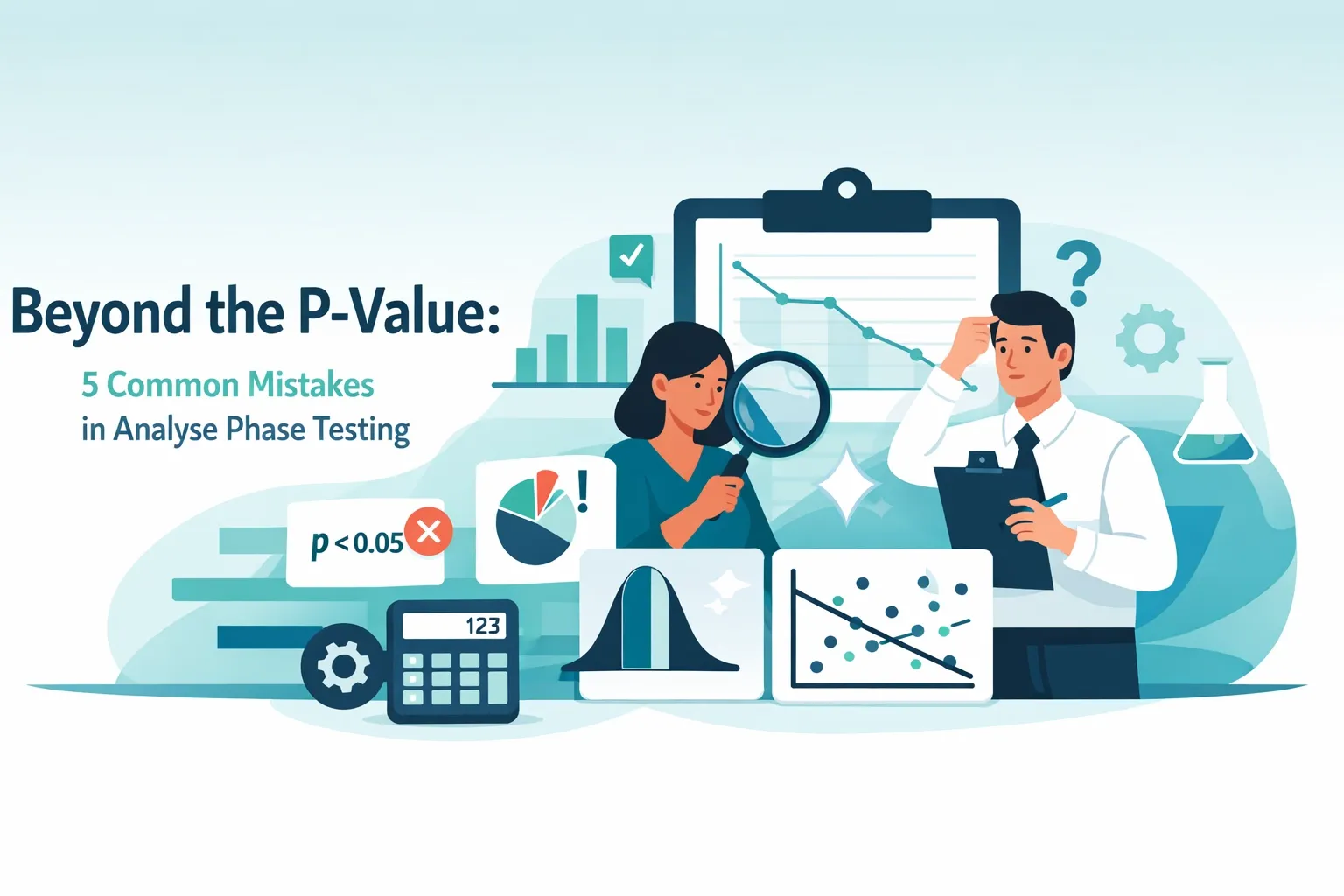
In the realm of process improvement, the Analyse phase of the DMAIC (Define, Measure, Analyse, Improve, Control) methodology serves as the critical bridge between identifying a problem and implementing a solution. It is the stage where "detective work" takes center stage, and practitioners use statistical tools to separate signal from noise. However, even the most seasoned professionals can fall into the trap of over-relying on a single metric: the p-value.
While hypothesis testing is the secret weapon for proving root causes, a superficial understanding of statistical significance can lead to costly errors and misguided business decisions. To truly excel in lean six sigma green belt training or to lead at an executive level via lean six sigma master black belt training, one must look beyond the p-value to ensure that results are not just statistically significant, but practically meaningful and scientifically valid.
The Fundamental Purpose of Hypothesis Testing in Analyse
The fundamental purpose of hypothesis testing within the Analyse phase is to validate the root causes identified during initial brainstorming sessions, such as those conducted using a cause-and-effect-diagram. Instead of relying on "gut feelings" or anecdotal evidence, practitioners use inferential statistics to determine if a specific factor: be it temperature, operator skill, or machine calibration: is truly influencing the output (the Big Y).
However, the transition from data logs to actionable insights is fraught with technical nuances. Below, we explore five common mistakes made during the Analyse phase and how to avoid them.

1. Misinterpreting What the P-Value Actually Measures
The most frequent error in statistical analysis is a fundamental misunderstanding of the p-value itself. Many practitioners mistakenly believe that a p-value of 0.03 means there is a 97% chance that their hypothesis is true. This is a fallacy.
In reality, a p-value is the probability of observing results at least as extreme as the ones obtained, assuming that the null hypothesis is true. It does not measure the probability that the research hypothesis is correct, nor does it measure the probability that the results occurred by random chance alone.
When you conduct lean six sigma green belt training, you learn that the p-value is a tool for risk management. If the p-value is less than your alpha level (typically 0.05), you reject the null hypothesis. But remember: rejecting the null does not "prove" your alternative hypothesis with absolute certainty; it merely suggests that the observed data is highly inconsistent with a world where the null hypothesis holds.
2. Confusing Statistical Significance with Practical Significance
A recurring pitfall for Lean Six Sigma practitioners is the "Small P-Value, Tiny Impact" trap. With a large enough sample size, almost any difference: no matter how trivial: can be made statistically significant.
For instance, consider a project aimed at reducing the cycle time of an autonomous vehicle's software update. A hypothesis test might show a p-value of 0.001, indicating a statistically significant reduction in time. However, if the actual reduction is only 0.5 seconds on a 2-hour process, the effect size is negligible.
To ensure results are valid for the business, practitioners must evaluate the Practical Significance. Does the change result in a measurable ROI? You can use a project charter ROI calculator to determine if the statistical "win" translates into financial value. If the cost of implementation outweighs the marginal gain, the root cause, while "proven," may not be worth addressing.
3. "P-Hacking" Through Sample Size Manipulation
In the quest for a "successful" project, some may be tempted to engage in p-hacking. This involves continuously increasing the sample size until a significant p-value is reached. Because p-values generally decrease as the sample size (n) increases, a researcher can eventually "force" a significant result even if the underlying effect is practically non-existent.
This distortion of evidence undermines the integrity of the DMAIC process. To avoid this, practitioners should determine the required sample size before data collection begins, based on the desired power of the test and the minimum effect size they wish to detect. This proactive approach is a hallmark of lean six sigma master black belt training, where the focus shifts from simply running tests to designing robust statistical experiments.

4. Failing to Correct for Multiple Comparisons
When analyzing complex processes, it is common to test multiple variables simultaneously. For example, you might test five different machine settings to see which one affects yield. However, every time you perform a hypothesis test at a 0.05 significance level, there is a 5% chance of committing a Type I error (a false positive).
If you perform 20 different tests, the probability of finding at least one "statistically significant" result purely by chance increases dramatically. This is known as the "Multiple Comparisons Problem." Without adjusting the alpha level (using methods like the Bonferroni correction), you risk chasing "ghost" root causes that do not actually exist.
A high-level gap analysis should always be paired with a rigorous statistical plan to ensure that the variables you identify are truly the levers that drive performance.
5. Neglecting the Real-World Context and Simulations
Data logs provide a snapshot of the past, but they do not always capture the full complexity of a live process. A significant error in the Analyse phase is relying solely on historical data logs without validating findings through real-world simulations.
Data-driven decision making is most effective when statistical results are stress-tested against the physical realities of the shop floor or the service environment. This is where tools like Sigma Magic become invaluable. They allow practitioners to run "what-if" scenarios and simulations to see how a change in a root cause variable will interact with other process constraints.
Before moving to the Improve phase, it is essential to ask: "Does this statistical conclusion make sense in the context of our SIPOC complexity?" If the data says "A causes B," but the operators on the floor say "that's impossible," it is time to re-examine your data collection methods or look for lurking variables.

Ensuring Validity: Tips for the Data Detective
To avoid these pitfalls and ensure your Analyse phase results are valid, consider the following protocols:
- Always Report Confidence Intervals: While a p-value tells you if an effect exists, a confidence interval tells you the likely magnitude and precision of that effect.
- Verify Data Integrity: Before running a t-test or ANOVA, ensure your data meets the necessary assumptions (normality, equal variance, independence). Use a free six sigma calculator to check your work.
- Use Stratification: Often, a root cause is hidden within a sub-set of data. Stratifying your data by shift, location, or material type can reveal insights that a high-level hypothesis test might miss.
- Triangulate Your Findings: Never rely on a single statistical test. Combine hypothesis testing with graphical analysis (Histograms, Box Plots) and process observation to build a "preponderance of evidence."
- Conduct a Pilot or Simulation: Before full-scale implementation, use a hypothetical project model to simulate the proposed changes and verify the impact.
Conclusion: The Path to Mastery
The Analyse phase is the intellectual heart of Lean Six Sigma. Mastering hypothesis testing requires moving beyond the simple "p < 0.05" rule and developing a deep appreciation for effect sizes, power, and practical application. By avoiding these five common mistakes, you ensure that your process improvements are built on a foundation of solid evidence rather than statistical illusions.
For those looking to deepen their expertise, pursuing structured certification is the most effective path. Whether you are starting your journey with lean six sigma green belt training or aiming for executive leadership through lean six sigma master black belt training, understanding the "Why" behind the data is what separates a technician from a true transformation leader.