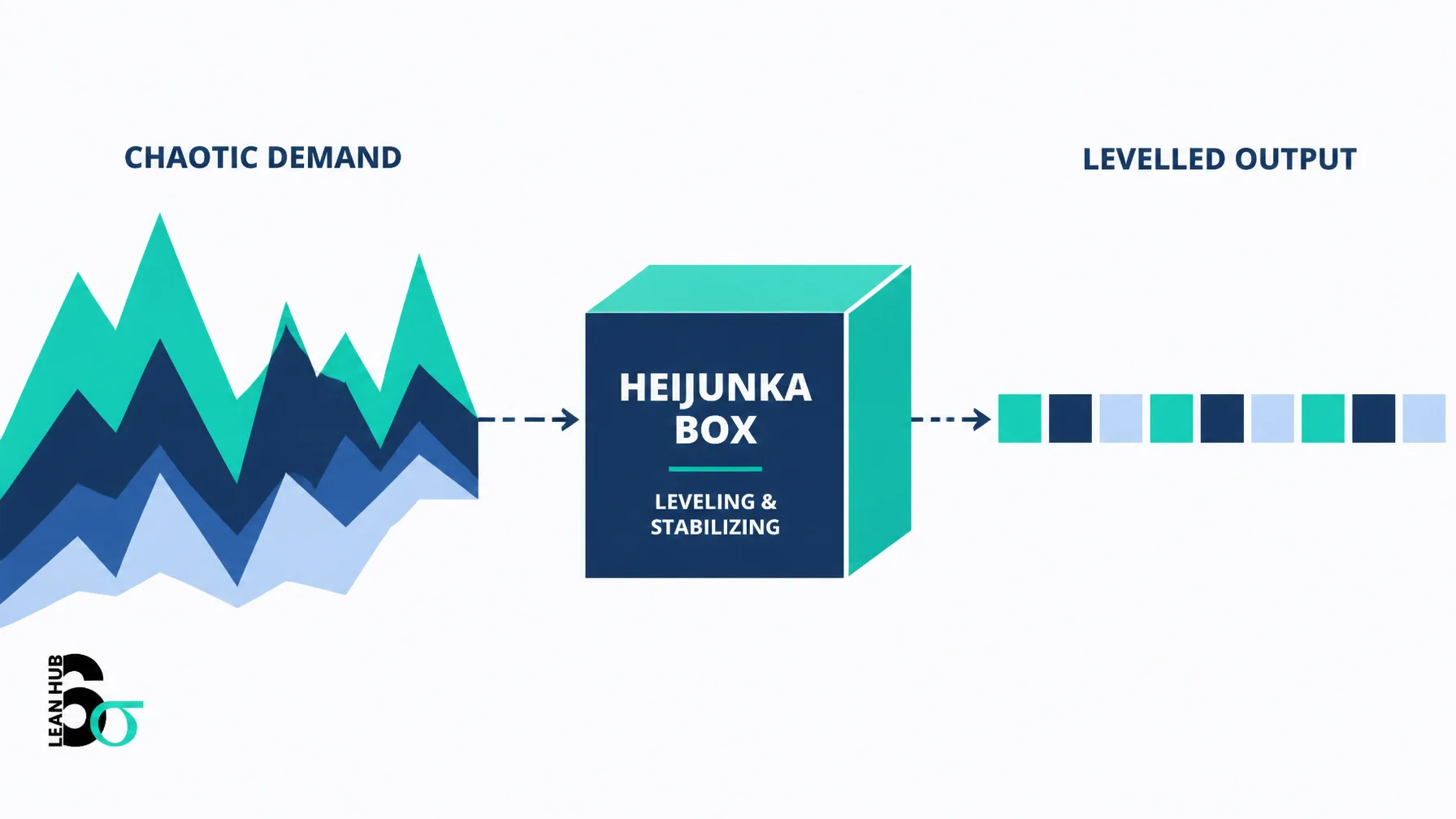
In the realm of operational excellence, most organizations are perpetually stuck in a reactive "firefighting" mode. They chase the erratic spikes of customer demand, leading to a cycle of burnout, overtime, and excessive inventory. To fully appreciate why most production and service systems fail to scale efficiently, one must look toward the second pillar of the Toyota Production System: Heijunka.
The fundamental purpose of Heijunka: or production leveling: is not merely to organize work, but to convert the chaos of a volatile market into a smooth, predictable, and high-performance flow. It is the sophisticated antidote to the traditional "batch and queue" mentality that plagues modern enterprises. As a seasoned professional, mastering Heijunka is the difference between surviving a volatile market and dominating it.
The High Cost of Unevenness: Mura and Muri
To understand the strategic value of Heijunka, we must first address the foundational concepts of Mura (unevenness) and Muri (overburden). In an unleveled process, demand fluctuates wildly. One day the team is overwhelmed (Muri), leading to errors and burnout; the next, they are idle, creating waste.
Heijunka eliminates this instability. By smoothing out the volume and variety of production, you create a baseline that allows for standard work and continuous improvement. Without a leveled schedule, your Standard Deviation in cycle times remains high, making statistical control nearly impossible.
The Technical Core: Leveling by Volume vs. Leveling by Mix
Heijunka is executed through two primary strategic levers. Achieving mastery requires a data-heavy understanding of how these two dimensions interact to stabilize your Value Stream.
1. Leveling by Volume (Workload)
Volume leveling involves producing at a constant rate based on the average demand over a planning horizon, rather than reacting to daily peaks and valleys. If your market demands 500 units a week, but the daily orders fluctuate between 20 and 180, a traditional shop would struggle. A Heijunka-driven system produces exactly 100 units every day. This creates a stable load on resources, suppliers, and personnel.
2. Leveling by Product Mix (Variety)
This is where true efficiency is built. Instead of producing large batches of "Product A" on Monday and "Product B" on Tuesday, Heijunka interleaves them in small, repeatable cycles. This is often referred to as Mixed-Model Flow.

By producing a small, representative batch of every product every day, you drastically reduce lead times and finished-goods inventory. You are no longer waiting until "Tuesday" to fulfill a B order; you are fulfilling it in the next cycle, which could be just an hour away.
The Toolkit: Takt Time, Pitch, and the Heijunka Box
To implement Heijunka with precision, we utilize a set of technical protocols that align production with the actual Voice of the Customer (VOC).
- Takt Time: The heart rate of your process. It is the available production time divided by customer demand. If your Takt Time is 60 seconds, your leveled schedule must release one unit every minute.
- Pitch: This is the standard interval at which work is released into production. It operationalizes Takt Time into manageable "time buckets." For example, if Takt is 1 minute and your pack size is 10, your Pitch is 10 minutes. Every 10 minutes, the next leveled batch of work is launched.
- The Heijunka Box: A visual scheduling tool that distributes these pitches across a grid. It ensures that the floor follows the sequence of product types and volumes without manual intervention or "guessing."

Strategic Value in Volatile Markets
Why is this essential for a Lean Six Sigma Black Belt or Master Black Belt? Because volatility is the ultimate "waste-multiplier." In a volatile market, the "Bullwhip Effect" distorts demand signals as they travel up the supply chain.
Heijunka acts as a shock absorber. By maintaining a steady internal rhythm, you:
- Reduce WIP (Work in Process) by up to 40% through smaller batch sizes.
- Improve First Pass Yield (FPY) because stable processes are inherently less prone to errors.
- Maximize Capacity Utilization by eliminating the idle time associated with demand valleys.
Consider a hypothetical case study in a high-mix electronics assembly plant. Before Heijunka, the plant operated on 2,000-unit batches with a 10-day lead time. After implementing mixed-model leveling with a 2-hour pitch, lead times dropped to 24 hours, and inventory carrying costs were reduced by $1.2 million annually.
Implementation Protocol: 4 Steps to Mastery
For those looking to lead this transformation, the protocol must be disciplined:
- Calculate the Average Demand: Use your Analyze Phase skills to determine the true average demand and Takt Time.
- Optimize Changeovers (SMED): You cannot level variety if your changeovers take hours. You must first drive down changeover times to enable small-batch production.
- Establish a Pull System: Use Kanban to signal when the leveled schedule should replenish a specific slot.
- Visualize with a Heijunka Box: Don't leave the schedule in an Excel sheet. Bring it to the Gemba (the real place) so every operator knows the rhythm of the day.

Elevate Your Expertise
Heijunka is not a "beginner" tool. It requires a deep understanding of process physics, data analysis, and change management. If you are ready to move beyond the basics and start architecting world-class flow, it is time to formalize your expertise.
At Lean 6 Sigma Hub, we provide the rigorous, CSSC-accredited training required to lead these enterprise-level transformations. From foundational principles to advanced statistical strategy, our courses are designed for professionals who demand results.
Take the next step in your professional development. Explore our Lean Six Sigma Black Belt Certification or reach the pinnacle of the industry with our Master Black Belt Program today.