In the contemporary landscape of organizational excellence, the pursuit of operational efficiency is no longer a luxury: it is a fundamental necessity for survival. As global markets become increasingly competitive, professionals who possess the methodologies to eliminate waste and reduce process variation are in high demand. For many, the journey toward mastery begins with the Six Sigma White Belt certification. This introductory tier serves as the foundational cornerstone for anyone looking to understand the mechanics of Lean Six Sigma without immediately committing to the rigorous technical demands of higher belt levels.
The fundamental purpose of this guide is to demystify the initial steps of the certification process and provide a strategic entry point through a structured six sigma white belt practice test. By engaging with preliminary assessments, candidates can gauge their current understanding of process improvement principles and identify specific areas for further study.
The Conceptual Framework of the Six Sigma White Belt
To fully appreciate the value of a White Belt, one must first understand its position within the broader Lean Six Sigma hierarchy. Unlike Green or Black Belts, who lead complex projects and perform advanced statistical analysis, a White Belt is designed to provide a high-level overview of the methodology. It focuses on the "what" and "why" of process improvement rather than the "how" of complex data modeling.
In the realm of professional development, the White Belt is often described as a "literacy" level. It ensures that every member of an organization speaks the same language when discussing efficiency, quality, and customer satisfaction. The curriculum typically covers:
- The History of Six Sigma: Understanding the evolution from Motorola’s quality initiatives to modern Lean integration.
- The DMAIC Framework: An introduction to Define, Measure, Analyze, Improve, and Control.
- Waste Identification: Recognizing the "8 Wastes" (DOWNTIME) that hinder productivity.
- Team Roles: Clarifying the responsibilities of Yellow, Green, Black, and Master Black Belts.

Why You Should Utilize a Six Sigma White Belt Practice Test
The transition from theoretical knowledge to exam-day success requires more than just passive reading. Utilizing a six sigma white belt practice test serves as a diagnostic tool that mirrors the official certification environment. While the White Belt exam is generally considered an entry-level assessment, it requires a precise understanding of terminology and logic.
The benefits of taking a practice test include:
- Risk Mitigation: Identifying knowledge gaps before attempting the final exam prevents the frustration of failure and the potential cost of re-examination.
- Psychological Readiness: Familiarity with the question format: typically multiple-choice: reduces anxiety and improves time management skills.
- Concept Reinforcement: The act of retrieving information during a practice test strengthens the neural pathways associated with Lean Six Sigma principles.
- Benchmarking: It provides a quantitative metric of your readiness, allowing you to move forward with confidence once a passing score (typically 70% or higher) is consistently achieved.

Core Competencies Tested in the White Belt Curriculum
To succeed in a six sigma white belt practice test, candidates must be proficient in several key domains. These domains form the bedrock of the Lean Six Sigma Hub educational philosophy.
1. The Define Phase: Setting the Objective
In this phase, the primary goal is to articulate the problem clearly. Candidates should be familiar with the Project Charter and the concept of the Voice of the Customer (VoC). Without a well-defined scope, projects often suffer from "scope creep," where the objectives expand beyond the team’s resources.
2. The Measure Phase: Quantifying the Problem
Understanding how to collect data is critical. Even at the White Belt level, one must appreciate the importance of calculating rework and scrap rates. For a deeper dive into these metrics, we recommend reviewing our guide on understanding and calculating rework and scrap rates in Six Sigma.
3. The Analyze Phase: Identifying Root Causes
The Analyze phase focuses on the "Y=f(x)" equation, where 'Y' is the output and 'x' represents the inputs. White Belts are expected to understand basic tools like the Fishbone (Ishikawa) Diagram and the "5 Whys" technique to drill down into the core reasons for process failure.
4. The Improve and Control Phases: Sustaining Excellence
While White Belts do not typically design the improvements, they are instrumental in their implementation. This involves training your team to maintain new processes to ensure that improvements are sustainable over the long term.
Hypothetical Case Study: Improving Service Delivery Metrics
To illustrate the practical application of White Belt knowledge, consider a hypothetical scenario involving a regional logistics firm, "ExpressLogix." The firm was experiencing a significant decline in "on-time delivery" rates, dropping from 94% to 86% over a six-month period.
An internal team, bolstered by White Belt-certified staff, initiated a preliminary review. Using the DMAIC framework, they identified that the bottleneck was not in the transportation phase, but in the documentation hand-off between the warehouse and the drivers.
- Define: The goal was to return to a 94% on-time delivery rate within 90 days.
- Measure: Data showed that 12% of deliveries were delayed by more than 20 minutes due to missing paperwork.
- Analyze: The root cause was identified as a lack of standardized digital checklists.
- Improve: A simplified digital signature process was introduced.
- Control: Weekly audits were established to monitor compliance.
The result was an immediate recovery to 95% on-time delivery, saving the company an estimated $14,500 per month in late-delivery penalties and customer churn. This demonstrates that even foundational knowledge can lead to significant fiscal outcomes.
Navigating the Certification Landscape in 2026
As of March 2026, the demand for Lean Six Sigma expertise continues to surge across diverse sectors, including healthcare, finance, and technology. For instance, in the financial sector, professionals use these tools for identifying regulatory reporting issues before they escalate into compliance failures.
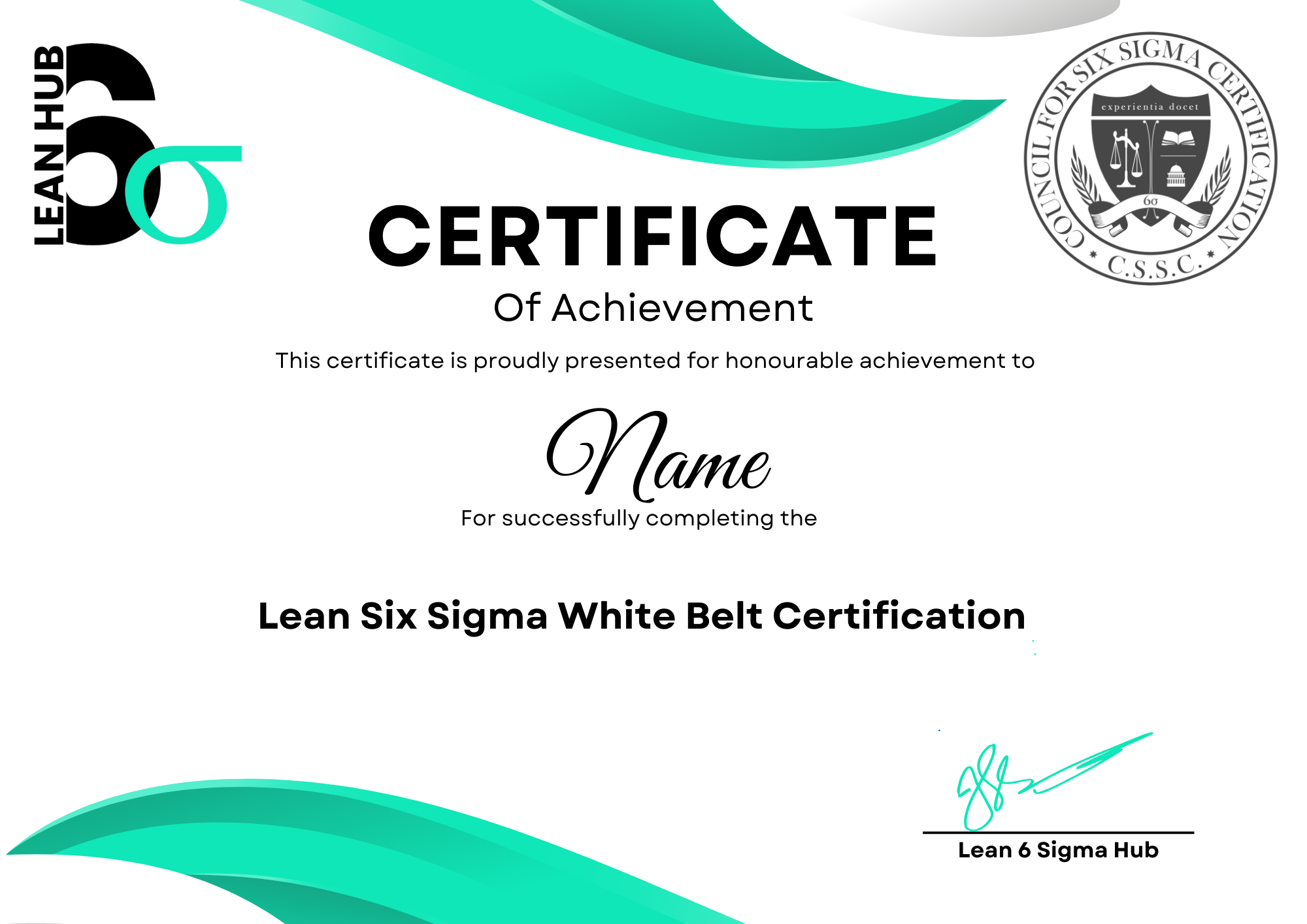
When selecting a certification body, accreditation is paramount. The Council for Six Sigma Certification (CSSC) is widely recognized as the industry standard. Lean 6 Sigma Hub provides CSSC-accredited training that ensures your credentials are respected by global employers.
The White Belt exam typically consists of 30 to 50 multiple-choice questions. While some organizations offer open-book formats, the most rigorous certifications require a focused understanding of the material. By starting with our six sigma white belt practice test, you align yourself with the high standards expected by top-tier firms where average salaries for certified professionals range from USD $45,000 to $65,000 at the entry level.
Strategic Steps to Success
For those ready to embark on this professional development journey, we suggest the following structured approach:
- Enroll in a Foundational Course: Access the Lean 6 Sigma Hub White Belt course to gain access to comprehensive study materials.
- Engage with the Community: Leverage forums and study groups to discuss complex topics such as outlier detection and data treatment.
- Perform the Practice Test: Take the six sigma white belt practice test under timed conditions to simulate the actual exam environment.
- Review and Refine: Analyze your incorrect answers to understand the logic behind the correct choices.
- Achieve Certification: Complete the final exam and add your credential to your professional profile.

Conclusion: The Path to Operational Mastery
The journey toward becoming a Lean Six Sigma expert does not require an immediate leap into complex statistics. It begins with a single, strategic step: mastering the fundamentals. By utilizing a six sigma white belt practice test, you provide yourself with a roadmap for success, ensuring that your transition into the world of process improvement is both smooth and data-driven.
Whether you are looking to enhance your current role or pivot to a new career in operational excellence, the White Belt provides the vocabulary and the mindset necessary to drive value in any organization. Once you have mastered this level, the path to Yellow, Green, and Black Belt certifications becomes a logical progression of your expanding skill set.
Take the first step toward professional excellence today. Access our free Six Sigma White Belt practice test and begin your journey toward a globally recognized certification with Lean 6 Sigma Hub.