In the realm of operational excellence, organizations frequently invest significant capital into training high-potential employees through rigorous programs like Lean Six Sigma Green Belt online training and advanced Lean Six Sigma Black Belt online training. These professionals return to their teams armed with powerful statistical tools, root-cause analysis frameworks, and the ability to execute flawless DMAIC (Define, Measure, Analyze, Improve, Control) projects.
Yet, a recurring paradox plagues modern enterprises: once the project concludes and the project charter is formally closed, performance metrics slowly drift back to their baseline levels. The savings vanish, the new templates gather digital dust, and leadership wonders why their investment in continuous improvement failed to stick.
The fundamental purpose of this article is to demystify how to bridge the chasm between isolated improvement projects and an enduring, self-sustaining daily operating rhythm. By transforming project-based achievements into permanent organizational systems, companies can move beyond temporary fixes and achieve long-term competitive advantage.
1. The Project-to-Operations Paradox: Why Belts Need a System
The root cause of project regression is rarely a lack of technical competence. Graduates of accredited belt programs understand process mapping, statistical process control, and hypothesis testing. The breakdown occurs because organizations treat Lean Six Sigma as an event rather than an environment.
When improvement is confined to project mode, practitioners function as elite task forces parachuting into broken processes. While this generates impressive short-term yield improvements and cost reductions: often ranging from $50,000 to over $100,000 per project: it creates structural dependency. When the belt moves on to their next assignment, the local team lacks the daily governance required to maintain the newly established process state.
To build lasting capability, practitioners must shift their mindset from "running a project" to "designing an operating system." This transition is anchored firmly in the final phase of the DMAIC methodology: Control.
2. Locking in Gains with Standard Work and Visual Controls
The Control phase of DMAIC is explicitly engineered to institutionalize improvements. However, institutionalization requires more than a handover meeting; it demands rigorous standardization.

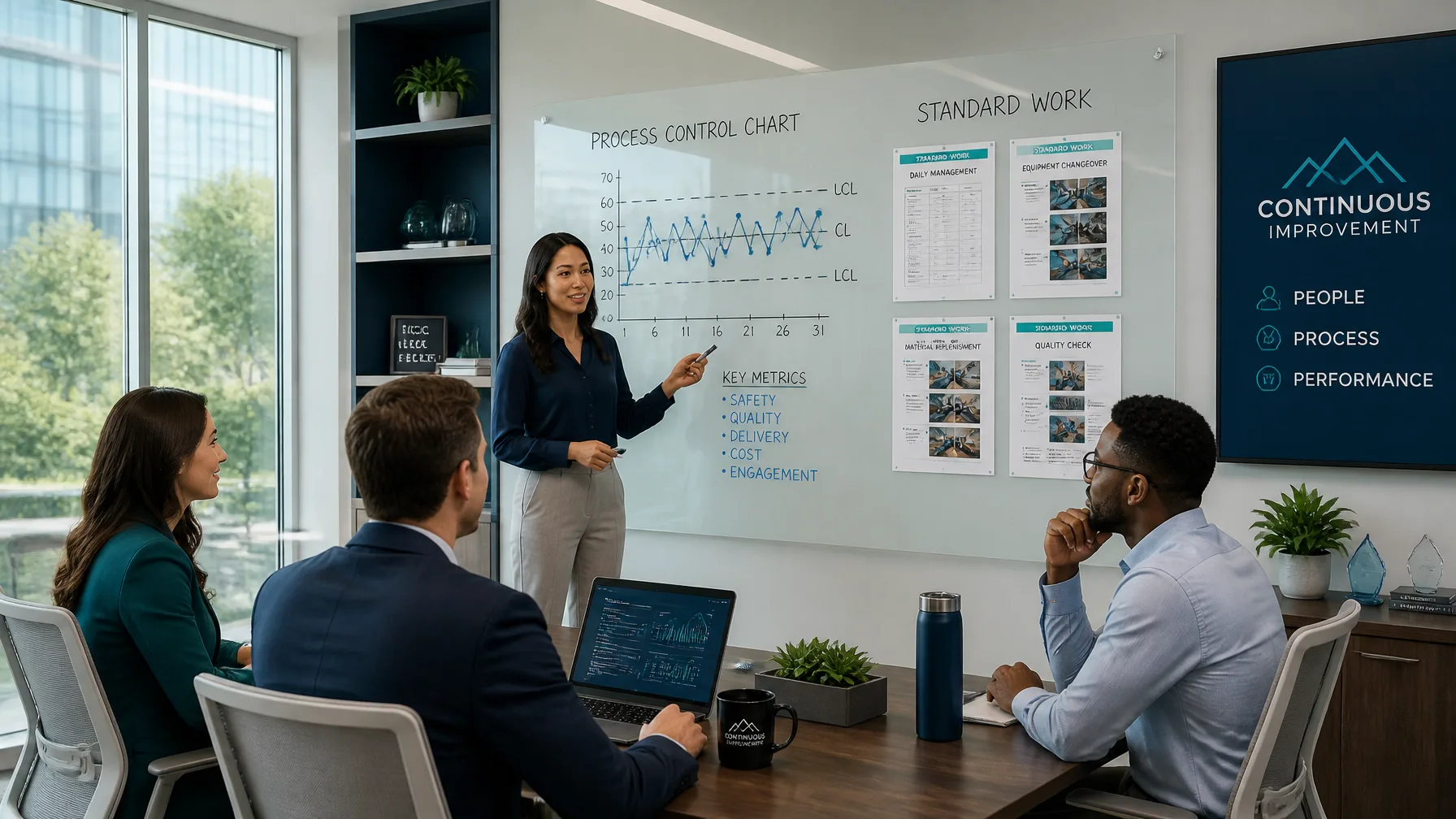
Standard work represents the best-known, safest, and most efficient method to perform a task. Without documented standard operating procedures (SOPs) derived directly from the improved process state, variation inevitably creeps back into daily operations.
Key Practices for Effective Standardization:
- Capture the Improved Sequence: Document the exact cycle times, operator movements, and quality checkpoints validated during the Improve phase of your project.
- Make Instructions Visual: Utilize visual management boards, color-coded tooling trays, and step-by-step pictorial guides to make non-conformance instantly visible to frontline teams.
- Validate Through Training: Conduct hands-on training sessions with operators and supervisors to ensure complete comprehension before freezing the new standard.
- Establish Regular Audits: Implement routine supervisory audits to verify adherence to standard work and capture feedback for future incremental improvements.
When standard work becomes the undisputed baseline of daily activity, training new hires accelerates, and operational variance plummets.
3. Monitoring Performance with Control Charts and Reaction Plans
In the Measure and Analyze phases, statistical tools like the X-bar and R chart are deployed to uncover hidden process shifts and quantify variability. In daily operations, these exact same tools transition from diagnostic instruments into early-warning radar systems.
+-------------------------------------------------------+
|              CONTROL CHART MONITORING                 |
|                                                       |
|  [Upper Control Limit] . . . . . . . . . . . . . .    |
|                          \   / \                      |
|  [Target Mean] --------*---*---*---*---*------        |
|                                 \   /                 |
|  [Lower Control Limit] . . . . . . . . . . . . . .    |
+-------------------------------------------------------+
Static dashboards that report monthly averages are insufficient for modern agility. To maintain control, teams must monitor critical-to-quality (CTQ) characteristics in real time using statistical process control (SPC).
Designing Actionable Control Mechanisms:
- Select High-Impact Metrics: Track vital process parameters such as First Pass Yield (FPY), customer wait times, or critical component dimensions.
- Define Clear Reaction Plans: Every control chart must be paired with an unambiguous protocol. If a data point exceeds control limits or exhibits a non-random trend (such as seven consecutive points on one side of the mean), operators must know precisely who to notify and what containment action to take within a 15-minute window.
- Cadence of Review: Pair frontline control charts with daily huddle reviews so that emerging special-cause variation is addressed before resulting in scrap, rework, or customer dissatisfaction.
4. Connecting Management to Reality Through Gemba Walks
Governance cannot be effectively maintained from a desk on the top floor. Leadership and process owners must routinely visit the Gemba: the Japanese term for the "actual place" where value is created.
A structured Gemba walk is not an inspection tour; it is an active listening and problem-solving expedition.

Pillars of an Effective Gemba Walk Routine:
- Observe Adherence: Compare current operational execution directly against the established standard work documentation.
- Identify Waste (Muda): Scan for the eight classic wastes: transportation, inventory, motion, waiting, overprocessing, overproduction, defects, and untapped human potential (DOWNTIME).
- Engage Frontline Operators: Ask open-ended questions: "What is slowing down your cycle today?" or "Where are you experiencing friction with materials?"
- Tie Observations to Action: Every identified bottleneck or deviation must be assigned a named owner and a strict resolution target date, tracked via visual daily management boards.
5. Establishing Governance and Tiered Escalation Pathways
An effective operating system bridges individual teamwork with executive strategy through structured governance. Organizations should implement a tiered daily management cadence:
- Tier 1 (Daily Shop-Floor Huddles): 10-minute stand-up meetings at shift change focusing on yesterday's safety, quality, delivery, and cost (SQDC) performance versus standard work.
- Tier 2 (Departmental Reviews): Weekly meetings examining aggregated trends, recurring quality escapes, and resource constraints that frontline teams cannot resolve independently.
- Tier 3 (Executive Steering Committee): Monthly or quarterly strategic reviews evaluating enterprise capability, high-level CTQs, and project pipeline health.
When local issues exceed the capability of standard work and daily countermeasures, clear escalation pathways must dictate when an operational roadblock transitions into a formal, structured DMAIC project led by certified practitioners.
Conclusion: Elevate Your Organizational Capabilities
Moving from isolated DMAIC projects to a resilient daily operating system requires deliberate design, robust standard work, real-time control charts, and disciplined Gemba leadership. Organizations that successfully bridge this gap transform continuous improvement from an unpredictable initiative into an enduring cultural habit.
To lead this transformation within your enterprise, equip yourself and your team with internationally recognized methodologies. Explore our comprehensive Lean Six Sigma Green Belt online training to master data-driven problem solving, or take your leadership to the highest level with our advanced Lean Six Sigma Black Belt online training.
Enroll in our CSSC-accredited programs today and start building systems that drive sustainable, world-class performance.