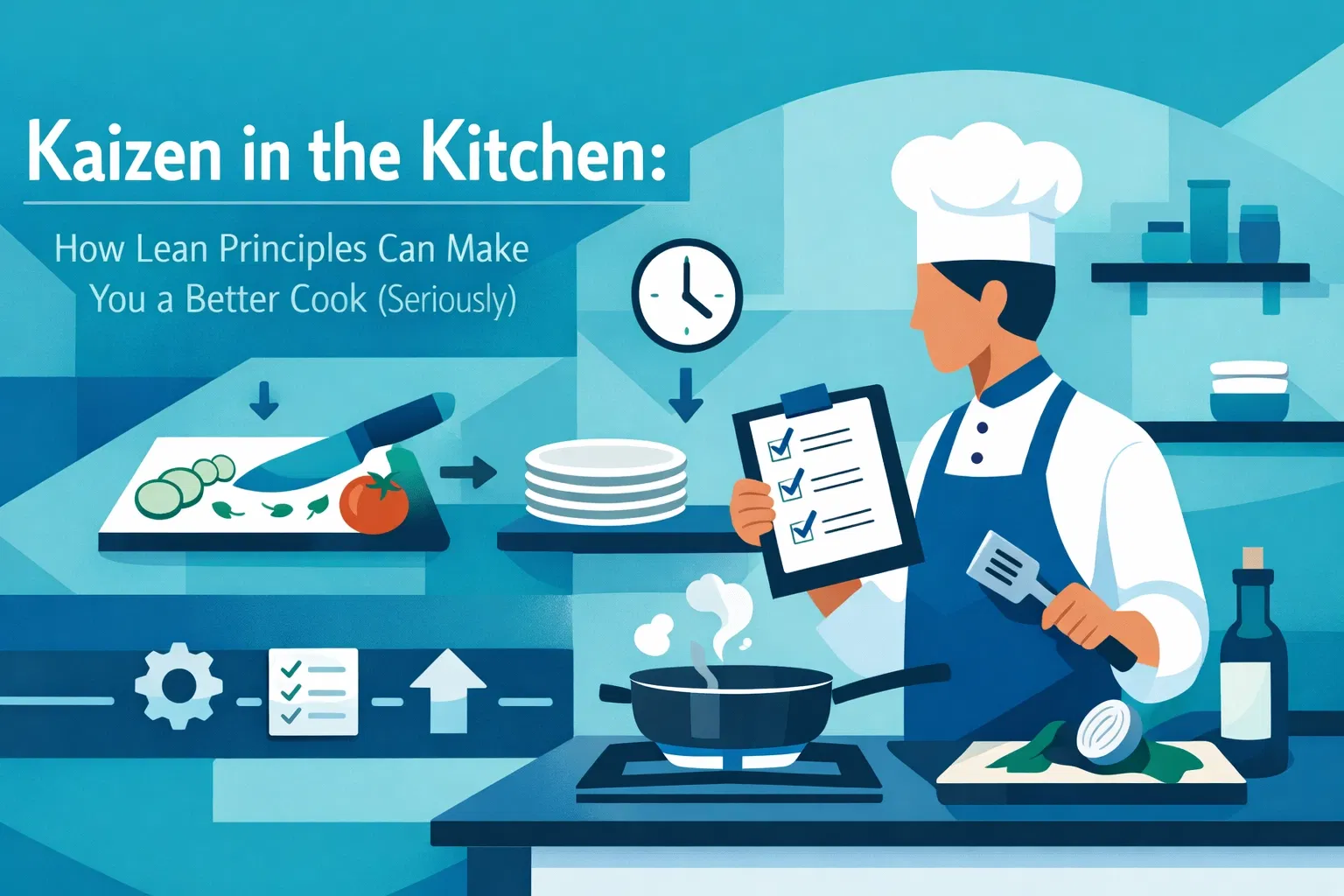
In the realm of professional process optimization, the methodology of Lean Six Sigma is often relegated to the sterile environments of manufacturing plants, healthcare facilities, or high-level corporate boardrooms. However, the fundamental purpose of Lean is the pursuit of perfection through the relentless elimination of waste and the continuous improvement of processes: a philosophy known as Kaizen. To fully appreciate the versatility of these tools, one need look no further than the heart of the home: the kitchen.
Culinary excellence is rarely the result of raw talent alone; it is the product of disciplined systems. By applying lean six sigma training principles to your cooking routine, you can transform a chaotic evening meal into a streamlined, high-output operation. This transition not only improves the quality of the "final product" but also drastically reduces the lead time and resources required to produce it.
The Conceptual Framework: Kaizen and the Culinary Arts
Kaizen, a Japanese term meaning "change for the better," focuses on small, incremental improvements that compound over time. In a professional setting, this might involve adjusting a machine's calibration by a fraction of a millimeter. In a kitchen, it may involve moving the salt cellar three inches closer to the stovetop.
The primary objective is to identify and eliminate Muda (waste). In Lean philosophy, waste is categorized into eight distinct types, often remembered by the acronym DOWNTIME. When we apply this to the kitchen, the inefficiencies become glaringly obvious:
- Defects: A burnt steak or an over-salted soup that requires rework or disposal.
- Over-production: Cooking five portions of pasta when only two are required, leading to physical waste or "inventory" that loses value over time.
- Waiting: Standing idle while water boils or meat rests because the next step in the process was not prepared in advance.
- Non-utilized Talent: Having a guest or family member stand around while the primary "operator" struggles with a complex task they could have assisted with.
- Transportation: Carrying ingredients across the kitchen multiple times because the storage area is disconnected from the preparation area.
- Inventory: A pantry overflowing with expired spices or duplicate bags of flour that obscure the visibility of necessary items.
- Motion: Excessive reaching, bending, or walking due to a poorly organized workspace.
- Extra-processing: Peeling a vegetable more thoroughly than necessary or over-complicating a recipe's steps.

Implementing 5S: The Foundation of Kitchen Efficiency
Before a single burner is lit, the environment must be optimized. The 5S methodology: Sort, Set in Order, Shine, Standardize, and Sustain: is the most effective way to establish a baseline for kitchen performance.
1. Sort (Seiri)
Begin by removing everything from your cabinets and drawers that does not serve a functional purpose. If you have three different types of garlic presses but only use one, the others are "obsolete inventory." In a professional lean six sigma certification context, this is akin to clearing a shop floor of unneeded tools.
2. Set in Order (Seiton)
Organize the remaining items so that the most frequently used tools are the easiest to access. This is known as "Point of Use" storage. Your primary chef’s knife and cutting board should be at your primary workstation, not tucked away in a distant cupboard. For help understanding how to visualize these flows, you might look at a SIPOC complexity score to see how inputs (ingredients) move to outputs (meals).
3. Shine (Seiso)
A clean workspace is essential for identifying "defects." In the kitchen, this means "cleaning as you go." By integrating cleaning into the process rather than leaving it for the end, you maintain a high standard of quality and safety throughout the production cycle.
4. Standardize (Seiketsu)
Create a standard for where things go and how tasks are performed. If everyone in the household knows that the mixing bowls live in the bottom-right drawer, the "Search Time" (a form of motion waste) is reduced to zero.
5. Sustain (Shitsuke)
This is the most challenging phase. It requires a cultural shift to ensure that the 5S standards are maintained daily. Without sustainability, the system will naturally revert to a state of entropy.
Mise en Place: The Ultimate Standard Work
In professional kitchens, the concept of mise en place ("everything in its place") is the culinary equivalent of Standard Work. It involves the complete preparation of all ingredients: chopping, measuring, and portioning: before the actual cooking process begins.
By establishing a "kit" for your recipe, you decouple the high-risk "processing" phase (cooking on heat) from the "preparation" phase. This prevents the "Waste of Waiting" and "Defects." There is no risk of burning the garlic while you are still struggling to peel the onions; the onions are already prepared and waiting in the queue.
To document these processes effectively, professional cooks often use recipe cards that function as Standard Operating Procedures (SOPs). You can learn more about how to document your process changes properly to apply this logic to your own kitchen routines.

Reducing Lead Time through Parallel Processing
One of the most valuable lessons in lean six sigma training is the reduction of cycle time. In the kitchen, this is achieved by identifying tasks that can be moved from "Internal" (tasks done while the machine/stove is running) to "External" (tasks done while the machine/stove is off).
Consider the preparation of a roasted chicken with vegetables.
- Non-Lean Approach: Chop vegetables, then preheat the oven, then season the chicken, then put everything in.
- Lean Approach (Parallel Processing): Preheat the oven (External task started immediately). While the oven reaches the required temperature (Waiting time), season the chicken and chop vegetables.
By the time the "machine" (oven) is ready, the "inventory" (food) is prepared. This utilizes the baseline metrics of your kitchen to ensure maximum throughput.
Poka-Yoke: Mistake-Proofing Your Meals
Errors in the kitchen can be costly, both in terms of time and money. Poka-Yoke, or mistake-proofing, involves designing the process so that errors are impossible: or at least very difficult: to make.
Examples of Kitchen Poka-Yoke include:
- Using Meat Thermometers: Instead of "guessing" if a protein is cooked (which leads to the defect of overcooking), use a digital probe with an alarm. This is a sensory-based control phase.
- Timer Integration: Setting a timer the moment an item enters the oven removes the reliance on human memory, a common source of process variation.
- Pre-measuring Spices: Measuring spices into a small bowl before adding them to a pot prevents the "defect" of the spice-jar lid falling off and ruining the entire batch.
For those interested in the technical side of risk management, calculating the probability of these culinary failures is similar to FMEA scoring and RPN calculations.

Case Study: The ROI of Batch Cooking
To illustrate the data-heavy benefits of Lean in the kitchen, let us examine "Batch Cooking" versus "Single-Piece Flow."
| Metric | Single Meal Prep (Daily) | Batch Prep (Weekly) |
|---|---|---|
| Setup Time (Cleaning/Gathering) | 15 mins x 7 = 105 mins | 20 mins |
| Processing Time (Cooking) | 30 mins x 7 = 210 mins | 90 mins |
| Cleanup Time | 20 mins x 7 = 140 mins | 40 mins |
| Total Weekly Time | 455 minutes | 150 minutes |
By applying a batching strategy, the "operator" realizes a 67% reduction in total time expenditure. This saved time can be reinvested into other value-added activities, such as pursuing a free six sigma calculator audit of other household processes.
From the Kitchen to the Boardroom
The skills refined at the kitchen counter: observing waste, standardizing tasks, and seeking marginal gains: are the exact same skills required to lead a multi-million dollar process improvement project. When you begin to see the world through the lens of Kaizen, every activity becomes an opportunity for optimization.
If you find that reorganizing your pantry and timing your pasta sauce has sparked an interest in systemic efficiency, it may be time to formalize your expertise. The principles of Lean Six Sigma are a powerful toolset for any professional looking to increase their value in the marketplace.

Enroll in our Lean Six Sigma training today to master the tools of efficiency and take the first step toward your professional certification.