
Hey there, I’m Jvalin, the founder of Lean 6 Sigma Hub. If you’ve ever kicked off a project only to realize three weeks later that you’re solving a symptom rather than the actual disease, you’re not alone. In fact, one of the biggest roadblocks I see professionals face isn't the complex statistics or the software: it’s simply figuring out what the heck the problem actually is.
Let’s be real: "Our efficiency is low" is not a problem statement. It’s a complaint. To fix things for good, you need a problem statement that is specific, measurable, and painful enough that people want to change it. This is the "D" in DMAIC (Define, Measure, Analyze, Improve, Control), and if you don’t nail the Define phase, the rest of your project is basically just expensive guesswork.
In this post, I’m going to break down why a clear problem statement matters and give you 15 practical examples across five different industries to use as a template for your next project.
Why the Problem Statement is the MVP of Your DMAIC Project
Before we jump into the examples, let's talk about why we care. In the world of Lean Six Sigma, we live and breathe the DMAIC methodology.

The Define phase is where you set the boundaries. A solid problem statement tells your team:
- What is going wrong (the gap).
- Where it is happening.
- When it started.
- How much it’s costing the business.
Without these details, your project scope will creep like a vine, and you’ll end up trying to boil the ocean. If you’re just getting started and want to understand how this fits into a broader charter, check out our free Project Charter template guide.
1. Healthcare Problem Statements
In healthcare, a bad process isn't just inefficient: it can be dangerous. Whether it’s patient wait times or medical errors, the stakes are sky-high.
- Patient Wait Times: "Over the last six months, the average wait time for patients in the Emergency Department at City Hospital has increased from 45 minutes to 110 minutes, resulting in a 15% increase in patients leaving without being seen."
- Medication Errors: "In the surgical wing, medication administration errors have risen by 12% in Q3 of 2025, leading to an average of two extended hospital stays per month and an estimated $40,000 in additional costs."
- Lab Turnaround Time: "Currently, only 65% of critical lab results are delivered to physicians within the 60-minute target window. This delay is impacting clinical decision-making and increasing the average length of stay by 0.5 days for acute patients."
2. Finance and Banking Problem Statements
Finance is all about precision and speed. When the numbers don’t add up or the clock is ticking on an approval, the customer experience takes a nosedive.
- Loan Approval Speed: "The average cycle time for small business loan approvals has increased from 5 days to 12 days over the past year. This has resulted in a 20% drop in 'Customer Ease of Use' scores and a loss of an estimated $2M in potential loan volume."
- Invoice Processing Errors: "In the Accounts Payable department, 18% of invoices are currently processed with errors (incorrect vendor codes or amounts), requiring manual rework that costs the team 40 man-hours per week."
- Compliance Audit Gaps: "During the last three internal audits, 25% of mortgage files were found to be missing mandatory documentation. This exposes the bank to potential regulatory fines of up to $500,000 per occurrence."

3. Manufacturing Problem Statements
Manufacturing is the birthplace of Lean Six Sigma. Here, we’re looking for defects, downtime, and waste. If you're looking to dive deep into these types of projects, our Yellow Belt online training is a great place to start learning how to spot these gaps.
- Scrap and Waste: "The production line for Model-X widgets is currently generating a 7% scrap rate due to thermal inconsistencies. This exceeds the 2% target and cost the company $150,000 in wasted raw materials in 2025."
- Machine Downtime: "Line 4 experienced an average of 14 hours of unplanned downtime per week over the last quarter. This downtime has reduced total throughput by 10%, leading to backlogged orders and $50,000 in overtime pay to meet deadlines."
- Product Defects: "Customer returns for the 'Pro-Fit' footwear line have increased from 1% to 4.5% due to sole-detachment issues. This has resulted in a $300,000 loss in revenue and a measurable dip in brand sentiment on social media."
4. IT and Tech Problem Statements
In IT, it’s all about uptime, bug fixes, and deployment speed. A clear problem statement helps bridge the gap between "the code is slow" and "we have a process failure."
- Help Desk Resolution: "The average 'Time to Resolution' for Tier 1 IT support tickets has risen from 4 hours to 18 hours since January 2026. This has led to a 30% decrease in internal staff productivity as employees wait for hardware fixes."
- Software Deployment Failures: "In the last six months, 40% of software releases have required an emergency 'roll-back' within 24 hours of deployment due to unforeseen bugs. This is delaying the product roadmap by an average of three weeks per quarter."
- Server Uptime: "Our primary cloud database has experienced four major outages in the last 90 days, totaling 12 hours of downtime. These outages occurred during peak trading hours, resulting in an estimated $450,000 in lost transaction fees."
5. Logistics and Supply Chain Problem Statements
Logistics is a giant puzzle. If one piece is missing or late, the whole picture falls apart. If you want to see how to organize these complex processes, you might find our guide on SIPOC complexity useful.
- On-Time Delivery (OTD): "The on-time delivery rate for regional shipments has dropped from 96% to 88% over the last two quarters. This has triggered penalty clauses in three major contracts, costing the company $75,000 in rebates."
- Inventory Accuracy: "Annual inventory audits show a 12% discrepancy between physical stock and the warehouse management system (WMS) records. This inaccuracy leads to frequent 'out of stock' messages for customers and unnecessary expedited shipping costs."
- Fuel Consumption Inefficiency: "Due to sub-optimal route planning, our fleet is currently averaging 15% more miles per delivery than the industry benchmark. At current fuel prices, this inefficiency is costing the company an extra $20,000 per month."
How to Write Your Own (The "Secret Sauce")
If none of these quite fit your situation, don't sweat it. You can build your own using this simple formula:
"In [Process/Area], [Problem] has been occurring [When/How often]. This is resulting in [Impact/Metric Gap], which is costing the business [Financial/Operational Impact]."
Notice what’s not in that formula? The solution.
A common mistake I see is people writing "The problem is we don't have enough staff." That’s not a problem; that’s a suggested solution. A better way to say it would be: "The current workload results in a 4-day backlog." This allows your team to Analyze (the 'A' in DMAIC) whether you truly need more staff or if the process itself is just broken.
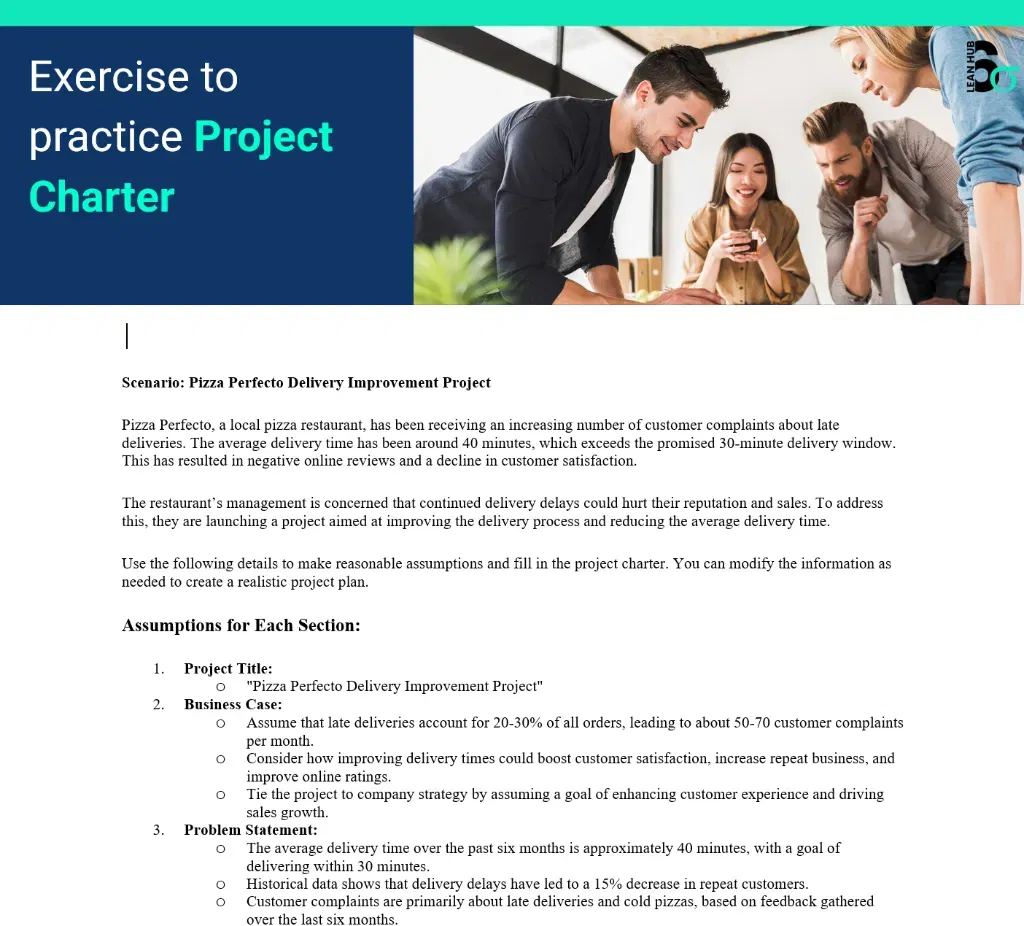
Ready to Start Your Project?
Writing the problem statement is just the beginning. To really move the needle, you need the tools to measure the data and find the root cause. If you're serious about becoming a problem-solving pro, we’ve got your back.
- For Beginners: Start with our White Belt Training to get the basics down.
- For Project Leaders: Our Green Belt Certification (don't mind the URL, we have Green Belt options too!) gives you the full DMAIC toolkit.
- For Professionals on the Go: Grab our Six Sigma Flash Cards to master the terminology while you commute.
At Lean 6 Sigma Hub, we believe that anyone can be a world-class problem solver with the right framework. Start with a clear problem statement today, and you’re already halfway to a successful project.
Don’t let a blurry problem waste your time. Define it, measure it, and fix it for good!