
In the realm of operational excellence, the Lean Six Sigma Black Belt is more than just a title; it is a mandate for organizational transformation. To fully appreciate the weight of this role, one must understand that a Black Belt is the primary engine behind complex process improvement and the mentor responsible for building enterprise capability. However, as more professionals transition to lean six sigma black belt online training, a series of common pitfalls have emerged that can derail even the most ambitious career trajectory.
At Lean 6 Sigma Hub, we see it daily: brilliant professionals who treat their certification as a high-stakes memory test rather than a leadership evolution. If you are pursuing your six sigma certification to simply "check a box," you are already falling behind.
Here are the seven most critical mistakes you are likely making with your Black Belt training: and how to fix them before they cost you your credibility.
1. Treating Certification as a "Theory-Only" Exercise
The fundamental purpose of a Black Belt is to deliver tangible, bottom-line results. One of the most pervasive mistakes in online training is a lack of real-world application. Many learners consume modules like a Netflix series, ignoring the fact that Lean Six Sigma is a contact sport.
In the real world, the equation Y = f(x) isn't just a math problem; it is the key to controlling critical inputs (x) to influence the process outcome (Y). If your training doesn't force you into simulations or require an end-to-end DMAIC project with "dummy data" and worked examples, you aren't learning; you’re just memorizing. At Lean 6 Sigma Hub, we emphasize practical application through real-world simulations so you can fail safely in a digital environment before you take the reins of a multi-million dollar corporate project.
2. Ignoring the Mentorship Mandate
A Lean Six Sigma Black Belt is not a lone wolf. A core component of the role is the leadership of people and the mentoring of Green Belts and Yellow Belts.
If you aren't learning how to guide a Yellow Belt through their foundational journey or how to help a Green Belt master data-driven decision-making, you are missing 50% of your value. Black Belts must understand how to navigate the social dynamics of a project, from securing Approval at formal checkpoints to managing the "people side" of change.
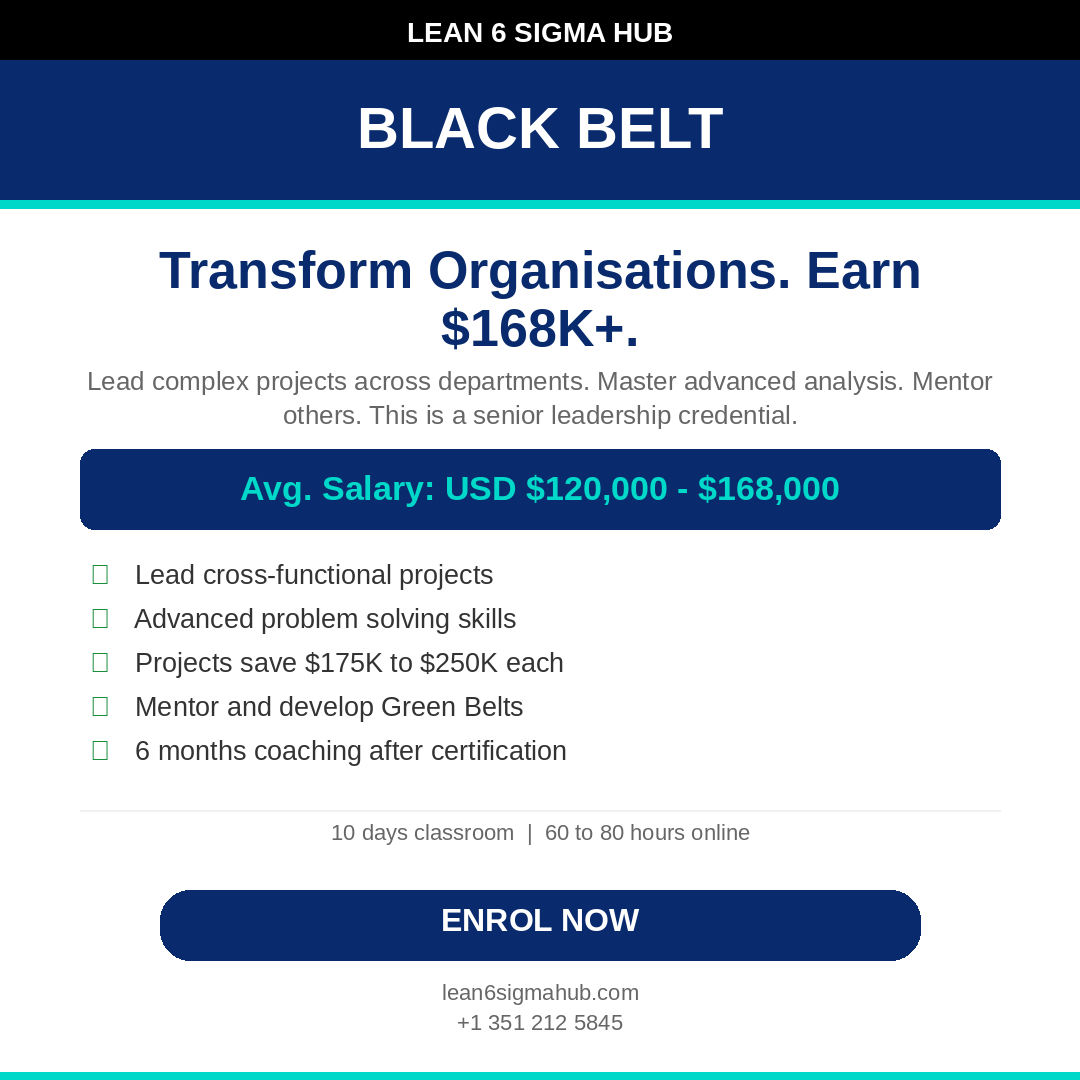
3. Weak Alignment with the "Voice of the Business"
Why are you doing this project? If your answer is "to get certified," you've already failed. High-caliber Black Belt projects must be grounded in a rock-solid Business Case.
Many online learners fail to reconcile the Voice of the Customer (VOC): which defines measurable CTQ (Critical to Quality) requirements: with the Voice of the Business (VOB). Without this balance, you might optimize a process that the business doesn't actually value. A Black Belt must ensure that every project lifts Throughput and improves the Yield (specifically tracking First Pass Yield and Rolled Throughput Yield) to ensure defect-free output that aligns with organizational priorities.
4. Overcomplicating the Analyze Phase
There is a common misconception that more complex statistics equal a "better" Black Belt. In the Analyze Phase (DMAIC), your goal is to identify root causes, not to show off your knowledge of ANOVA or Bartlett’s Test.
While it is essential to know how Bartlett’s Test assesses equal variances before an ANOVA, or how a Box Plot reveals the five-number summary of spread and outliers, these are tools to reach an end: not the end itself. If your analysis doesn't lead to a clear reduction in Variation or a better understanding of the Voice of the Process, it is Waste (Muda). Remember, the most sophisticated statistical model is useless if it doesn't solve a Bottleneck or improve the Average (Mean) performance in a way that the customer notices.

5. Neglecting the Value Stream Mapping Process
Many online courses teach tools in isolation, but a Black Belt must see the "big picture." If you are optimizing a single step without performing Value Stream Mapping (VSM), you are likely just moving the Bottleneck from one department to another.
A comprehensive Value Stream encompasses all steps from start to finish: including material and information flow. Without a current and future state map, you cannot identify where Work in Process (WIP) is accumulating or where Waiting (one of the eight DOWNTIME wastes) is eroding your lead time.
To truly master this, you should be using a Time Observation Sheet to record actual step times and separate value-added work from the non-value-added fluff. This is where the Theory of Constraints (TOC) comes into play; systematically improving the limiting factor is the only way to lift overall capacity. If you aren't looking at the flow, you aren't doing Lean.
6. Losing Your "Takt Time" of Learning
The beauty of lean six sigma black belt online training is its flexibility. However, 100% self-paced learning is a double-edged sword. Many candidates lose their rhythm: or what we call Takt Time in a production setting.
In Lean, Takt Time is the pace at which you must produce to meet customer demand. In your training, your "customer" is your career. If you don't set a consistent schedule, you lose momentum, and the technical details of X-bar Charts or calculating a Z-Score to benchmark global process performance will begin to blur.
Successful candidates treat their training like an Agile project: iterative, disciplined, and focused on constant progress. They use tools like an Affinity Diagram to organize their thoughts and study materials, ensuring they don't get overwhelmed by the vast syllabus.
7. Choosing Non-Accredited or "Black Box" Training
The final and perhaps most damaging mistake is choosing a provider based solely on price or speed. A six sigma certification is only as valuable as the body that stands behind it.
If your training isn't accredited by a recognized organization like the Council for Six Sigma Certification (CSSC), you are gambling with your professional future. Furthermore, if the training doesn't teach you the philosophy of Zero Defects (the idea of doing it right the first time) or advanced concepts like Autonomation (Jidoka): where intelligent automation detects issues in real-time: you are getting a watered-down education.
At Lean 6 Sigma Hub, our courses are CSSC-accredited and designed to move you from a foundational White Belt awareness all the way to a Master Black Belt capability. We don't just teach you the tools; we teach you how to lead.

The Path to Mastery
To be a successful Black Belt, you must bridge the gap between data and people. You must understand how Variation guides your corrective actions and how an X-bar Chart monitors process averages to detect shifts before they become defects. You must be the one who can explain a Break-Even Analysis to an executive while simultaneously coaching a team on how to use an Andon signal on the shop floor.
Stop making these mistakes and start leading with confidence. The transition from a practitioner to a leader starts with the right training environment: one that prioritizes practical application, mentorship, and global standards.
Don’t settle for a mediocre career. Enrol in our CSSC-Accredited Lean Six Sigma Black Belt Online Training today and master the tools that drive organizational change.