
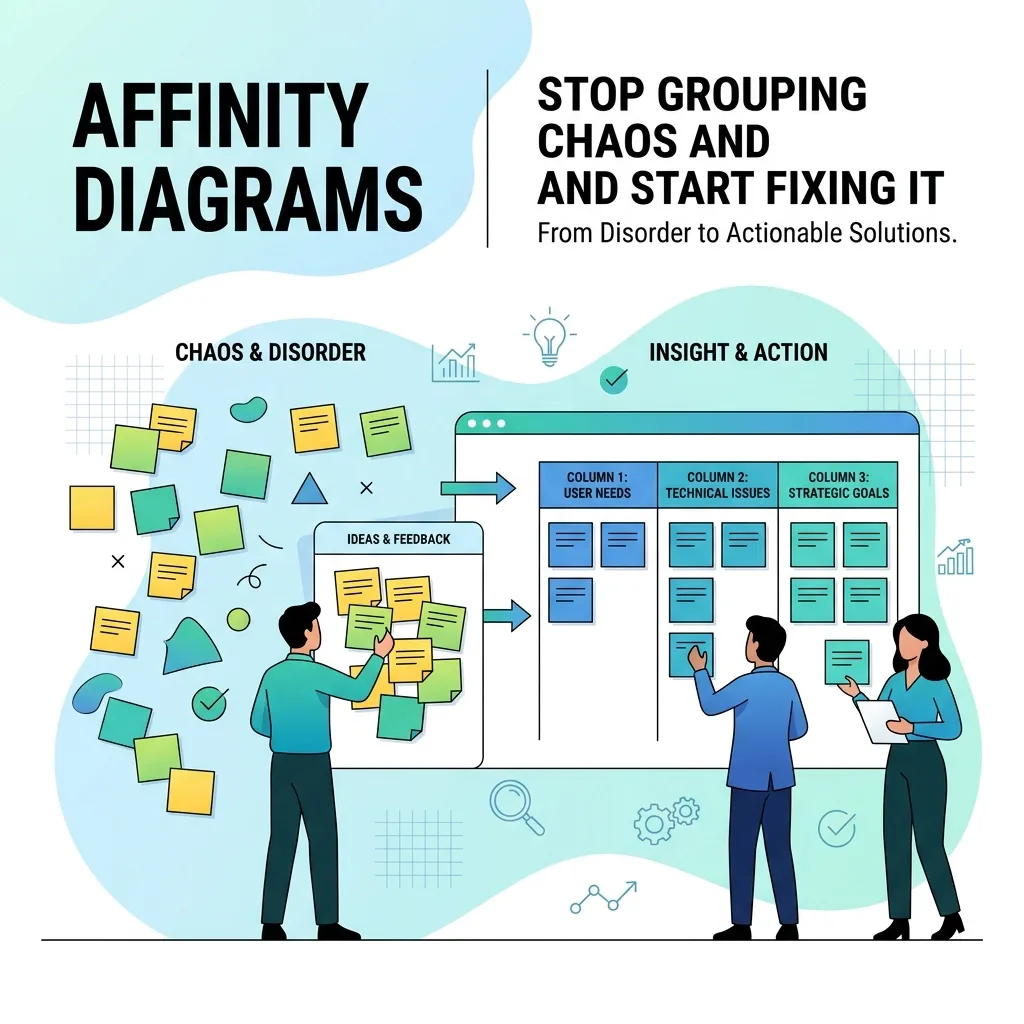
Let’s be brutally honest: most corporate brainstorming sessions are an absolute dumpster fire. You gather a dozen people in a room, provide "creative" snacks, hand out colorful sticky notes, and ask everyone to "think outside the box." What do you get? You get 150 disorganized ideas, three hours of wasted salary, and a wall that looks like a preschool art project.
If you think that simply sticking paper to a wall constitutes process improvement, you’re not just wrong: you’re a liability to your organization’s efficiency.
In the world of Lean Six Sigma, we don’t play games with "vibes" or "gut feelings." We use the Affinity Diagram, also known as the K-J Method (developed by Kawakita Jiro), to ruthlessly categorize chaos and extract actionable intelligence. This isn't about making a pretty chart; it is a fundamental tool used in the Analyze phase of the DMAIC methodology to bridge the gap between raw, unorganized data and structured, data-driven decision-making.
The Brutal Reality of "Organized Chaos"
The fundamental purpose of an Affinity Diagram is to organize a large number of ideas, opinions, or facts into natural groupings. In any complex project, especially those involving the Voice of the Customer (VOC), you are bombarded with qualitative data. Survey results, employee complaints, and stakeholder feedback don't arrive in neat spreadsheets. They arrive as a chaotic mess.
The mistake most "amateur" facilitators make is allowing the loudest person in the room to dictate the categories. This leads to biased groupings that confirm existing prejudices rather than uncovering new truths. To truly fix the chaos, you must follow a disciplined, technical approach that removes individual ego from the equation.

The K-J Method: Discipline Over Drama
To fully appreciate the power of the Affinity Diagram, you must understand that it is a convergent thinking tool. While brainstorming is divergent (expanding the field of ideas), the Affinity Diagram is about narrowing down. It is designed to find the "latent" structure in your data: the patterns you were too close to the problem to see initially.
In the realm of Lean Six Sigma Hub, we teach that this process must be silent. Why? Because the moment someone starts talking, they start selling. They sell their ideas, they defend their department, and they drown out the subtle patterns that the data is trying to show you.
The Technical Protocol for Affinity Mapping
If you want to move from "grouping" to "fixing," you must adhere to these strict rules:
- Generate the Data Points: Each idea, observation, or piece of feedback is written on a separate card or sticky note. This is the "atomic" level of your data.
- The Silent Sort: This is where most teams fail. The team must move the cards into groups without speaking. If you see a card that belongs in another group, move it. If someone moves it back, create a duplicate or have a brief discussion only after the initial sorting is complete. This forces the brain to look for logical relationships rather than social ones.
- Define the Header Cards: Once the clusters have emerged, create a header card for each. A header card must be a concise, descriptive phrase that captures the essence of the group. Avoid one-word headers like "Technology" or "People." Use descriptive phrases like "Legacy Software Integration Failures" or "Internal Communication Latency."
- Create the Final Map: Draw lines to show the relationships between the clusters. This is no longer a list of ideas; it is a process map of the current state of your problem.
Why Your Affinity Diagrams Suck (and How to Fix Them)
Most practitioners fail because they use the Affinity Diagram as a storage unit for junk ideas. They think that because an idea is on the wall, it has value. It doesn’t.
In a high-performing Lean Six Sigma environment, the Affinity Diagram is a filter. If a cluster of ideas doesn't relate back to your Project Selection Scoring or your primary metrics, it is noise.
Stop including "Noise Factors" in your primary solution paths. In the how-to-identify-and-control-noise-factors framework, we learn that some variables are beyond our control. Your Affinity Diagram should help you separate the controllable "signals" from the uncontrollable "noise." If you have a cluster of 20 sticky notes about "The Economy," great: put them in the bin. You can't fix the economy; fix your internal cycle times instead.
Integrating the Voice of the Customer
One of the most potent applications of the Affinity Diagram is synthesizing the Voice of the Customer (VOC). When customers complain, they don't give you a Pareto chart. They give you a rambling narrative of frustration.
By applying the K-J Method to VOC data, you can transform 500 disparate customer comments into five or six Critical to Quality (CTQ) requirements. This is the foundation of any successful LSS Black Belt sample project.
Without an Affinity Diagram, you are just guessing at what the customer wants. With it, you are performing a surgical extraction of their true needs. You move from "The customers are unhappy" to "45% of customer dissatisfaction stems from the 48-hour delay in order confirmation emails." That is a fixable problem.
The Transition: From Grouping to Solving
The "Affinity" phase is only successful if it leads directly to the next phase of the DMAIC cycle. Once you have your clusters, you must prioritize them. This isn't a popularity contest; it is a strategic decision.
Utilize tools like the Interrelationship Digraph to see which clusters are "drivers" and which are "outcomes." If "Lack of Training" is driving "High Error Rates," "Poor Safety Documentation," and "Low Employee Morale," then training is your primary lever. You don't fix the morale; you fix the training, and the morale follows.
This is the level of sophisticated analysis required to earn a Lean Six Sigma certification. It requires a shift in mindset from "What can we do?" to "What must we do to move the needle?"
The Professional Standard
If you are leading a team and you aren't using these structured tools, you are essentially driving a bus blindfolded. You might get to the destination eventually, but the casualty rate will be high.
Professional problem-solving is not an innate talent; it is a developed skill set. It requires an understanding of how to manage cognitive bias, how to categorize complex data sets, and how to drive consensus without compromising on the integrity of the data.
To truly master these tools, you cannot rely on blog posts alone. You need to immerse yourself in a curriculum that challenges your assumptions and provides you with the technical rigor to lead multi-million dollar improvement projects. Whether you are starting with a Yellow Belt to understand the basics or aiming for the Black Belt to lead organizational transformation, the path is clear.
Your Action Plan for Chaos Elimination
- Stop Talking: Conduct your next brainstorming and categorization session in total silence. Watch how the "power dynamics" in the room shift when the loudest person can't speak.
- Be Brutal with Headers: If a header doesn't imply an action or a specific problem, rewrite it. "Staffing" is a category; "Insufficient Night Shift Staffing During Peak Season" is a problem statement.
- Link to Metrics: Every cluster on your Affinity Diagram must be tied back to a KPI. If it doesn't impact the bottom line, the customer, or the process efficiency, discard it.
- Get Certified: Stop playing at process improvement. If you want to be respected as a leader in operational excellence, you need the credentials to back it up.

The difference between a "manager" and a "Lean Six Sigma Professional" is the ability to walk into a room full of chaos and walk out with a roadmap. The Affinity Diagram is one of your primary tools for that transformation. Don't just group the chaos. Fix it.
Stop wasting your career on "maybe" and start delivering "definitely." Enrol in our Lean Six Sigma Green Belt or Black Belt certification program today and master the tools that separate the experts from the amateurs.