
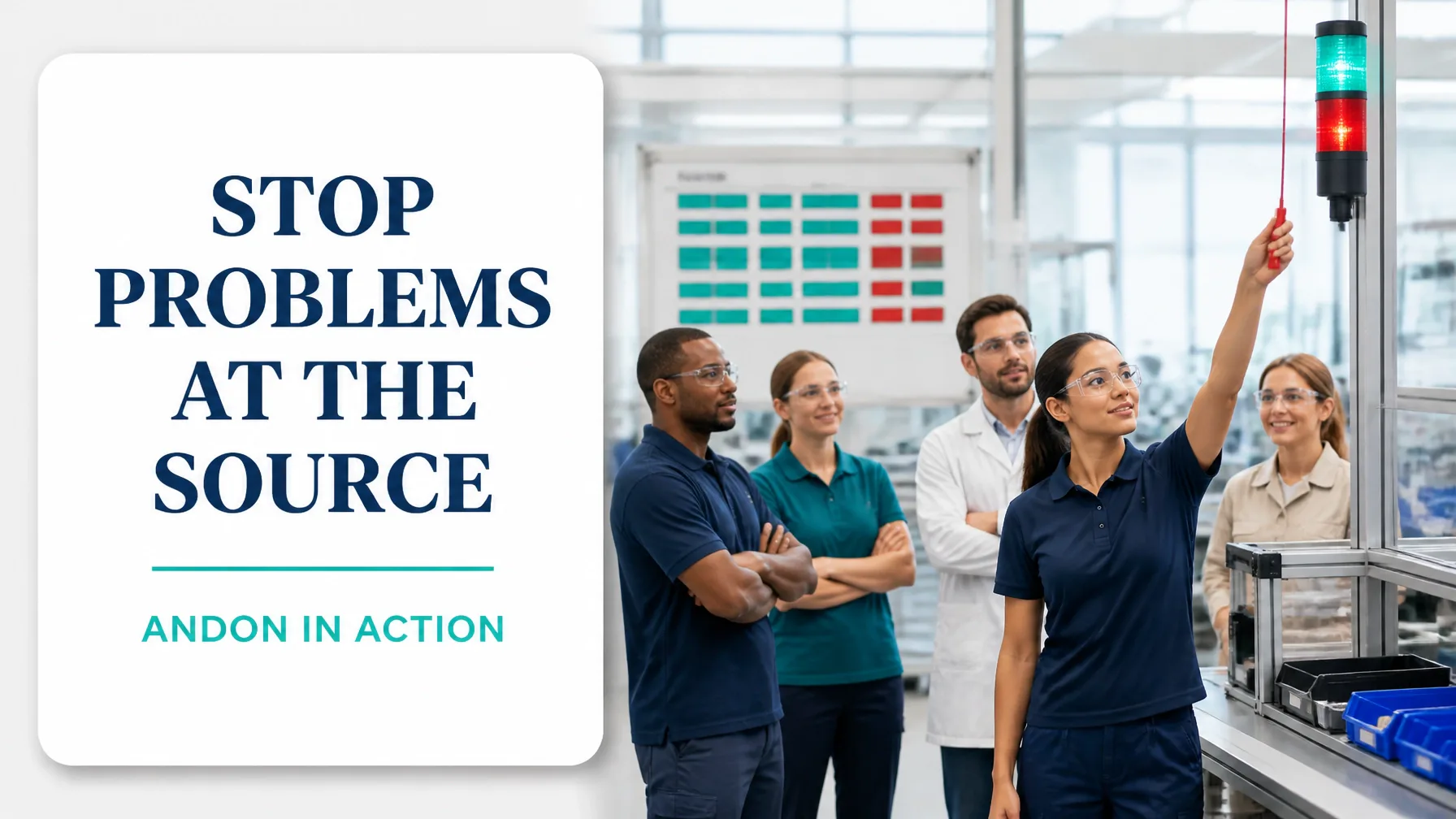
A production problem rarely becomes expensive at the moment it begins. It becomes expensive when the process continues, the defect travels downstream, and nobody has a clear signal that action is required.
That is the purpose of Andon.
In the realm of Lean manufacturing, Andon is a visual signalling system that makes abnormalities visible in real time. An operator may pull a cord, press a button, or trigger an electronic alert. Lights, sounds, digital displays, or Andon boards then show where the issue occurred and what support is needed.
The fundamental purpose is simple: see the problem, respond quickly, contain the impact, and learn from the cause.
Andon is not merely a warning light. Properly designed, it gives front-line employees the authority to protect quality and improve the process before a small issue becomes a major financial event.
What Is an Andon System?
An Andon system is a form of visual management used to communicate the status of a process at a glance. Typical signals include:
- Green: The process is operating normally.
- Yellow: Assistance or attention is required.
- Red: The process has stopped because of a serious abnormality.
- Flashing or audible alerts: Immediate response is required.
- Digital displays: The location, problem type, response time, and escalation status are visible.
The signal can be manual or automatic. In a traditional arrangement, an operator pulls an Andon cord when they identify a quality issue, equipment abnormality, missing material, safety concern, or inability to complete the standard work. In a modern system, sensors, machine controls, barcode scanners, or software may generate the alert automatically.
The technology can vary, but the management principle remains consistent: abnormal conditions must be visible immediately.
Toyota describes Andon as part of its production system, where operators can stop work when an abnormality occurs and draw attention to the issue through an Andon display. The Toyota Production System overview provides useful context on the relationship between built-in quality, standardised work, and continuous improvement.

How the Andon Cord and Call System Works
A practical Andon response should be fast, structured, and respectful of the operator who raises the alert. A common sequence is:
-
The operator detects an abnormality.
This may involve a dimensional measurement outside specification, a missing component, an equipment fault, an unsafe condition, or a process step that cannot be completed correctly. -
The operator activates the signal.
They pull the cord, press a button, or select a problem category on a digital interface. -
The local signal becomes visible.
A light, sound, display, or Andon board identifies the workstation and the type of assistance required. -
The team leader responds within a defined time.
The response standard might be 30 seconds for acknowledgement and two minutes for initial containment. -
The issue is contained and classified.
The team determines whether to correct the problem at the station, stop the affected process, quarantine material, or escalate to maintenance, quality, engineering, or production control. -
The cause is recorded for follow-up.
A short-term correction restores flow. A structured problem-solving process prevents recurrence.
The system should distinguish between calling for help and stopping the entire line. Some organisations allow the operator to signal first while the line continues briefly until a fixed point. Others stop the process immediately. The correct design depends on risk, takt time, process interdependence, and the potential severity of the defect.
However, the essential requirement is non-negotiable: the person closest to the work must have a defined and supported way to raise the issue.
Andon, Jidoka, and Autonomation
Andon is closely connected to Jidoka, often translated as “automation with a human touch” or “built-in quality.” Jidoka means that a process should detect an abnormal condition and stop, preventing defective work from moving forward.
This can happen through:
- An operator identifying a problem and stopping the process.
- A machine detecting an out-of-range condition and stopping automatically.
- A sensor identifying a missing part or incorrect sequence.
- A control system escalating the problem through a visual and audible alert.
This is also known as autonomation. It does not mean replacing human judgement with automation. Instead, intelligent automation detects abnormalities and supports immediate intervention.

An Andon cord therefore acts as the operator-facing mechanism of Jidoka. It turns the principle of built-in quality into a practical behaviour:
If the standard cannot be followed, stop and make the abnormality visible.
The result is a shift from end-of-line inspection to quality at the source. Rather than allowing 500 units to pass through before a defect pattern is discovered, the team can investigate the first abnormal unit and protect the remaining production.
Worked Example: The Cost of a 30-Second Decision
Consider a hypothetical assembly line producing electronic control modules.
The line operates:
- 2 shifts per day
- 480 minutes per shift
- 20 working days per month
- 600 units per shift
- 1,200 units per day
- Average finished-unit value: $420
- Cost to rework a defect found internally: $35
- Cost of an escaped defect, including field service and customer recovery: $1,850
Before Andon implementation, operators often continued production when a connector insertion felt inconsistent. A supervisor might discover the issue during an hourly audit.
The baseline data showed:
- 4,800 units produced per month
- 3.2% connector-related defect rate
- 154 defective units per month
- 22% of those defects escaped internal inspection
- 34 escaped defects per month
- Estimated monthly external failure cost:
34 × $1,850 = $62,900
The improvement team introduced an Andon call system with a 30-second response standard. Operators could signal immediately when insertion force, alignment, or component fit appeared abnormal.
After six weeks, the hypothetical results were:
- Defect catch rate at the workstation increased from 61% to 94%
- Internal defect rate fell from 3.2% to 1.4%
- Escaped defects fell from 34 to 5 per month
- Average response time was 24 seconds
- Average line stoppage per alert was 3.5 minutes
- 68 alerts were raised during the month
The additional downtime was:
68 × 3.5 minutes = 238 minutes per month
At an estimated contribution loss of $18 per production minute, the downtime trade-off was:
238 × $18 = $4,284
The reduction in escaped defects was:
29 × $1,850 = $53,650 avoided cost
Even after allowing for the additional downtime, the estimated monthly benefit was:
$53,650 − $4,284 = $49,366
The most important result was not simply the financial saving. The process began identifying the abnormality at the workstation, where the cause was still visible and the response options were greatest.

How Andon Supports TPM
Total Productive Maintenance (TPM) seeks to improve equipment reliability, availability, performance, and quality through shared ownership. Andon supports TPM by making equipment abnormalities visible before they become major breakdowns.
An Andon signal may identify:
- Repeated minor stoppages.
- Unusual vibration or noise.
- Tool wear.
- Temperature drift.
- Pressure variation.
- Sensor faults.
- Lubrication requirements.
- Frequent resets or adjustments.
- Maintenance response delays.
These events can be analysed using downtime logs, Pareto charts, trend analysis, and root-cause investigation. In this way, Andon data becomes an input to planned maintenance and focused improvement rather than a collection of isolated interruptions.
A useful TPM routine is to review Andon events by:
- Frequency: Which machines generate the most alerts?
- Duration: Which problems create the greatest downtime?
- Recurrence: Which abnormalities return after correction?
- Response: How quickly does the support team acknowledge and contain the issue?
- Cause category: Are events related to equipment, materials, methods, people, or measurement?
This moves the organisation from reactive firefighting to a more disciplined reliability system.
Five Rules for a High-Performance Andon Culture
An Andon system will not deliver its potential if employees fear criticism for using it. Establish these operating rules:
- Make the signal easy to activate. It should be accessible from the normal working position.
- Define response expectations. For example, acknowledge within 30 seconds and arrive within two minutes.
- Separate the person from the problem. The operator is reporting useful process information.
- Record every meaningful event. Repeated small signals often reveal the largest improvement opportunities.
- Close the loop. Explain what was found, what changed, and how recurrence will be prevented.
The measure of Andon maturity is not a falling number of alerts. A mature system may initially produce more alerts because employees have confidence in the process. Over time, the organisation should see fewer repeat abnormalities, shorter response times, stronger first-pass yield, and improved equipment stability.
Building Andon Capability Through Lean Six Sigma Training
Understanding Andon is valuable, but implementing it effectively requires broader capability. Teams must know how to define abnormal conditions, establish operational definitions, analyse response data, identify root causes, and sustain improvements through control plans and standard work.
That is where structured Lean Six Sigma training becomes practical. A Yellow Belt can support local problem-solving activities and help document recurring signals. A Green Belt can analyse trends, quantify the cost of defects and downtime, and lead improvement projects. Black Belts can connect Andon data to advanced statistical analysis, reliability strategy, and organisational change.
Lean 6 Sigma Hub’s Yellow Belt online training is designed for professionals who support larger projects or lead smaller improvements. The Green Belt online training develops the capability to lead more complex, data-driven initiatives.
For project governance, an RDMAICS project storyboard toolkit can help teams document the business case, baseline, root causes, countermeasures, control plan, and sustained results.
Final Takeaway
Andon is a simple idea with strategic consequences. A visible signal, a defined response, and genuine operator authority can prevent defects from travelling downstream, protect customers, and reveal the equipment and process conditions that require improvement.
The strongest systems do not treat line stoppage as lost productivity. They recognise that a short, controlled stop can protect hours of rework, customer disruption, and financial exposure.
Build the capability to use Andon, Jidoka, and TPM as part of a structured Lean Six Sigma improvement system. Enrol in CSSC-accredited Lean Six Sigma training and start applying these principles with confidence.
Kaizen. Kai-Care. Kai-Done. ( Lean Six Sigma)