
Look, your process is constantly talking to you. The real question is: are you actually listening, or are you just reacting to every little hiccup like a nervous intern on their first day?
In the world of Lean Six Sigma, there is a massive difference between a process that is "behaving" and one that has gone completely off the rails. Most managers see a dip in a performance metric and immediately start demanding answers, launching "emergency" meetings, and tweaking settings. This is what we call "tampering," and it usually makes things worse.
If you want to manage like a pro: specifically, a Six Sigma pro: you need to understand Statistical Process Control (SPC). Specifically, you need to know how to use Control Charts to distinguish between "normal" variation and a process that is fundamentally unstable.
The Chaos of Management by "Feel"
Most business leaders manage by the "gut." They look at a monthly report, see that defects are up 2%, and lose their minds. But here is a reality check: every process varies. No process produces the exact same result every single time. If you flip a coin ten times, you don't always get five heads and five tails. That variation is natural.
To fully appreciate the power of Control Charts, you must first stop treating every data point as a crisis. You need to distinguish between the "noise" (common cause variation) and the "signal" (special cause variation).
In the realm of professional process improvement, if you can’t tell the difference, you aren't improving the process: you’re just reacting to it.

Common Cause vs. Special Cause: The Heart of the Matter
The fundamental purpose of a Control Chart is to categorize variation. According to the Lean Six Sigma concepts and glossary, we divide variation into two distinct buckets:
1. Common Cause Variation (The "Normal" Stuff)
Common cause variation is the noise inherent in any system. It’s the result of the way the process was designed. Think of your morning commute. If it takes you 20 minutes one day and 22 minutes the next because of a few extra red lights, that is common cause variation. It is predictable, stable, and expected.
- The Rule: You do not "fix" common cause variation by yelling at people. You fix it by redesigning the process itself.
2. Special Cause Variation (The "Unstable" Stuff)
Special cause variation is the "signal." It’s something unusual, unexpected, and outside the system's design. If your 20-minute commute suddenly takes 90 minutes because a truck flipped over on the highway, that is a special cause. It is not part of the "normal" process.
- The Rule: You must investigate the root cause immediately and eliminate it.
The Anatomy of a Control Chart
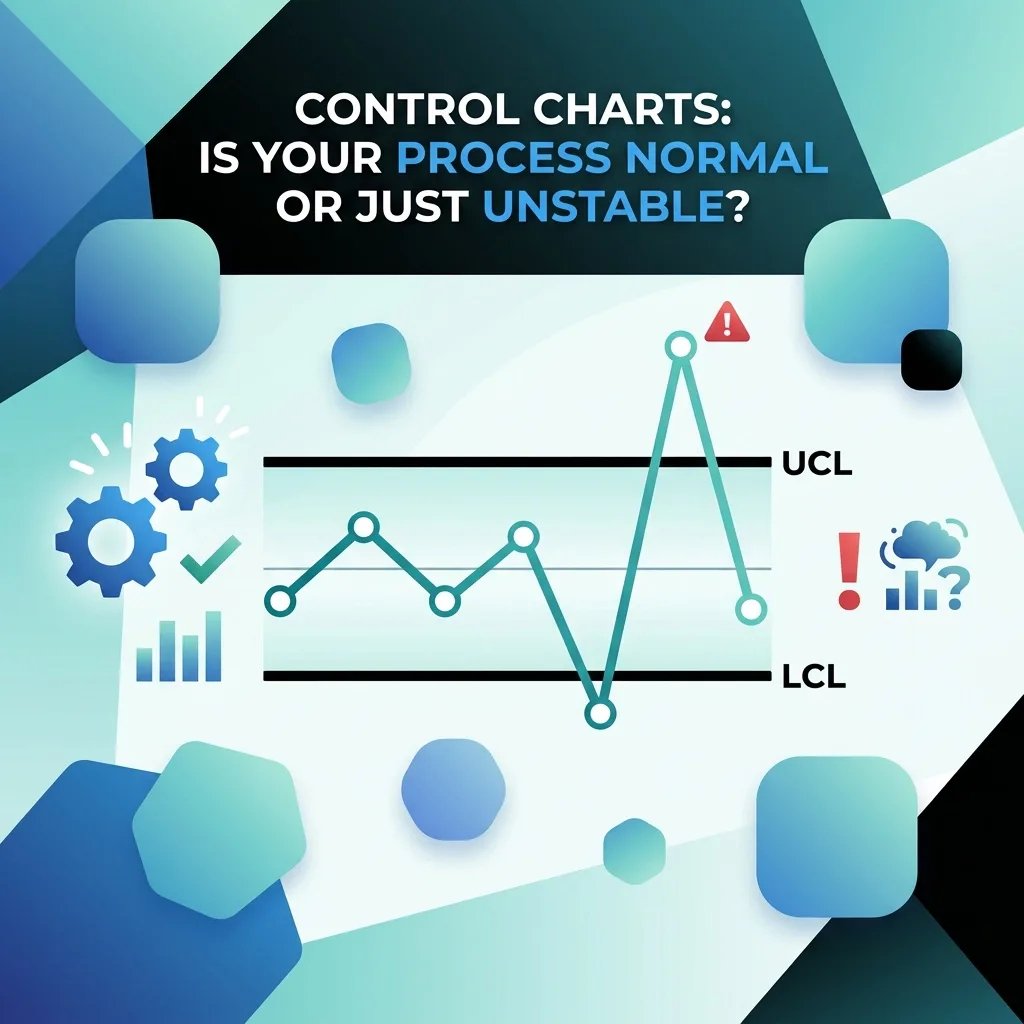
A Control Chart isn't just a line graph with an attitude. It is a statistical tool that calculates the voice of the process. It consists of three primary lines:
- The Centerline: This is the mathematical average (mean) of your data over time.
- Upper Control Limit (UCL): Typically set at +3 standard deviations (Sigma) from the mean.
- Lower Control Limit (LCL): Typically set at -3 standard deviations from the mean.
These limits are not "targets" or "goals." They are calculated based on the actual performance of the process. They tell you what the process is capable of doing right now. If your data points stay within these limits and look random, your process is "stable" or "in control."

Is Your Process Normal or Just Unstable?
This is where people get confused. "Normal" in statistics often refers to a Normal Distribution (the Bell Curve). To determine if your data follows this distribution, you might use tools like the Shapiro-Wilk test.
However, a process can be "Normal" but still "Unstable." Conversely, a process can be "Non-Normal" but perfectly "Stable."
Stability is about predictability. An unstable process is a wild animal. You have no idea what it will do tomorrow. If you are trying to implement quick wins vs. long-term solutions, you must stabilize the process first. You cannot improve something that isn't predictable.
The 8 Red Flags of an Unstable Process
How do you know if your process is screaming for help? We use specific rules (often called the Nelson Rules or Western Electric Rules) to spot instability. If your Control Chart shows any of these, your process is unstable:
- The Outlier: A single point falls outside the Upper or Lower Control Limits. (This is the most obvious sign of a special cause).
- The Shift: 8 or more consecutive points fall on one side of the centerline. This indicates the "mean" has shifted.
- The Trend: 6 or more points in a row are steadily increasing or decreasing. Something is drifting.
- The Sawtooth: 14 points in a row alternating up and down. This often signals over-adjustment or two different operators fighting for control.
- The Zone Violation: 2 out of 3 points in a row fall in "Zone A" (the outer third of the limits).
- The Cluster: 4 out of 5 points in a row fall in "Zone B" or beyond.
- The Hugger: 15 points in a row fall within "Zone C" (the area closest to the centerline). While this looks "good," it actually suggests your control limits might be calculated incorrectly or your data is being manipulated.
- The Cycle: 8 points in a row on both sides of the centerline with none in Zone C. This usually means you have two different processes mixed together.
If you see these patterns, stop what you are doing. You need to perform a root cause analysis and document your process changes properly once you find the fix.

Stability vs. Capability: Don't Get it Twisted
One of the biggest amateur mistakes is confusing stability with capability.
- Stability: Is the process predictable? (Are there any special causes?)
- Capability: Does the process meet the customer's requirements?
A process can be perfectly stable: meaning it produces the same result every day: but still be totally incapable of meeting customer specs. For example, if your customer needs a part that is 10cm wide, and your process consistently (stably) produces parts that are 12cm wide, your process is stable but incapable.
You must achieve stability before you can measure capability. If you try to calculate capability on an unstable process, the numbers are meaningless. It’s like trying to measure the top speed of a car while the engine is exploding.
The Cost of Tampering
When a process is stable (showing only common cause variation) and you try to "adjust" it based on a single high or low point, you are tampering.
Dr. W. Edwards Deming, the grandfather of modern quality, famously showed that tampering actually increases variation. By reacting to common cause noise, you inject new special causes into the system. This is why having a solid grasp of SPC is non-negotiable for leadership. If you want to dive deeper into how this works in a real-world scenario, check out our LSS Black Belt sample project.
Professional Implementation of Control Charts
To use Control Charts effectively in your organization, follow this protocol:
- Identify the CTQ: Determine what is Critical to Quality. Don't chart everything; chart what matters.
- Select the Right Chart: Use I-MR charts for individual data points, or X-bar and R charts for subgroup data.
- Collect Baseline Data: You typically need 20 to 25 data points to establish reliable control limits.
- Monitor and Respond: Use the 8 rules of instability to identify when to take action.
- Refine: Once a special cause is removed, recalculate your limits to reflect the new, "clean" process.

Stop Guessing. Start Controlling.
The difference between a "manager" and a "Lean Six Sigma Leader" is the ability to look at a chart and know exactly when to act and when to get out of the way. If you are still relying on "gut feeling" to run your operations, you are leaving money on the table and driving your team crazy with unnecessary fire drills.
Mastering SPC and Control Charts is a core requirement for any serious professional. Whether you are looking to lead a transformation or simply want to stop the cycle of constant "emergency" fixes, the data will show you the way.
Pursue your professional development and become the expert your company needs by enrolling in our Lean Six Sigma Certification programs today.