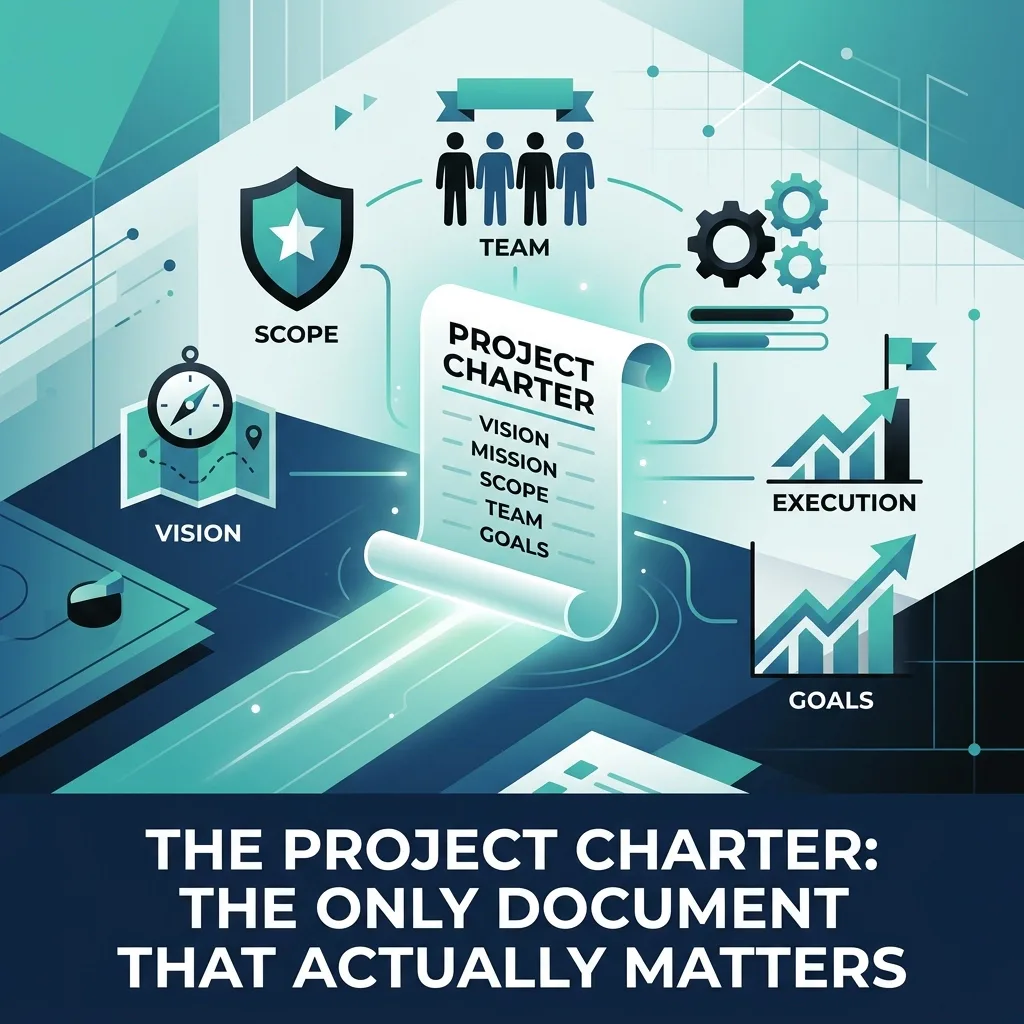
Let’s be brutally honest: most Lean Six Sigma projects are dead before they even start. They don't die because the data is bad or the team is lazy. They die because they lack a soul. In the world of process improvement, that soul is the Project Charter.
If you think a charter is just another piece of administrative red tape to appease some Master Black Belt, you’ve already lost the game. The Project Charter is the single most important document in your entire toolkit. It is your contract, your shield, and your license to operate. Without it, you aren't leading a project; you’re just having a very expensive, very disorganized hobby.
The Foundation: Why Your Project is Probably Already Failing
In the realm of organizational change, ambiguity is the enemy. Most "projects" start as a vague complaint from a manager: "Our shipping times are too slow" or "We’re losing too much money on scrap." Those aren't projects. Those are grievances.
A project only becomes real when it is codified into a charter. The fundamental purpose of this document is to transition from "we have a problem" to "we have a mission." If you cannot articulate exactly what you are doing, why you are doing it, and who is paying for it on a single page, you are destined for scope creep and stakeholder abandonment.
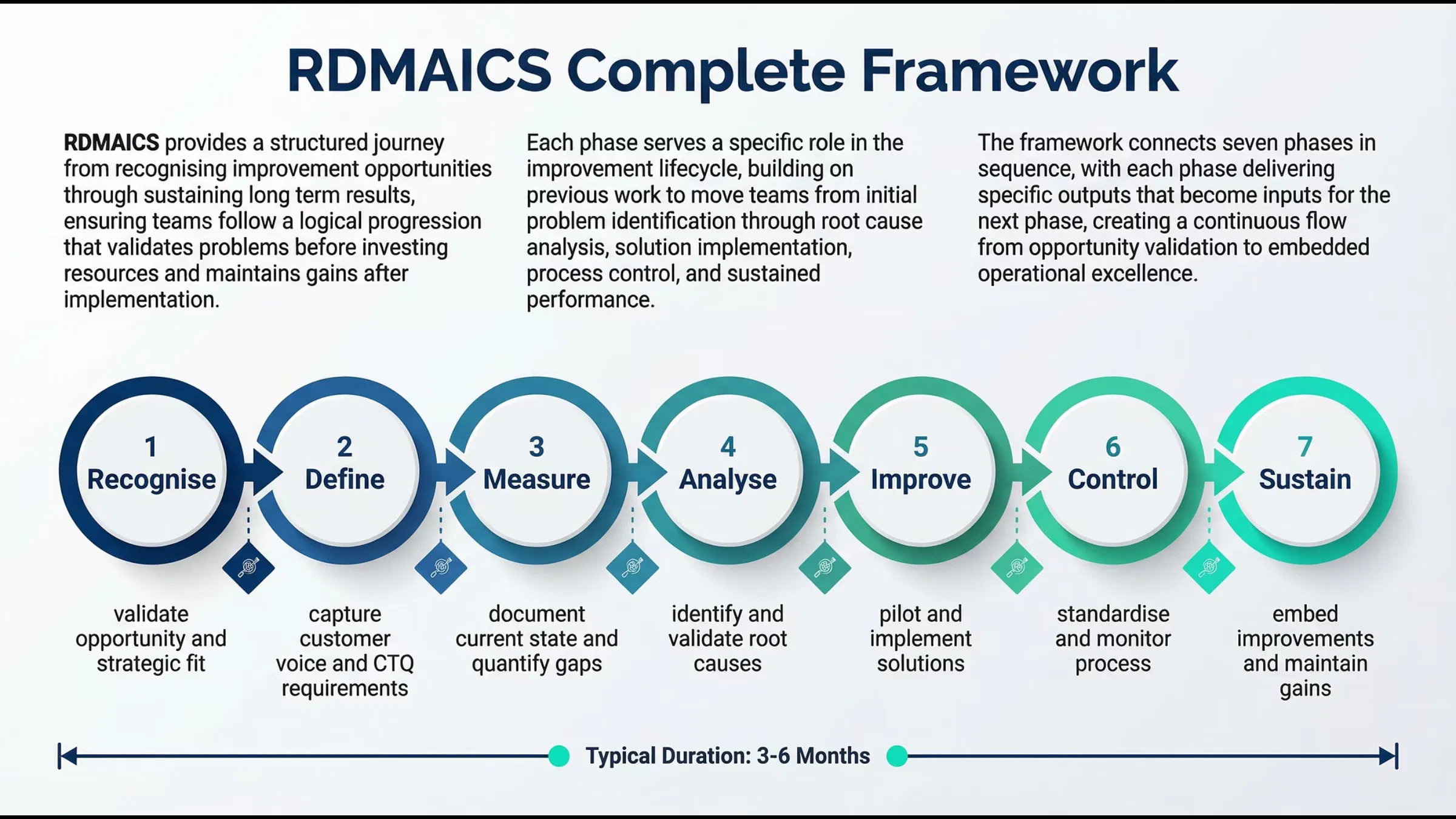
As shown in the RDMAICS framework above, the Define phase is where the heavy lifting happens. The charter is the output of this phase. To fully appreciate its weight, you must understand that every subsequent step, Measure, Analyse, Improve, Control, and Sustain, depends entirely on the boundaries set in the charter.
The Anatomy of a High-Attitude Project Charter
A weak charter is a "choose your own adventure" book where everyone chooses a different ending. A strong charter is a tactical directive. It requires four non-negotiable elements that must be data-heavy and precise.
1. The Problem Statement (The "What’s Wrong?")
Do not give me "quality is low." Give me blood, guts, and numbers. A real problem statement looks like this: "In the last 12 months, the Widget Assembly Line has experienced a 14% defect rate in North American operations, resulting in $450,000 in annual rework costs and a 12-point drop in Customer Satisfaction (CSAT)."
2. The Business Case (The "So What?")
Why should the company care? This isn't where you talk about making people feel better. This is where you talk about the bottom line. Link your project to the strategic goals of the organization. If the company wants to expand into Europe but the current process can't handle 10% more volume, that’s your business case. Use our Project Selection Scoring Calculator to ensure you're even working on the right thing before you ink the charter.
3. The Goal Statement (The "Where are we going?")
This must be a SMART goal. Specifically, it needs to mirror the problem statement. If you're losing 14%, your goal isn't "to do better." It's "to reduce the defect rate from 14% to 4% by December 31st, 2026, saving $300,000."
4. The Scope (The "Not My Problem" Section)
This is where projects either thrive or go to the graveyard. Scoping is the act of drawing a line in the sand and telling stakeholders, "I am fixing this, but I am absolutely NOT fixing that."

Scoping and Buy-In: The Non-Negotiables
If you take nothing else away from this, remember this: Unscoped projects are where careers go to die.
Scope creep is a silent killer. It starts with a stakeholder saying, "While you're looking at the shipping process, could you just take a quick look at the procurement software?" No. The answer is no. If it isn't in the charter, it doesn't exist.
To manage this, you need to use a SIPOC (Supplier, Input, Process, Output, Customer) to define your boundaries clearly. If a process step isn't in your SIPOC, it’s out of scope. Period. For those dealing with complex systems, our SIPOC Complexity Score Calculator can help you determine if your scope is too broad before you commit.
Getting the Suit to Sign Off
Buy-in isn't just a "thumbs up" in a hallway. Buy-in is a physical or digital signature from the Project Champion and the Process Owner. When a leader signs the charter, they aren't just saying "good luck." They are saying "I authorize this project manager to use these resources, access this data, and take up the time of these employees."
Without a signed charter, you have zero authority. When you run into resistance, and in Lean Six Sigma, you will run into resistance, the charter is the document you pull out to remind everyone that the higher-ups have already sanctioned this mission. Use our Stakeholder Impact Assessment Calculator to identify who needs to be on that signature line.

The ROI of a Project Charter: The Numbers Don't Lie
We are in the business of results. In the realm of Lean Six Sigma, we don't guess; we calculate. A well-defined charter allows you to project the Return on Investment (ROI) of your efforts before you spend a single dollar on implementation.
If you cannot show a clear path to savings or revenue generation, your charter will be rejected at the first Tollgate Review. This is why we insist on using a Project Charter ROI Calculator. By inputting your current state metrics and your goal state targets, you can provide the executive team with a hard number. It’s much harder for a manager to say "no" to a project that has a documented potential to save $250,000.
The "Tollgate" Connection: Your License to Move
In the Lean Six Sigma methodology, projects move through "Tollgates." Think of these as checkpoints. You cannot move from the Define phase to the Measure phase without a completed, signed Project Charter.
If you try to skip this, you’ll find yourself in the Analyse phase six months from now, realize you’re measuring the wrong thing, and have to start over. Or worse, you’ll implement a solution that the Process Owner hates because they were never included in the original scoping.
The charter ensures that:
- Strategic Alignment: The project actually matters to the business.
- Resource Allocation: You have the people and time you need.
- Measurable Success: You know exactly when you can stop and claim victory.
Common Pitfalls: Why a Bad Charter is Dangerous
A poorly written charter is worse than no charter at all because it gives a false sense of security. Avoid these "Charter Sins":
- The "World Peace" Scope: Trying to fix everything at once. Keep it narrow.
- Missing Metrics: If there are no numbers in your problem statement, it’s just an opinion.
- Ghost Stakeholders: People who are impacted by the project but weren't consulted.
- Vague Goals: "Improve quality" is not a goal. "Reduce internal rework by 25%" is a goal.
To avoid these, always ground your work in the Company Glossary to ensure everyone is using the same language. If you call it a "cycle time" and the CFO calls it "lead time," you're going to have a bad time at the board meeting.
The Final Word: Don't Be a Clipboard Warrior
The Project Charter is your declaration of intent. It is the only document that actually matters because it sets the trajectory for every single action you take for the next 3 to 6 months. Treat it with the respect it deserves, or watch your project fall apart under the weight of corporate apathy and shifting priorities.
If you are ready to stop playing at process improvement and start delivering high-impact results, you need to master the art of the Define phase. Check out our Lean Six Sigma Hub Online Training to learn how to craft charters that get signed, get funded, and get results.
Your next step is clear: Stop talking about the problem and start chartering the solution. Pursue your professional certification today and become the leader who actually gets things done.