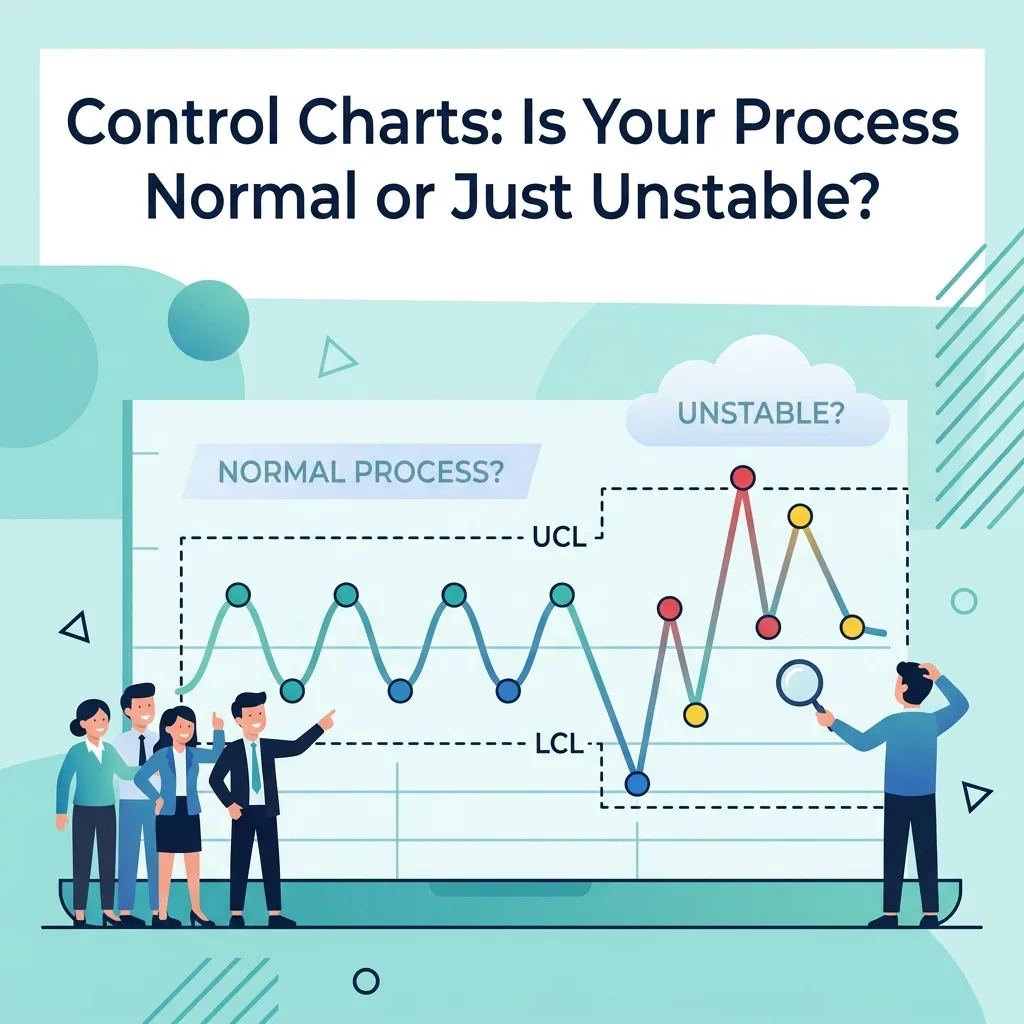
Stop guessing. If you are managing a process based on "vibes" or a morning gut feeling, you aren't managing; you’re just reacting. In the world of Lean Six Sigma, we don’t care about your intuition. We care about the data. Specifically, we care about whether your process is actually doing what it's supposed to do or if it’s currently having a nervous breakdown.
The tool that tells us the truth? The Control Chart.
If you’ve ever looked at a line graph of your production numbers or service times and wondered, "Is that spike a problem, or just a Tuesday?" then you need to understand Statistical Process Control (SPC). Control charts are the ultimate lie detector for your operations. They help you distinguish between the "noise" of everyday life and the "signals" that something is fundamentally broken.
The Voice of the Process: Are You Even Listening?
In the realm of process improvement, we talk a lot about the Voice of the Customer (VOC). We use tools like the Critical to Quality (CTQ) tree calculator to figure out what the customer wants. But the customer doesn't care about your internal struggles.
The Voice of the Process (VOP) is what your process is actually capable of delivering. While the customer sets the specifications (the "shoulds"), the process sets the control limits (the "cans").
A control chart is the megaphone for the VOP. It tells you exactly what your process is doing in real-time. If you don't listen to the Voice of the Process, you’ll end up making promises to customers that your operations simply cannot keep. Worse, you might spend thousands of dollars "fixing" things that aren’t actually broken, or ignoring a slow-motion train wreck because you thought a downward trend was just a fluke.
What a Control Chart Actually Is (No Boring Fluff)
A control chart is a time-ordered plot of your process data. It looks like a standard line graph, but it has three critical lines that change everything:
- The Center Line (CL): This is the average (mean) of your process. It’s your current "normal."
- Upper Control Limit (UCL): Usually calculated as the mean plus three standard deviations (+3σ).
- Lower Control Limit (LCL): Usually the mean minus three standard deviations (-3σ).
Here is the most important part that people screw up: Control limits are NOT specification limits.
Specification limits come from the customer or engineering. Control limits come from the data itself. They describe what the process naturally does. If your control limits are wider than your specification limits, you have a "stable" process that is consistently producing garbage. To fix that, you'd need to look into process mapping in the measure phase to redesign the workflow.

Common Cause vs. Special Cause: The Edge of Sanity
To master control charts, you have to understand the two types of variation. If you don't, you will fall into the trap of "tampering": the act of adjusting a process that should have been left alone.
1. Common Cause Variation (The "Noise")
This is the natural, random variation inherent in any system. Think of your morning commute. Even if you leave at the exact same time, hit the same lights, and drive the same speed, your arrival time will vary by a few minutes. That’s common cause.
- The Rule: If only common causes are present, the process is stable and in statistical control.
- The Action: Don't touch it. If you want to reduce this variation, you have to fundamentally change the process (e.g., take a different route or buy a faster car).
2. Special Cause Variation (The "Signal")
This is the "freak" occurrence. This is the flat tire, the road closure, or the engine fire on your commute. It’s not supposed to be there.
- The Rule: If special causes are present, the process is unstable and out of control.
- The Action: Stop everything. Find the root cause. Eliminate it. This is where you might use a SIPOC complexity score calculator to see where the external influences are creeping in.
Is Your Process Normal or Just Unstable?
A process can be "normal" in a statistical sense: meaning it follows a normal distribution: and still be unstable. Conversely, it could be stable but not normal. This is why we often use the Shapiro-Wilk test to check for normality before we get too deep into the weeds.
However, for a control chart, we are looking for stability.
How to spot instability (The "Oh Sh*t" Signals):
- The Outlier: A single point outside the UCL or LCL. This is the clearest sign of a special cause. Something weird happened.
- The Shift: Eight or more consecutive points on one side of the center line. This means your "average" has moved. Your process has a new normal, and you probably didn't authorize it.
- The Trend: Six or more points steadily increasing or decreasing. Your process is drifting. Maybe a machine is wearing out, or your staff is getting lazier (or more efficient).
- The Cycle: Points that follow a repeating pattern (up-down-up-down). This often points to shift changes or environmental factors like temperature.

Choosing Your Weapon: Which Chart Do You Need?
You can't just slap any data onto a chart and call it a day. You need the right tool for the data type.
For Variable Data (Measurements like weight, time, length):
- I-MR Chart (Individuals & Moving Range): Use this when you are taking one measurement at a time (e.g., the time it takes to process a single invoice).
- X-bar and R Chart: Use this for subgrouped data (e.g., measuring five parts every hour). It tracks both the average and the range within the groups.
For Attribute Data (Counts like defects or "pass/fail"):
- P-Chart: For the proportion of defective items (e.g., the % of late deliveries).
- C-Chart: For the count of defects in a constant sample size (e.g., the number of scratches on every single car door).
Using the wrong chart is a rookie mistake. It can mask instability or create "false alarms," leading you to make bad decisions. If you're unsure where to start, check out our Lean Six Sigma concepts and glossary for a deeper dive into data types.
The Danger of Tampering
One of the biggest sins in management is tampering. This happens when a manager sees a point that is slightly higher than average (but still within control limits) and yells at the team to "fix it."
When you react to common cause variation as if it were a special cause, you actually increase the variation in the system. You are adding noise to a noisy system. Control charts give you the "permission" to stay calm. If the data is between the lines and shows no patterns, leave it alone. Focus your energy on scaling solutions from pilot to full implementation instead.
Practical Steps to Control Chart Mastery
- Collect Data in Time Order: Control charts are useless if the data isn't chronological.
- Establish a Baseline: Collect 20-25 data points to calculate your initial control limits.
- Identify Special Causes: Look for the signals we discussed. If you find them, investigate. Document what happened using effective process documentation.
- Remove the Noise: Once you identify a special cause, eliminate it so it doesn't come back.
- Recalculate: Once the process is stable, recalculate your limits. These are now your "operating parameters."

Why This Matters for Your Career
Understanding SPC and control charts isn't just about making the factory run better. it's about becoming a data-driven leader. People who can interpret the "Voice of the Process" are the ones who get promoted to senior leadership because they don't panic: they analyze.
Whether you are looking at quick wins vs. long-term solutions or trying to justify a budget for new equipment using a project charter ROI calculator, control charts provide the evidence you need.
If you really want to step up, you need to go beyond the basics. Our Black Belt and Master Black Belt programs dive deep into advanced statistical tools, including how to create and use an optimization plot.

Stop Guessing, Start Controlling
A process that is out of control is a liability. It’s a ticking time bomb of waste, customer complaints, and stress. Control charts turn the lights on in a dark room. They tell you when to act and, more importantly, when to sit still.
Are you ready to stop being a "firefighter" and start being a Process Master? The journey starts with understanding the data. Don't let your process run you: run your process.
Get certified and master the tools of the trade. Pursue your professional Lean Six Sigma certification today and start listening to what your process is trying to tell you.