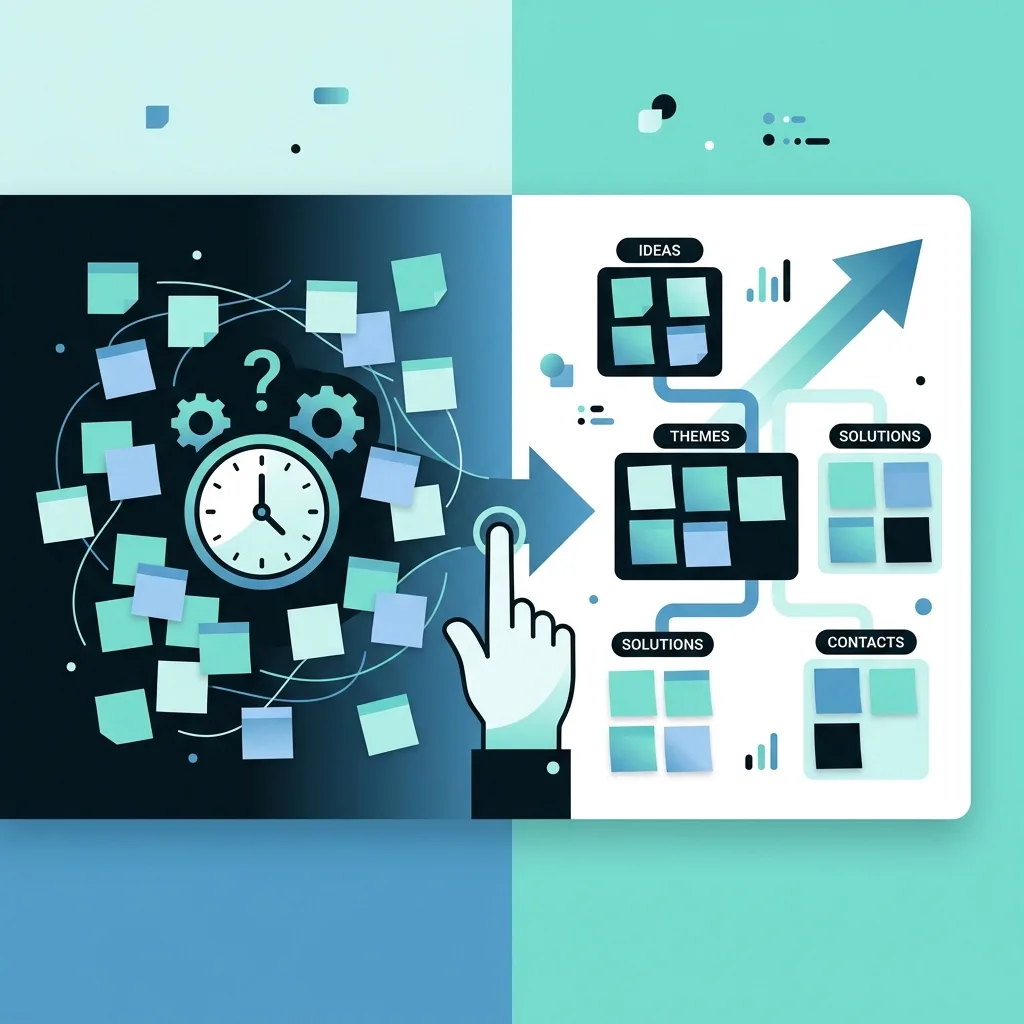
Let’s be honest: most corporate "brainstorming" sessions are just expensive performance theater. You gather a dozen highly-paid professionals in a room, hand out stacks of neon sticky notes, and spend three hours "clustering ideas." By the end of the day, you have a colorful wall that looks like a kindergarten art project and a group of people who are no closer to solving the actual problem than when they walked in.
The Affinity Diagram: originally known as the K-J Method: is a staple of the Lean Six Sigma toolkit. It is designed to organize large amounts of data into logical groupings based on natural relationships. But in the hands of an amateur facilitator or a disengaged team, it becomes a monumental waste of time.
If your last sticky note session resulted in a "parking lot" of ideas that were never looked at again, you didn’t perform an Affinity Diagram. You performed a ritual. Here is why your sessions are failing and how to inject some actual Lean Six Sigma rigor back into the process.
The Illusion of Productivity: Why Your Sessions Fail
The primary reason Affinity Diagrams fail is that they are treated as a creative exercise rather than an analytical one. In a professional environment, creativity without structure is just chaos.
1. The Focus Question Vacuum
Most sessions start with a vague prompt like "How can we improve?" This is useless. Without a specific, data-backed focus question, the sticky notes will range from "get better coffee" to "restructure the entire supply chain." When the input is garbage, the clusters will be garbage.
2. The Groupthink Trap
Humans are social creatures. In a typical session, the loudest person in the room dictates the categories. As soon as one person says, "I think these three go under 'Communication'," everyone else nods their head to avoid conflict or to get out of the room faster. This isn't collaboration; it’s conformity. True insight is buried under the weight of the dominant personality’s ego.
3. Surface-Level Keyword Matching
This is the most common technical error. Teams look for words that look the same rather than concepts that are fundamentally related. If five notes mention "software," they get lumped into a "Software" category. Congratulations, you’ve discovered that you use computers. This provides zero insight into the root cause of process inefficiencies.
4. The "Post-It Fatigue" and Lack of Action
The session ends, everyone takes a photo of the wall, and… nothing happens. The notes lose their stickiness, fall to the floor, and are eventually swept up by janitorial staff. If an Affinity Diagram doesn't lead directly to a Project Selection Scoring Calculator or a clear set of next steps, it was a waste of company resources.
 ]
]
How to Actually Use Affinity Diagrams for Real Insight
If you want to stop wasting time, you need to stop playing with paper and start analyzing data. Here is the high-attitude, high-rigor approach to fixing your Affinity sessions.
Step 1: Define the Focus Question (With Teeth)
Before anyone touches a marker, you must define the problem. Use your Voice of Customer Priority Matrix Calculator to identify the specific pain points. Your focus question should be narrow and aggressive. Instead of "How do we improve?", try "What specific process bottlenecks are preventing us from hitting our 24-hour turnaround goal?"
Step 2: The "Silent" Generation Phase
Silence is the enemy of groupthink. Give everyone 10 minutes to write their ideas in total silence. No talking, no peeking at others' notes. This ensures that the quietest person in the room: who often has the best technical insights: isn't drowned out by the "Visionary" VP who hasn't looked at a process map in five years.
Step 3: Silent Clustering (The Rigorous Way)
Once the notes are on the wall, the team moves them into groups: again, in total silence. If someone moves a note and someone else moves it back, you’ve found a point of contention. That is where the real data lies. Silence forces people to look at the relationship between ideas rather than debating the validity of the person who wrote it.
Step 4: Create "Header" Cards that Mean Something
Avoid one-word labels like "People," "Process," or "Technology." Those are buckets, not insights. A good header card should be a descriptive phrase that summarizes the relationship. Instead of "Training," use "Inconsistent Onboarding Leads to Variable Quality." This transition from noun to insight is where the value is created.

Integrating the Affinity Diagram into the DMAIC Cycle
An Affinity Diagram is not a standalone tool. In the world of Lean Six Sigma, it’s a bridge.
During the Define Phase, it helps clarify the SIPOC Complexity Score.
During the Analyse Phase, it can help you sort through the "noise" identified in your guide to noise factors.
If you are currently in the Measure Phase, using an Affinity Diagram alongside Process Mapping allows you to group observed waste and bottlenecks before you dive into statistical testing like the Shapiro-Wilk test for data normality.
The "So What?" Factor: Turning Sticky Notes into Solutions
The biggest failure is stopping once the wall looks pretty. A Lean Six Sigma practitioner knows that the Affinity Diagram is just the input for the next tool.
- Transfer to a CTQ Tree: Use the clusters to build a Critical to Quality (CTQ) Tree to translate vague ideas into measurable requirements.
- Evaluate Impact: Use a Stakeholder Impact Assessment Calculator to see which of these clusters will meet the most resistance during implementation.
- Calculate ROI: Before moving to the Improve phase, run your potential solutions through a Project Charter ROI Calculator. If the "insight" on the sticky note doesn't save money or time, it’s a hobby, not a project.
 ]
]
Brutal Honesty: Are You the Problem?
If you are a manager and you find that your Affinity Diagrams are consistently "fluff," it’s likely because you aren't facilitating; you're hovering. Your presence changes the chemistry of the room. If people are writing what they think you want to hear, the data is corrupted.
To fix this, you must become a student of the methodology. Understanding Lean Six Sigma concepts and glossary terms isn't just for the people on the floor: it's for leadership. You need to know the difference between a real solution and a "band-aid" fix.
Furthermore, if you aren't documenting these sessions properly, you are losing institutional knowledge. Every "failed" brainstorming session should be part of your lessons learned documentation so the next team doesn't repeat your mistakes.
Stop Playing, Start Solving
Affinity Diagrams are powerful, but they are not toys. They are surgical instruments for cutting through the clutter of a messy process. If you want to be more than just a person with a pack of Post-its, you need professional training.
The difference between a "sticky note session" and a high-impact "K-J Analysis" is the person leading it. Whether you are aiming for a Green Belt or a Black Belt, mastering these tools is about more than just organizing paper: it’s about driving measurable, bottom-line results.
Don't let your next project be a colorful failure. Become the expert your company needs. Enroll in our Lean Six Sigma Certification programs today and start using tools that actually work.