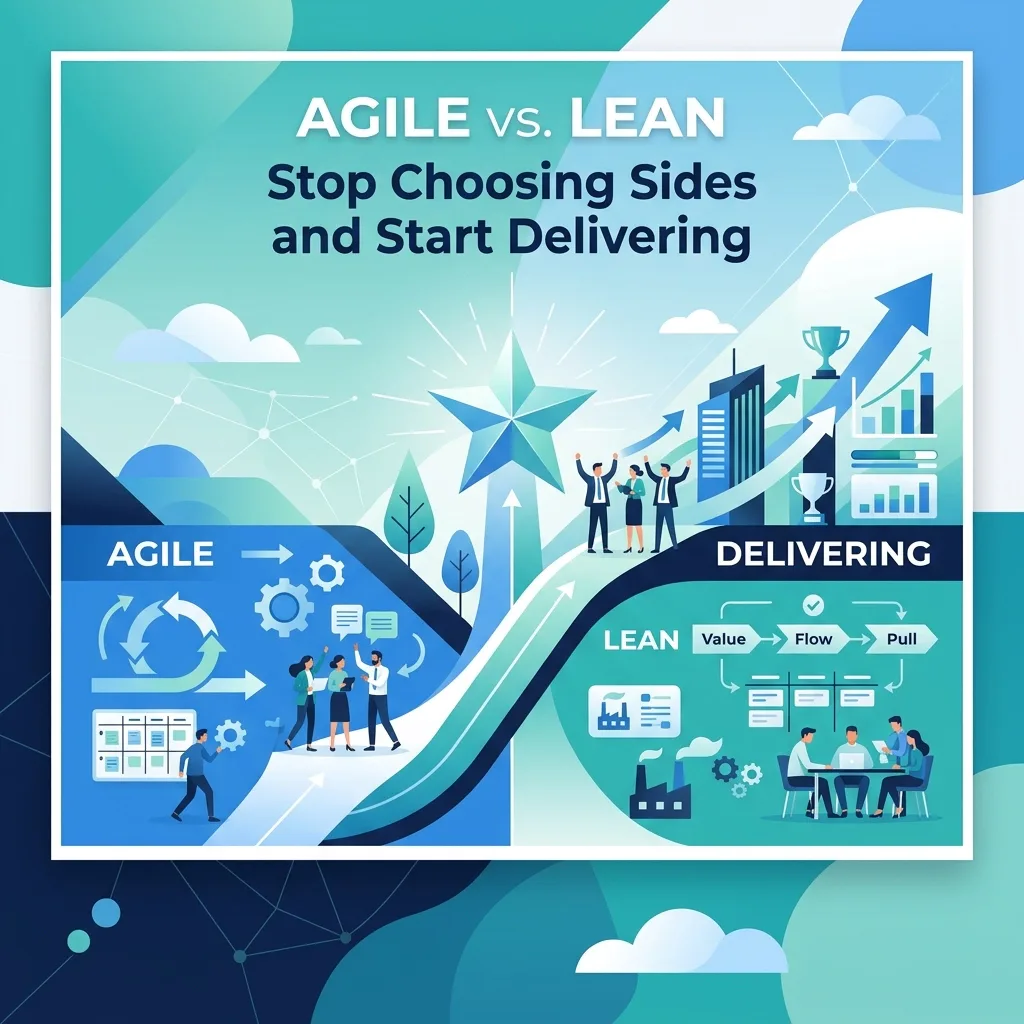
Let’s get one thing straight: the corporate world loves a good civil war. For the last two decades, we’ve watched "Agile Evangelists" and "Lean Purists" throw stones at each other from their respective silos. One side screams about "sprints" and "scrum ceremonies," while the other obsessively maps "value streams" and hunts down "muda" like it’s a personal vendetta.
Here’s the cold, hard truth: If you are choosing one over the other, you are failing your organization.
Choosing between Agile and Lean is like a professional athlete choosing between strength and cardio. You need both to win the game, and anyone telling you otherwise is likely trying to sell you a very expensive, very one-sided consulting package. It is time to stop the "Agile vs. Lean" nonsense and recognize that they are two sides of the same damn coin.
The Delusion of "Choosing" a Methodology
Most companies treat process improvement methodologies like religion. They pick a denomination, buy the books, and start shaming anyone who doesn’t follow the liturgy.
Agile was born in the software world to combat the "Waterfall" disaster, projects that took three years to deliver something the customer didn't want anymore. Lean was born on the manufacturing floor to eliminate waste and make sure every movement adds value.
When you treat them as mutually exclusive, you end up with two specific types of failure:
- Agile without Lean: You are moving fast, but you are moving fast toward a cliff. You are "iterating" on garbage. You have no standard work, no concept of process stability, and your "velocity" is just a measure of how quickly you can create technical debt.
- Lean without Agile: You have the most efficient process in the history of mankind, but you’re producing something nobody wants. You are so focused on reducing "setup time" that you forgot to check if the market moved while you were calibrating your machines.
To truly understand how these work together, you need to revisit the Lean Six Sigma concepts and glossary. These aren't just definitions; they are the bedrock of why "delivering" matters more than "methodology."

Lean is the Foundation, Not the Alternative
People think Lean is "old school." They think it’s just for guys in hard hats at Toyota. That is a dangerous misunderstanding. Lean is about Value. If a step in your process doesn't add value to the end customer, it is waste. Period.
Before you start "sprinting," you need to know what your current state looks like. This is where most Agile teams fail, they have no clue how their work actually flows through the system. This is why process mapping in the measure phase is non-negotiable. You cannot improve what you have not documented.
Lean provides the analytical rigor that Agile often lacks. While Agile tells you to "fail fast," Lean tells you to "understand why you failed so you don't do it again." Lean focuses on the system; Agile focuses on the delivery. If your system is broken, your delivery will be too.
Agile is the Engine, Not the Goal
Agile is about adaptability. It is a response to the fact that humans are terrible at predicting the future. In a Lean context, Agile is the mechanism that allows for rapid feedback loops.
The biggest overlap between the two is the Voice of the Customer (VOC). Both methodologies claim to be customer-centric, but Agile provides the cadence for testing that assumption. Instead of spending months on a project charter, Agile suggests you get a Minimum Viable Product (MVP) in front of a human being immediately.
If you want to prioritize what actually matters to that customer, don't just guess during a stand-up meeting. Use a Voice of Customer Priority Matrix Calculator to bring some actual data to your "Agile" pivots.
Stop the Methodology Tribalism
The "war" between Agile and Lean is usually fueled by middle managers who want to justify their existence by implementing "transformation programs."
Let’s look at the reality of a project. You start with an idea. You need to decide if it's worth doing. Do you use a "Lean" tool or an "Agile" tool? Neither. You use logic. You use a project selection scoring calculator to ensure you aren't wasting resources on a vanity project.
Once the project starts, the lines blur:
- Kanban: Is it Lean? Yes (JIT). Is it Agile? Yes (Visual Management). It’s both.
- Kaizen: Is it Lean? Yes (Continuous Improvement). Does it fit in a Sprint Retrospective? Absolutely.
- Root Cause Analysis: Lean purists love it. Agile teams need it when their "velocity" hits a wall.
If you are a Black Belt or a Scrum Master and you refuse to use the "other" side’s tools, you are a handicap to your company. You are choosing a label over a result.
The Brutally Honest Hybrid Approach
If you want to actually deliver results instead of just "doing Agile" or "doing Lean," here is the protocol you should follow:
- Map the Mess: Use Lean tools to visualize the current state. Identify the bottlenecks and the waste. If you don't know where the "noise" is, you can't fix it. Check out our guide on how to identify and control noise factors to stop chasing ghosts.
- Iterate with Intent: Use Agile cycles (Sprints/Scrums) to tackle the waste identified in step one. Don't try to fix the whole company in one go. Pick a piece, improve it, and test it.
- Pilot Everything: Before you roll out a "Global Agile Transformation," run a pilot. How long? That depends. Learn about pilot study duration so you don't scale a broken process.
- Capture the Knowledge: This is where both Lean and Agile teams usually fail. They finish a project and run to the next one. Use lessons learned documentation to ensure the organization actually gets smarter.

Why Choosing Sides is a Mistake for Real Improvement
When you choose a side, you develop blind spots.
The "Agile side" often ignores technical excellence and process stability. They think "standard work" is a dirty word that stifles creativity. In reality, standard work is what allows for creativity because you aren't constantly fighting the same fires every day.
The "Lean side" often ignores the human element of change and the need for rapid pivot points. They can get bogged down in data normality tests: though if you’re going to do them, do them right with a Shapiro-Wilk test: and lose sight of the fact that the market has already moved.
Real process improvement requires the speed of Agile and the discipline of Lean. It requires you to be a "Master" of the entire toolkit, not just one drawer.
The Bottom Line: Deliver or Get Out of the Way
At Lean 6 Sigma Hub, we don't care what you call your methodology. We care about whether your process is stable, your waste is minimized, and your customer is satisfied.
If you are sitting in meetings debating whether to use a "User Story" or a "CTQ Tree," you are missing the point. (By the way, use a CTQ Tree Calculator and move on).
The industry is moving toward a hybrid reality where the most successful leaders are those who can navigate both worlds. They know how to scale solutions from pilot to full implementation using Lean principles while maintaining the iterative flexibility of Agile.
Stop being a "Scrum Master" or a "Lean Six Sigma Green Belt." Be a Problem Solver. The world has enough people who can recite the Agile Manifesto; it doesn't have enough people who can actually fix a broken supply chain or a dysfunctional software deployment pipeline.
If you're ready to stop playing corporate games and start delivering serious value, it’s time to level up your credentials. Don't just learn a framework; learn the science of improvement.
Pursue your Black Belt Certification today and master the tools that actually drive bottom-line results.
Take the next step in your career and apply for the Master Black Belt Program to lead organizational transformation at the highest level.