Let’s be honest: your office is a lie. That ergonomic chair, the dual-monitor setup, and the climate-controlled air might feel like the cockpit of your professional life, but as far as process improvement is concerned, it’s a filtered bubble. If you’re spending your day staring at spreadsheets and "sanitized" PDF reports, you aren't leading, you’re guessing.
In the world of Lean Six Sigma, we have a term for the antidote to this corporate isolation: Gemba.
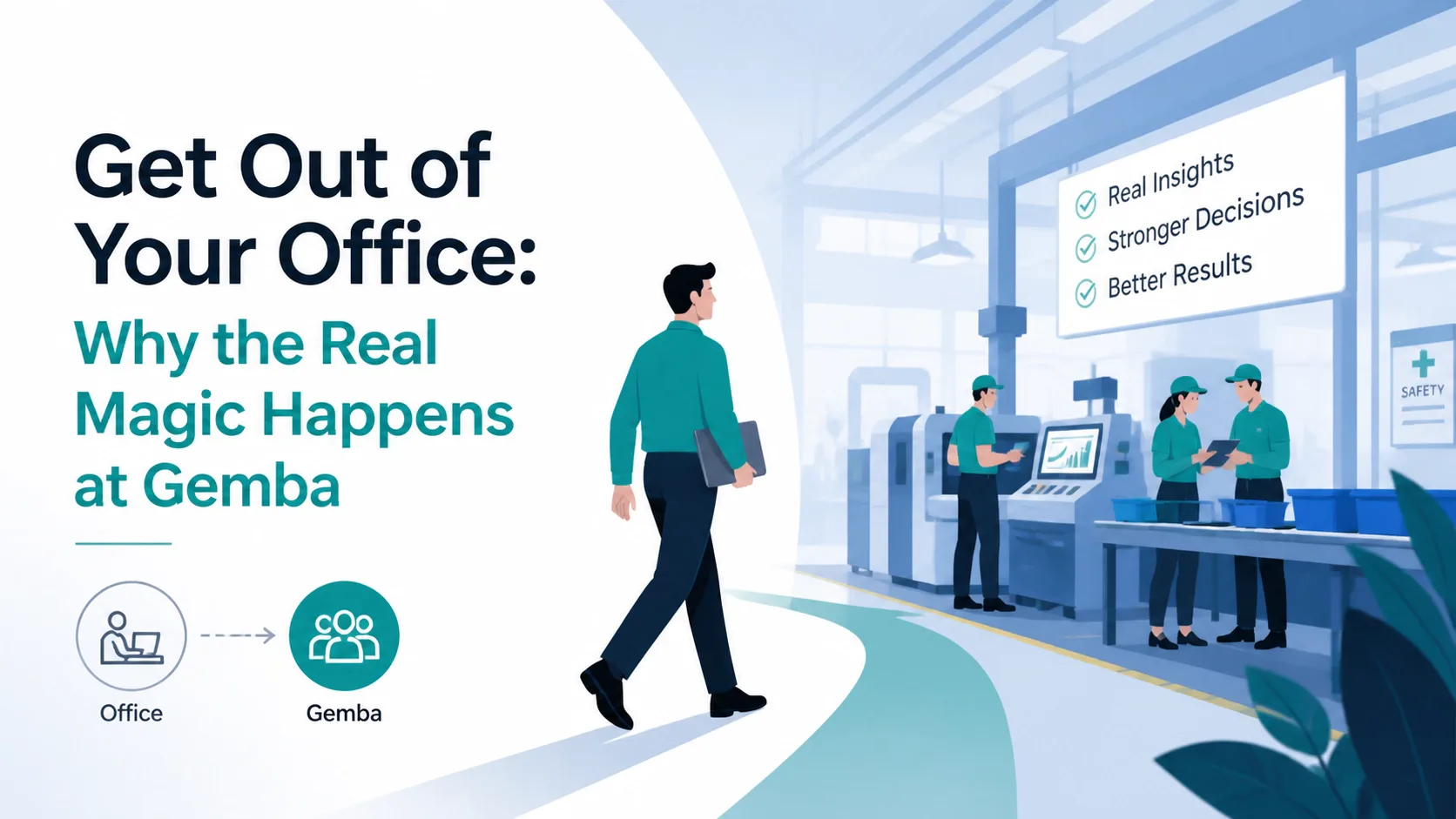
Gemba is a Japanese term that translates literally to "the actual place." In a courtroom drama, it’s the scene of the crime. In a news broadcast, it’s where the reporter is standing in the rain. In your business, it is the factory floor, the warehouse, the call center cubicle, or the software developer’s desk. It is the place where value is created and, more importantly, where waste hides in plain sight.
If you want to stop firefighting and start fixing, you need to get out of your chair. Here is why the real magic, the kind that saves millions and transforms cultures, only happens when you go to Gemba.
The Great Illusion: Observation vs. Reports
Most managers believe they understand their business because they read the reports. They look at the KPIs, the throughput metrics, and the utilization rates. But a report is a post-mortem; it’s a story about what happened yesterday, filtered through the biases of the person who wrote it.
When you rely solely on reports, you are seeing a "Watermelon Project", green on the outside, but bright red on the inside.
Direct observation at Gemba strips away the filters. When you stand on the floor and watch a process for sixty minutes, you see the reality that never makes it into a PowerPoint slide. You see the operator who has to walk fifty feet to find a specific tool because the shadow board is broken. You see the "workarounds" that employees have invented to bypass a glitchy software interface. These are the details that define your efficiency, yet they are invisible from the view of a corner office.

What is a Gemba Walk? (And What It Isn’t)
To fully appreciate the power of Gemba, we have to look at the Gemba Walk. This isn't a casual stroll to say "hello" to the staff, nor is it a "police inspection" to catch people doing something wrong.
A Gemba Walk is a structured activity where leaders go to the front lines to observe the actual process, engage with the people doing the work, and identify opportunities for improvement. According to our Lean Six Sigma Glossary, it is a foundational pillar of continuous improvement.
There are three unbreakable rules for a successful Gemba Walk:
- Go See: Move your physical body to where the work happens. If you are a digital company, "Go See" means sitting with a user or a developer and watching their screen as they navigate the workflow.
- Ask Why: This isn't about interrogation; it’s about inquiry. Use the "5 Whys" technique to understand the root cause of what you are observing.
- Show Respect: You are there to learn, not to judge. The people doing the work are the experts. If they feel like you’re there to play "gotcha," they will hide the waste, and the magic of Gemba will vanish instantly.
The "Gemba Magic": Why Direct Observation Changes Everything
Why do we call it "magic"? Because the insights gained at Gemba often defy the logic of the boardroom.
In the realm of process improvement, we often talk about the Measure Phase of DMAIC. You can try to map a process from a conference room with sticky notes, but that map will only show you the ideal state, how the manual says the work should be done. When you go to Gemba, you map the actual state.
I once worked with a plant manager who was convinced that their downtime was caused by a lack of operator training. After twenty minutes at Gemba, we watched an operator struggle with a machine that had been "repaired" with a literal rubber band because the maintenance department was out of the correct parts. No amount of training would have fixed that rubber band. That’s Gemba magic: the sudden, undeniable clarity of seeing the truth.
https://cdn.marblism.com/6ogRhdG1YiT.webp
Identifying Waste in Real-Time
When you are at Gemba, you start to see the "Eight Wastes" of Lean in high definition. You see Motion (employees walking back and forth), Waiting (people standing around because a previous step is delayed), and Defects (rework happening on the fly).
Seeing these wastes in person allows for what we call Quick Wins. Sometimes, the solution is as simple as moving a printer closer to a desk or changing the order of a few steps in a software tool. These immediate adjustments provide instant ROI while you work on long-term solutions.
If you are looking at setup time reduction, you cannot simply demand faster changeovers from your office. You have to stand there with a stopwatch, watch the mechanics, and realize that they spend 15 minutes looking for a specific wrench. That’s where the "magic" happens, the realization that your problem isn't worker speed; it’s tool organization.
Building a Culture of Trust
Beyond the data and the process maps, Gemba is a leadership tool. When a leader consistently shows up at the "actual place," it sends a powerful signal: The work you do matters, and I am here to support you.
This builds a culture of transparency. When workers see that you are there to fix the system rather than blame the person, they start bringing problems to you. Instead of hiding a mistake, they’ll say, "Hey, look at this: this step is really difficult and causes a lot of errors."
This level of honesty is the holy grail of Lean Six Sigma. It allows you to capture lessons learned properly and prevents the same mistakes from recurring in future projects.

How to Start Your First Gemba Walk
If you’ve been stuck in your office for months, stepping out can feel awkward. Here is a high-attitude, no-nonsense protocol to get you started:
- Ditch the Clipboard: You aren't a high school principal. Bring a notebook, but keep your eyes on the people and the machines.
- Pick a Theme: Don't try to see everything. Focus on one thing: maybe it’s safety, or maybe it’s the flow of a specific product line.
- Follow the Value Stream: Start where the raw material (or data) enters and follow it until it leaves as a finished product.
- Listen More Than You Talk: If you’re talking, you aren't observing. Ask open-ended questions like, "What is the most frustrating part of this task?" or "If you had a magic wand, what would you change about this machine?"
- Follow Up: The quickest way to kill the magic of Gemba is to observe a problem and then do nothing about it. If you see a "rubber band fix," make sure the real part is ordered before you leave for the day.
Stop Reading and Start Walking
The fundamental purpose of Lean Six Sigma is to maximize value by eliminating waste. You cannot eliminate what you cannot see, and you cannot see reality from a 20th-floor office or a remote Zoom call.
The real magic of process improvement doesn't happen in a brainstorming session with fancy catering. It happens in the dust, the noise, and the grind of the front lines. It happens when a leader humbles themselves enough to ask a frontline worker, "Help me understand why we do it this way."
To fully appreciate the nuances of Gemba and other Lean methodologies, you need more than just a blog post: you need a mindset shift and the technical skills to back it up.
Stop guessing and start observing. Enroll in our Green Belt or Black Belt certification programs today and master the art of the Gemba Walk to drive real, measurable results in your organization.