In the realm of operational excellence, there is a distinct difference between a professional who identifies problems and a leader who solves them. The bridge between these two states is the Business Case. Unfortunately, the majority of project pitches delivered to senior leadership are not bridges; they are crumbling structures of vague promises and unsubstantiated claims.
If you have ever presented a project idea only to be met with blank stares, polite "we'll think about its," or an outright rejection, the fault likely does not lie with the problem you identified. It lies with your pitch. Most business cases are ignored because they are "fluff-heavy," fiscally illiterate, and strategically irrelevant. To fully appreciate why your proposals are hitting the corporate shredder, we must examine the fundamental purpose of a business case through a lens of brutal honesty.
The Curse of the "Soft" Benefit: Why Fluff Kills Funding
The primary reason a business case gets rejected is a lack of hard, quantifiable data. Many project leads rely on "soft benefits", subjective improvements that sound pleasant but offer no measurable impact on the bottom line. Phrases such as "improving morale," "enhancing the customer experience," or "streamlining communication" are the hallmarks of a weak pitch.
While these outcomes are desirable, they are not a substitute for a Return on Investment (ROI). In a competitive corporate environment, resources are finite. When you ask for $50,000 to "improve efficiency" without defining exactly what that efficiency translates to in dollars, you are essentially asking for a donation.
To rectify this, you must pivot from adjectives to integers. Instead of saying you will improve a process, state that you will reduce lead time by 22%, resulting in a cost-per-unit decrease of $4.15. This level of precision requires deep analysis. You can utilize the Project Charter ROI Calculator to transform your vague aspirations into a compelling financial argument. If the math doesn't work, the project doesn't happen.
Strategic Disconnect: Solving Problems Nobody Cares About
Even if your project has a positive ROI, it may still be ignored if it lacks Strategic Alignment. A common mistake among junior practitioners is focusing on localized "pain points" while ignoring the overarching goals of the organization.
If the CEO is focused on market expansion in Asia, and you are pitching a project to optimize the filing system in the local HR department, your pitch is dead on arrival. You are solving a problem, yes, but you are not solving the problem.
In Lean Six Sigma, we prioritize projects that move the needle on the organization's Critical to Quality (CTQ) metrics. Before you even draft a proposal, you must understand the company's strategic roadmap. Use a Project Selection Scoring Calculator to objectively rank your project ideas against the business’s primary goals. If your pitch doesn't align with the strategic pillars of the company, it is a hobby, not a business priority.

Technical Illiteracy: When Data Doesn’t Speak
A business case that lacks a robust technical foundation is easily dismantled by any competent executive or Master Black Belt. When you present data, you must be prepared to defend its validity. Many pitches fail because they rely on "dirty data": data that is biased, unrepresentative, or fundamentally misunderstood.
For instance, if your business case relies on mean averages without considering the distribution of the data, you are presenting an incomplete picture. Are you aware of the noise factors affecting your process? If not, you should study how to identify and control noise factors in process improvement.
Furthermore, failing to prove that your data follows a normal distribution can lead to incorrect conclusions during the Analyse phase. Professionals who want their pitches taken seriously should be proficient in technical validation, such as performing the Shapiro-Wilk test to ensure their data normality before making bold claims about process capability.
The Anatomy of a Bulletproof Business Case
To write a business case that actually gets funded, you must move beyond the "pitch" mentality and adopt a "charter" mentality. A professional Lean Six Sigma project charter is the gold standard for business cases. It must include the following elements, stripped of all fluff and corporate jargon:
- The Problem Statement: A concise description of the current state, including specific metrics, the duration of the issue, and the financial impact of doing nothing.
- The Goal Statement: A SMART (Specific, Measurable, Achievable, Relevant, Time-bound) target. "We will reduce defect rates from 5% to 1.5% by Q3 2026."
- The Scope: What is in and what is out. This prevents "scope creep" and ensures the project remains manageable.
- Financial Impact: A transparent calculation of expected savings or revenue growth.
- The Stakeholders: Identification of who is impacted and who needs to approve the change. Use the Stakeholder Impact Assessment Calculator to ensure you haven't missed a key gatekeeper.

Stop Guessing and Start Measuring
One of the most frequent reasons for rejection is the "Lack of Evidence" trap. Management will ignore your pitch if they suspect you are guessing. To counter this, you must present a current-state process map. Visualizing the workflow exposes bottlenecks and waste (Muda) that words alone cannot describe.
If you are unsure where to begin, our guide on process mapping in the Measure phase provides a structured methodology for documenting current states. When you show a room full of executives exactly where the money is leaking out of the process, they stop ignoring you and start listening.
The Six Sigma Solution: The RDMAICS Framework
The difference between a "good idea" and a "fundable project" is the framework used to develop it. At Lean 6 Sigma Hub, we teach the RDMAICS framework: Recognise, Define, Measure, Analyse, Improve, Control, and Sustain.
Most failed pitches attempt to jump straight to "Improve" without ever going through "Recognise" or "Define." This is known as "solution jumping," and it is the fastest way to lose credibility. A professional business case is developed during the Recognise and Define phases. It is the result of rigorous investigation, not a sudden "aha!" moment in the shower.
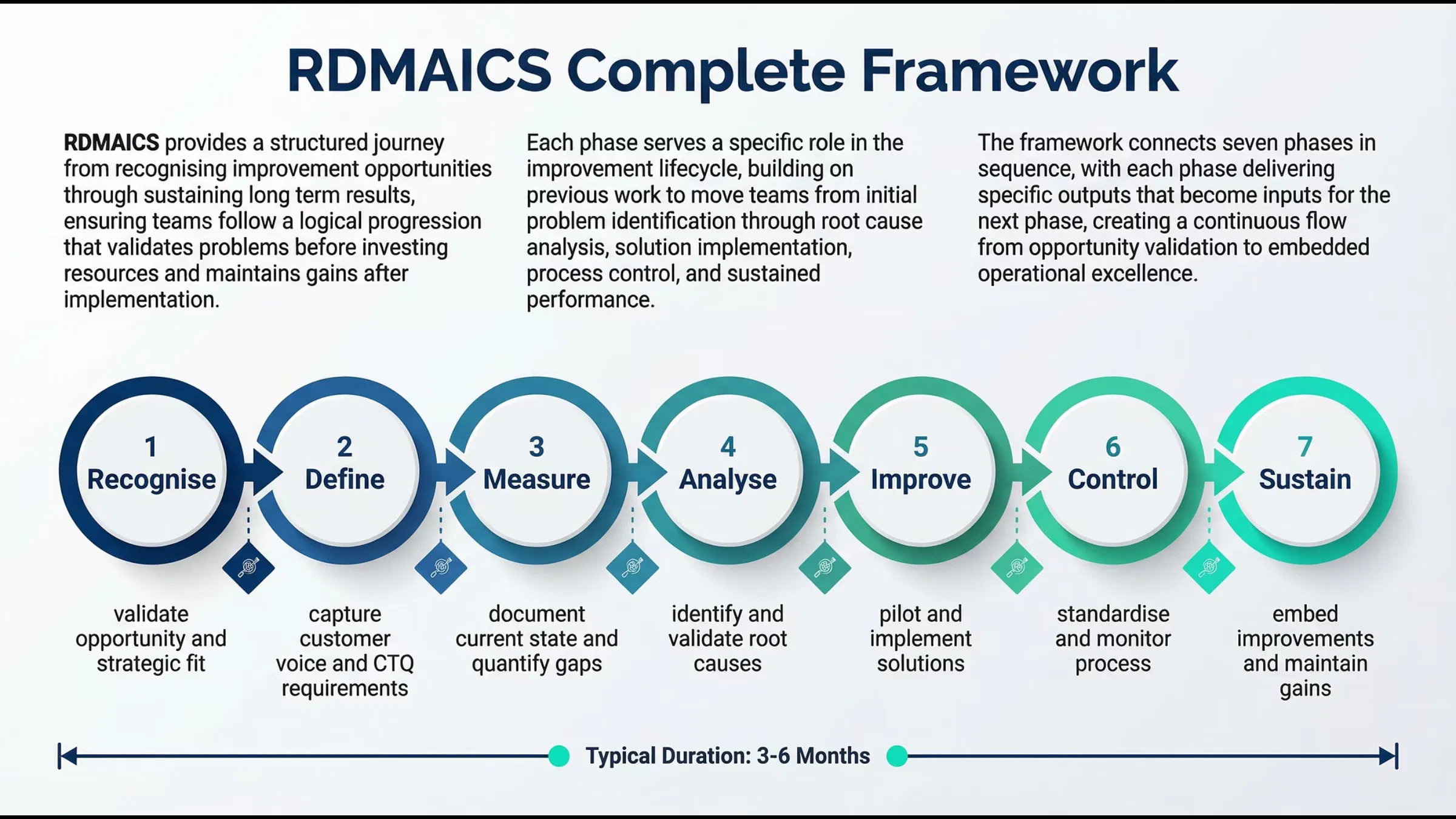
By following a structured cycle, you ensure that every project you pitch is rooted in reality. You aren't just suggesting a change; you are presenting a documented, validated, and statistically sound path to operational excellence.
Case Study: From Ignored to Implementation
Consider a hypothetical project involving a manufacturing plant struggling with slow setup times. A junior engineer pitches "investing in better tools to speed up setups." The pitch is ignored because it lacks ROI and specific data.
A Green Belt, however, approaches the same problem differently. They perform a pilot study on one machine. They document that setup time is currently 120 minutes, leading to 480 hours of lost production annually, valued at $240,000. They propose a setup time reduction (SMED) project to reduce time by 50%.
The Green Belt’s business case includes:
- A SIPOC Complexity Score to show the project is manageable.
- A Voice of the Customer (VOC) Priority Matrix to show the customer demands faster lead times.
- A clear ROI of $120,000 against a project cost of $15,000.
This is not a pitch; it is a mathematical inevitability. It is impossible to ignore.
The Professional Standard: Get Certified
The cold, hard truth is that the "business case" is a technical skill, not a creative one. If you are struggling to get your projects off the ground, it is likely because you lack the formal training required to speak the language of senior leadership: the language of data and ROI.
Lean Six Sigma certification provides the tools, the templates, and the authority to command respect in any boardroom. Whether you are aiming for a Green Belt to lead departmental improvements or a Black Belt to drive enterprise-wide transformation, the goal is the same: to stop being ignored and start being the person who delivers results.
Stop submitting "ideas" and start submitting business cases that cannot be refused. Take the first step toward becoming a data-driven leader by enrolling in our CSSC-accredited Lean Six Sigma training today.
Enrol in the Lean Six Sigma Green Belt Certification Program
Apply for the Lean Six Sigma Black Belt Certification Program