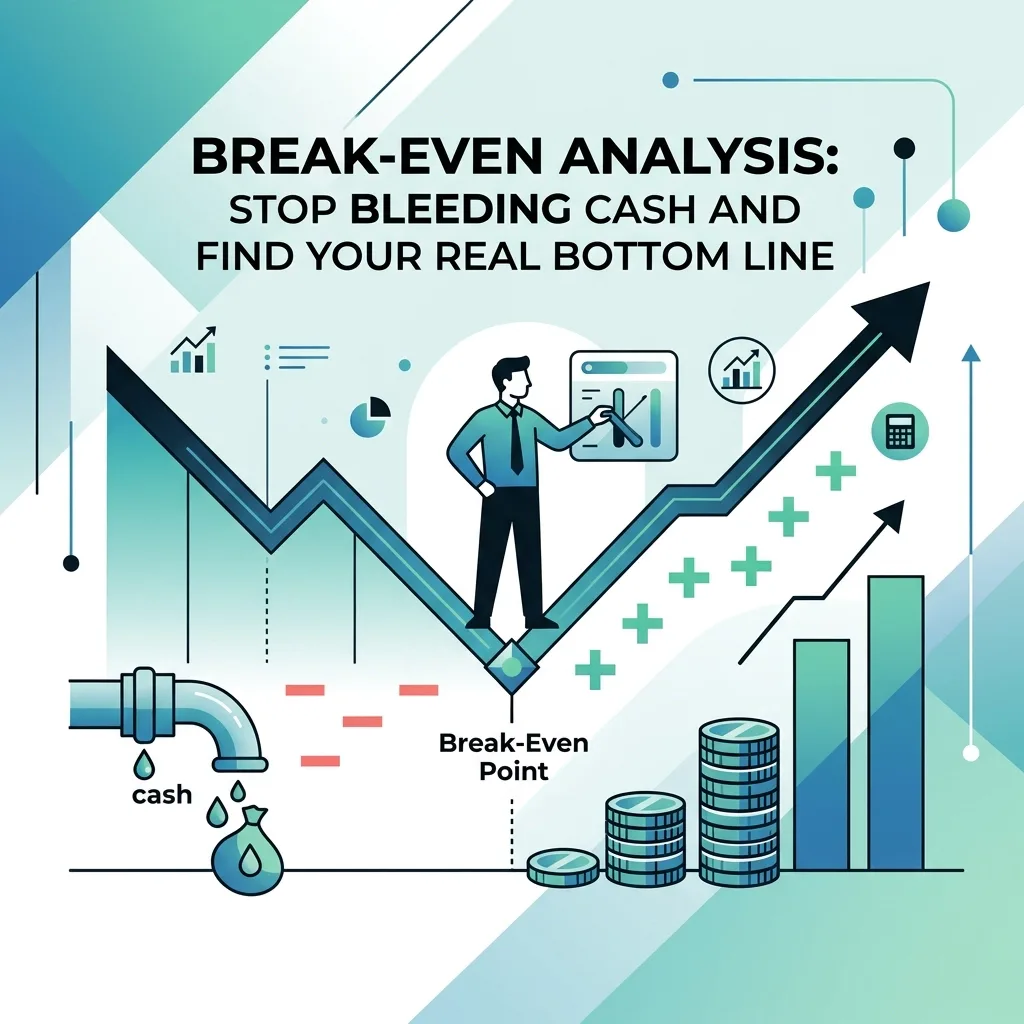
Most business owners and project managers are lying to themselves. They look at their monthly spreadsheets, see a few green cells, and convince themselves they’re "doing okay." They treat the break-even point as some distant milestone they’ll eventually cruise past once "sales pick up."
Here is the cold, hard truth: If you don’t know exactly where your break-even point is: calculated with surgical precision and zero optimism: you aren't running a business; you’re running a charity that happens to employ you. In the world of Lean Six Sigma, we don’t do "hope." We do data. And most of the data I see in amateur break-even analyses is filtered through rose-tinted glasses that ignore the reality of "bleeding cash."
The Myth of the "Easy" Break-Even
The textbook definition of break-even is simple: the point where total revenue equals total costs. You aren’t making a profit, but you aren't losing money either. Mathematically, it looks like this:
Break-Even Point (Units) = Fixed Costs / (Sales Price per Unit – Variable Cost per Unit)
On paper, it’s a middle-school math problem. In the real world, it’s a nightmare because most people have no idea what their actual costs are. They underestimate their fixed costs and completely ignore the "noise" in their variable costs. When you fail to account for how to identify and control noise factors in process improvement, your variable costs fluctuate wildly, making your break-even point a moving target that you will never hit.
Stop Hiding Your Fixed Costs
Fixed costs are the bills you pay even if you don’t sell a single widget. Rent, insurance, salaries, and software subscriptions. But the "brutally honest" version of break-even analysis requires you to look at the costs you’re hiding from yourself:
- Depreciation: Your equipment is dying every day. Are you accounting for its replacement?
- Opportunity Cost: If you’re spending 80 hours a week on a project that barely breaks even, you’re losing the money you could have made elsewhere.
- Administrative Bloat: The "little things" that add up to thousands in wasted overhead.
If your fixed costs are bloated, your break-even volume becomes impossible to reach. You end up in a "death spiral" where you need more sales to cover the overhead, but the cost of acquiring those sales drives your variable costs up even further.

The Variable Cost Trap: Where the Bleeding Happens
Variable costs are supposed to scale with production. If you make more, you spend more. Simple. But in an inefficient process, variable costs are riddled with "Muda" (waste).
When we look at Lean Six Sigma concepts and glossary, we see that waste isn't just discarded material. It’s waiting time, over-processing, and defects. Every time a worker has to redo a task because the initial process mapping was flawed, your variable cost per unit spikes. Every time a machine sits idle because of poor setup times, you are bleeding cash.
If you want to lower your break-even point, you don’t just "try to sell more." You attack the variable costs. For example, understanding setup time reduction can drastically lower the cost of switching between products, allowing you to be profitable at much lower volumes.
The Real Bottom Line: It’s Not Zero
A "break-even" of zero profit is a failure. In a professional environment, your "real" break-even should include your required profit margin. If you need a 15% margin to stay competitive and reinvest in the business, that 15% should be treated as a fixed cost in your calculation.
If you aren't using a Project Charter ROI Calculator to forecast these numbers before you launch a project, you are flying blind. You’re guessing. And in this economy, guessing is a luxury you can’t afford.

Why Most Analyses Are Optimistic Lies
Why do smart people produce bad break-even analyses? Because they want the project to happen. They engage in "confirmation bias," where they overestimate sales and underestimate the time it takes to get to market.
They ignore the pilot study duration. They assume they can go from zero to full implementation overnight. They don’t account for the "learning curve" or the inevitable hiccups that happen when scaling solutions from pilot to full implementation.
To find your real bottom line, you need to run a "Stress Test" on your break-even analysis:
- Increase Fixed Costs by 20%: Because things always cost more than you think.
- Decrease Sales Price by 10%: Because competitors will react and force your hand.
- Increase Variable Costs by 15%: Because supply chains break and errors happen.
If you can’t break even under those "stress" conditions, your business model is fragile.
The Lean Six Sigma Solution to Cash Bleeding
At Lean 6 Sigma Hub, we teach a rigorous approach to financial health. We don’t just look at the P&L; we look at the process. If your break-even point is too high, you have a process problem.
- Process Mapping: You need to perform process mapping in the measure phase to see exactly where the money is leaking.
- Data Normality: Before you trust your cost data, you need to know if it's reliable. If you don't know how to perform the Shapiro-Wilk test, you might be making decisions based on skewed data outliers.
- Prioritization: Stop trying to fix everything. Use a Project Selection Scoring Calculator to identify which cost-cutting measures will actually move the needle on your break-even point.

Stop Playing Business and Start Measuring
If you are tired of wondering where the money went at the end of every month, it’s time to stop using "hope" as a financial strategy. Break-even analysis isn't a one-time exercise you do for a bank loan; it’s a living metric that should guide every operational decision you make.
Every time you add a person to the payroll, your break-even point goes up. Every time you accept a "rush order" that disrupts your production flow, your variable costs skyrocket. If you don’t have the data to see these impacts in real-time, you are bleeding cash in the dark.
The difference between a struggling manager and a Lean Six Sigma professional is the ability to look at a process and see the dollars and cents flowing through it. It’s about moving beyond the "feeling" of being busy and into the reality of being profitable.
Whether you are looking at a LSS Black Belt sample project or running a small local shop, the principles remain the same: Identify the waste, control the noise, and protect your bottom line with everything you’ve got.
Stop guessing and start leading. Pursue your Lean Six Sigma certification today to master the tools that turn failing projects into profit engines.