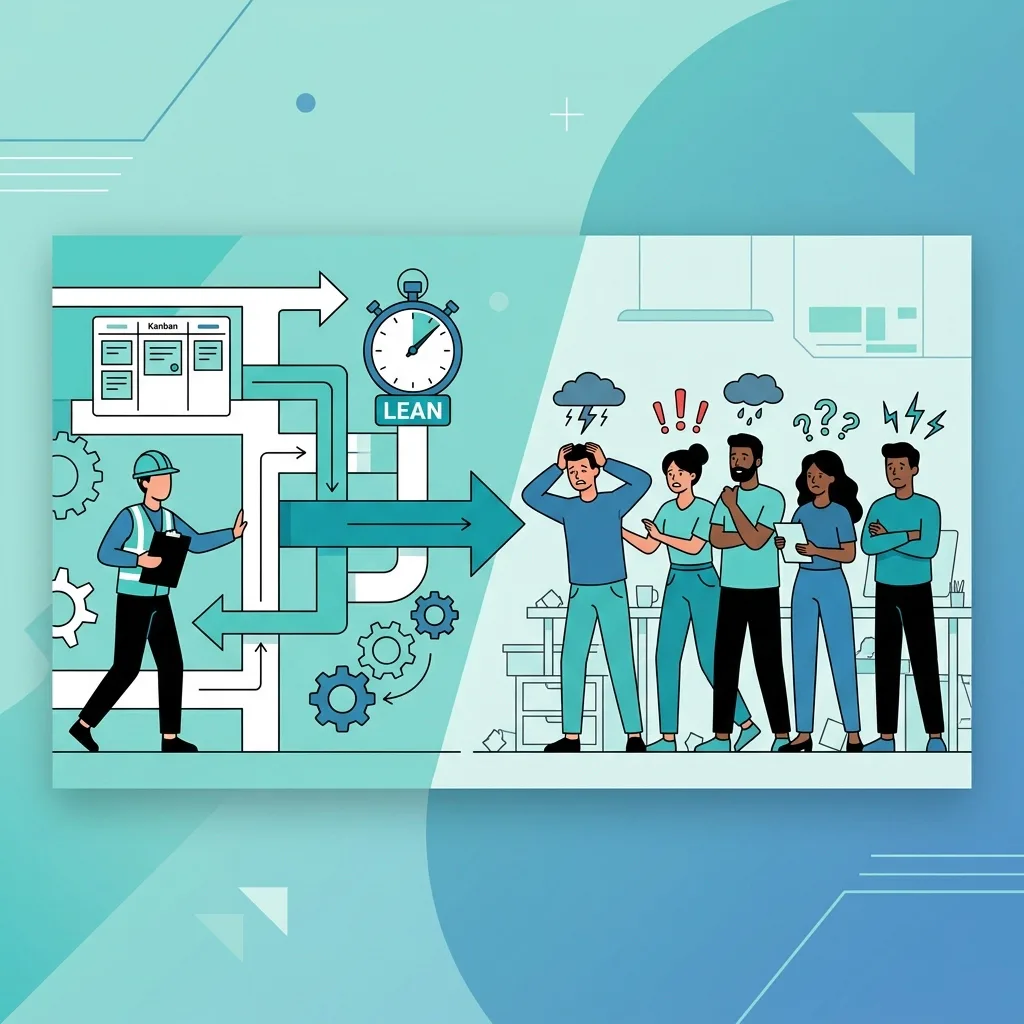
Let’s be brutally honest: You’ve spent weeks mapping out the perfect Value Stream Map. You’ve identified the waste, calculated the Takt time, and designed a future state that looks like a masterpiece of efficiency. But the moment you try to roll it out, your team treats your new Lean process like a virus. They roll their eyes in meetings, "forget" to fill out the new logs, and quietly revert to the old way of doing things the second you turn your back.
In the realm of continuous improvement, this isn't a failure of logic; it’s a failure of Change Management. Most practitioners treat Lean Six Sigma like a math problem, but it’s actually a psychology problem. If you don't understand why your team is sharpening their pitchforks, your project is dead on arrival.
The Fundamental Purpose of Change Management
Change Management is not just a corporate buzzword used to fill up slides in a Tollgate Review. According to the Lean Six Sigma Hub Glossary, it is the structured approach used to transition individuals, teams, and organizations from a current state to a desired future state.
The goal isn't just to "implement" a process; it's to ensure the process is adopted and sustained. Without buy-in, your sophisticated optimization plots are nothing more than digital wallpaper.
Why the Resistance? (Hint: It’s Not About the Data)
To fully appreciate why your team is pushing back, you have to look past the technical benefits. You see "30% efficiency gains." They see "30% more work" or, worse, "30% of us are getting fired."
1. Threats to Identity and Status
In a traditional environment, "knowledge is power." When you introduce a transparent, Lean process that simplifies tasks and uses data to make decisions, you are stripping away the "hero" status of people who used to solve problems through tribal knowledge. If Bob is the only one who knows how to fix the machine when it breaks, Bob has job security. Your Lean process makes Bob replaceable. Of course he hates it.
2. The "Add-On" Syndrome
Teams are often suffering from change fatigue. They’ve seen "Management Initiative of the Month" come and go. If your new process looks like extra work on top of their already overflowing plates, they will resist it. This is why balancing quick wins vs. long-term solutions is critical. If they don't see an immediate reduction in their daily "pain," they won't invest in the long-term gain.
3. Psychological Safety Gaps
If your culture punishes "failure," and your new Lean process requires people to admit to defects or inefficiencies, they will hide the truth. Lean requires radical honesty. If the team doesn't feel safe, they will sabotage the data to make themselves look good.

Tools for the Battle: Force Field Analysis
If you want to stop guessing why people are mad, use a Force Field Analysis. Developed by Kurt Lewin, this tool allows you to visualize the "tug-of-war" occurring within your organization.
To perform a Force Field Analysis, you list the Driving Forces (the factors pushing for the change) against the Restraining Forces (the factors resisting the change).
- Driving Forces: Reduced lead time, improved quality, cost savings, competitive advantage.
- Restraining Forces: Fear of the unknown, lack of training, legacy systems, "We’ve always done it this way" mentality.
The mistake most Green and Black Belts make is trying to "push" harder on the Driving Forces. They shout louder about the ROI. But in physics and in business, pushing harder usually just increases the counter-pressure. Instead, the most effective strategy is to weaken the Restraining Forces. Remove the fear, simplify the training, and address the legacy complaints first.
To get a better grip on how these forces impact your specific project, use our Stakeholder Impact Assessment Calculator. It will help you quantify the "human" variables that your Excel sheet is currently ignoring.
The High Cost of Poor Documentation
One of the fastest ways to lose a team's trust is to change the process without documenting it clearly. When roles are fuzzy and the "new way" isn't defined, anxiety skyrockets.
Proper process mapping in the Measure phase isn't just for the Project Charter; it's a communication tool. It shows the team that you actually understand what they do. If your documentation is sloppy, the team assumes your solution is sloppy too.
Furthermore, you must document your process changes properly to ensure that when the "Project Hero" (you) leaves, the process doesn't revert. Documentation provides the "standard" that prevents the "restraining forces" from pulling the team back into the old, wasteful habits.

Scaling Solutions: From Pilot to Full Implementation
Another reason teams hate Lean? The "Ivory Tower" implementation. You run a pilot in a controlled environment, it works, and then you dump the solution onto the entire organization without warning.
Scaling solutions from pilot to full implementation requires a phased approach. You need to capture lessons learned from the pilot participants: who are your internal influencers: and use their stories to sell the change to the rest of the company. A peer-to-peer recommendation is worth ten management memos.
The Checklist for Change
If you want your team to stop hating your Lean process and start owning it, you need a tactical plan:
- Identify the Influencers: Who do people actually listen to? It’s rarely the person with the fanciest title. Get the informal leaders on your side first.
- Quantify the Pain: Use the Voice of the Customer Priority Matrix not just for external customers, but for your "internal customers": the employees. What is their biggest headache? Fix that first.
- Over-Communicate: If you think you've communicated enough, you're halfway there. Explain the why behind every change.
- Simplify the Tools: Don't throw complex Shapiro-Wilk tests at people who just want to know if they're winning or losing the day. Keep the shop-floor metrics simple.
- Celebrate the Small Stuff: Lean is a marathon. If you only celebrate the end-of-year savings, the team will burn out by February.

Stop Playing Small
Change management isn't "soft skills": it's the hardest part of the job. If you can't manage the people, you can't manage the process. You can have the best project selection scoring in the world, but if your team doesn't trust you, your project is a waste of time.
If you’re ready to move beyond just "running projects" and start leading organizational transformations, you need to level up your credentials. The difference between a technician and a leader is the ability to navigate the complex human landscape of a Lean deployment.
Step up to the challenge and lead with authority. Enroll in our Black Belt Certification today and master the art and science of Change Management.