If you are still relying on "the average" to manage your processes, you are lying to yourself, your stakeholders, and your customers. In the world of Lean Six Sigma, the average is often a mask used to hide incompetence, inefficiency, and chaos. You might have a mean turnaround time of 24 hours, but if half your customers get it in 2 hours and the other half get it in 46, your "average" is a useless metric that is killing your business.
To truly understand what is happening on your shop floor, in your warehouse, or within your service team, you need to see the distribution. You need to see the variation. And there is no faster, more brutally honest way to do that than with a Box Plot.
The Illusion of the Average
We have been conditioned to believe that the mean is the ultimate truth. It isn't. The mean is sensitive to extreme values and tells you nothing about the "spread" of your data. If you have one foot in a bucket of ice and the other in a fire, on average, you’re comfortable. In reality, you’re in agony.
Variation is the enemy of quality. It creates unpredictability, increases costs, and destroys customer trust. While a histogram is great for seeing the shape of data, the box plot (also known as a box-and-whisker plot) is designed to expose the outliers and the range of your process performance in a single, compact visual.
In the realm of process improvement, the fundamental purpose of a box plot is to give you a reality check. Before you dive into the Lean Six Sigma concepts and glossary, you need to understand that if you can't visualize your variation, you can't control it.
Anatomy of a Box Plot: The Five-Number Summary
A box plot doesn’t care about your feelings or your "gut instinct." It relies on the five-number summary: the Minimum, the First Quartile (Q1), the Median (Q2), the Third Quartile (Q3), and the Maximum.

- The Median (The Center Line): This is the middle of your data. Unlike the mean, it isn’t easily swayed by a few catastrophic failures. If your median is far from the center of the box, your process is skewed.
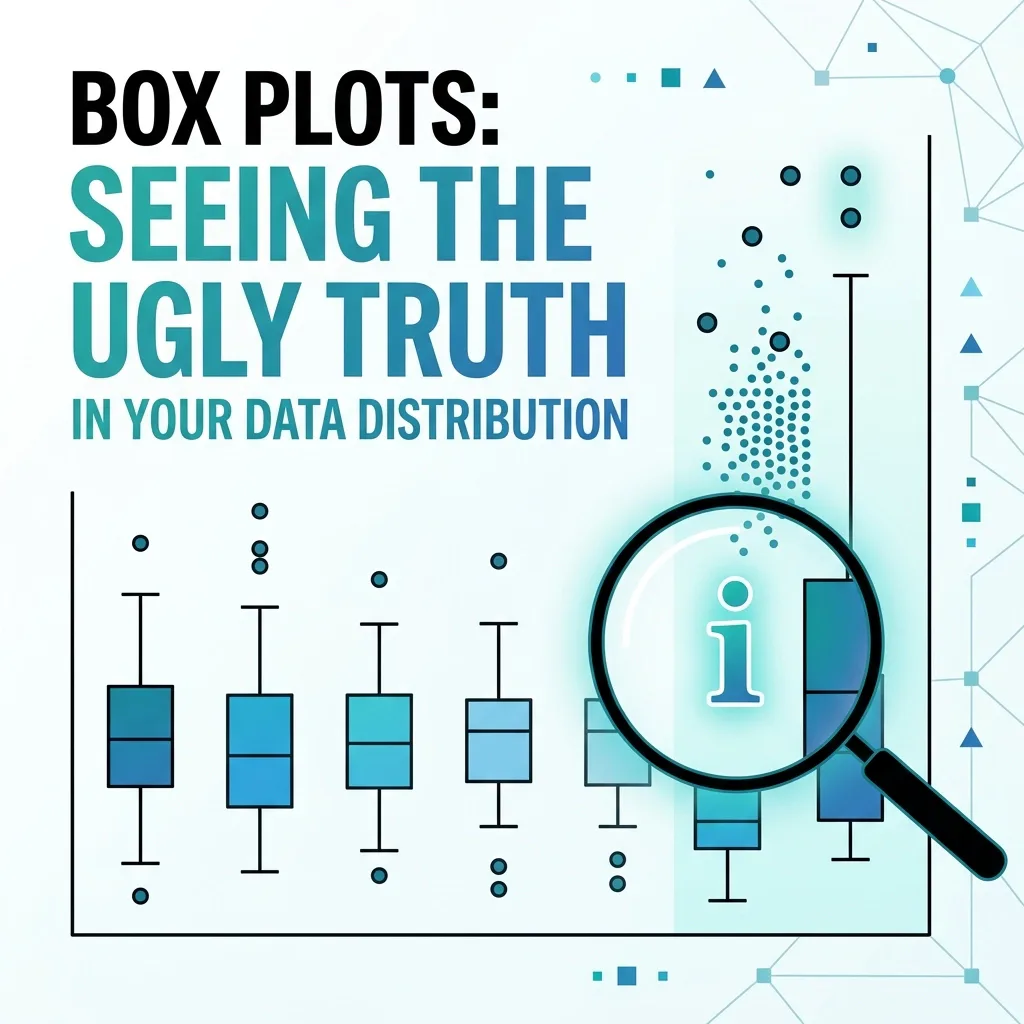
- The Box (The Interquartile Range – IQR): This represents the middle 50% of your data. If this box is wide, your process is unstable and lacks precision. If it’s narrow, you’ve achieved some level of consistency.
- The Whiskers: These lines extend to the minimum and maximum values that aren't considered outliers. They show the "expected" range of your process.
- Outliers (The Ugly Truth): These are the dots or stars outside the whiskers. These are your process failures. These are the "noise factors" that indicate a process is out of control.
To fully appreciate the importance of these metrics, one must understand how they relate to the Shapiro-Wilk test for normality. If your box plot looks like a lopsided mess, your data isn't normal, and your standard statistical assumptions are probably wrong.
Why Outliers Are Killing Your Efficiency
Outliers are the most important part of a box plot because they represent the moments where your process completely broke down. Management often likes to "ignore the anomalies" and look at the "typical" day. That is a coward’s approach to data.
Every outlier is a signal. It represents a "special cause" variation: a machine breaking, a trainee making a mistake, or a supplier sending defective material. By ignoring these points, you are ignoring the very factors that drive up your overhead and drive down your OEE (Overall Equipment Effectiveness).
In the Measure and Analyze phases of DMAIC, identifying these outliers is step one. You cannot move to the Improve phase and start understanding setup time reduction if you haven't even figured out why your process swings wildly from one extreme to the other.
Skewness: The Story of Hidden Bias
The position of the median within the box tells you about the skewness of your distribution.
- Positively Skewed (Right-Skewed): Most of your data is clustered at the low end, but you have a "long tail" of high values. This is common in service times; most calls are short, but a few "nightmare" calls take forever.
- Negatively Skewed (Left-Skewed): Most data is at the high end, with a tail of low values.
If your median isn't centered, you have a systemic issue. It means your process is naturally "pulling" toward one direction. If you are aiming for a specific target, skewness is a sign that your process mapping was either incomplete or you are ignoring significant "noise" in your environment.

Comparing Groups: Exposing the Slackers
The real power of box plots comes when you place them side-by-side. Do you want to see which shift is actually performing? Which production line is the most consistent? Which vendor is sending you garbage? Put their data into side-by-side box plots.
When you compare two or more boxes, you aren't just looking at who is "faster." You are looking at who is more reliable.
- Case Study: Imagine Line A has an average cycle time of 10 minutes with a very tight box. Line B has an average of 9 minutes but a box that spans from 5 to 15 minutes with ten outliers.
- The Reality: Line B is a disaster. Even though they are "faster" on average, you can't plan a production schedule around them because you never know if they’ll finish in 5 minutes or 15. Line A is the superior process because it is predictable.
Ignoring this variation leads to "firefighting" culture. You spend your whole day dealing with the fallout of the 15-minute cycles instead of improving the system. This is exactly why identifying and controlling noise factors is non-negotiable for anyone serious about Lean Six Sigma.
Applying Box Plots in Your Projects
Whether you are conducting a pilot study or scaling to full implementation, box plots should be your primary tool for validating results.
If you implement a "solution" but your box plot shows that the IQR hasn't shrunk: only the median has moved: you haven't fixed the process; you've just shifted the problem. Real improvement is characterized by a reduction in variation (a narrower box) and the elimination of outliers.
The Brutal Truth About Professional Development
Most people in corporate environments are terrified of box plots because they can't hide behind them. If you want to be the person who actually solves problems instead of just talking about them, you need to master these statistical tools.
At Lean 6 Sigma Hub, we don't just teach you how to draw a chart; we teach you how to hunt down variation and kill it. If you are tired of being the person who "thinks" they know what's wrong and you want to be the professional who proves what's wrong, it’s time to level up.
Using data effectively: specifically advanced tools like box plots: is what separates a "manager" from a Six Sigma professional. It’s also why Lean Six Sigma certification will change the way you use AI at work. AI is great at generating data, but without the discipline to analyze it, you're just generating faster junk.
Conclusion: Stop Guessing and Start Measuring
Box plots are the fastest way to spot the variation that is bleeding your company dry. They expose the outliers, reveal the skewness, and allow for a brutal comparison between different parts of your operation. If you aren't using them, you aren't doing Six Sigma: you're just doing expensive guesswork.
Don't let your career or your process stagnate because you're afraid to see the "ugly truth" in your data distribution. Embrace the variation, identify the root causes, and sustain your improvements.

Stop relying on averages and start mastering the metrics that matter. Join the elite group of professionals who know how to turn data into a competitive advantage.