
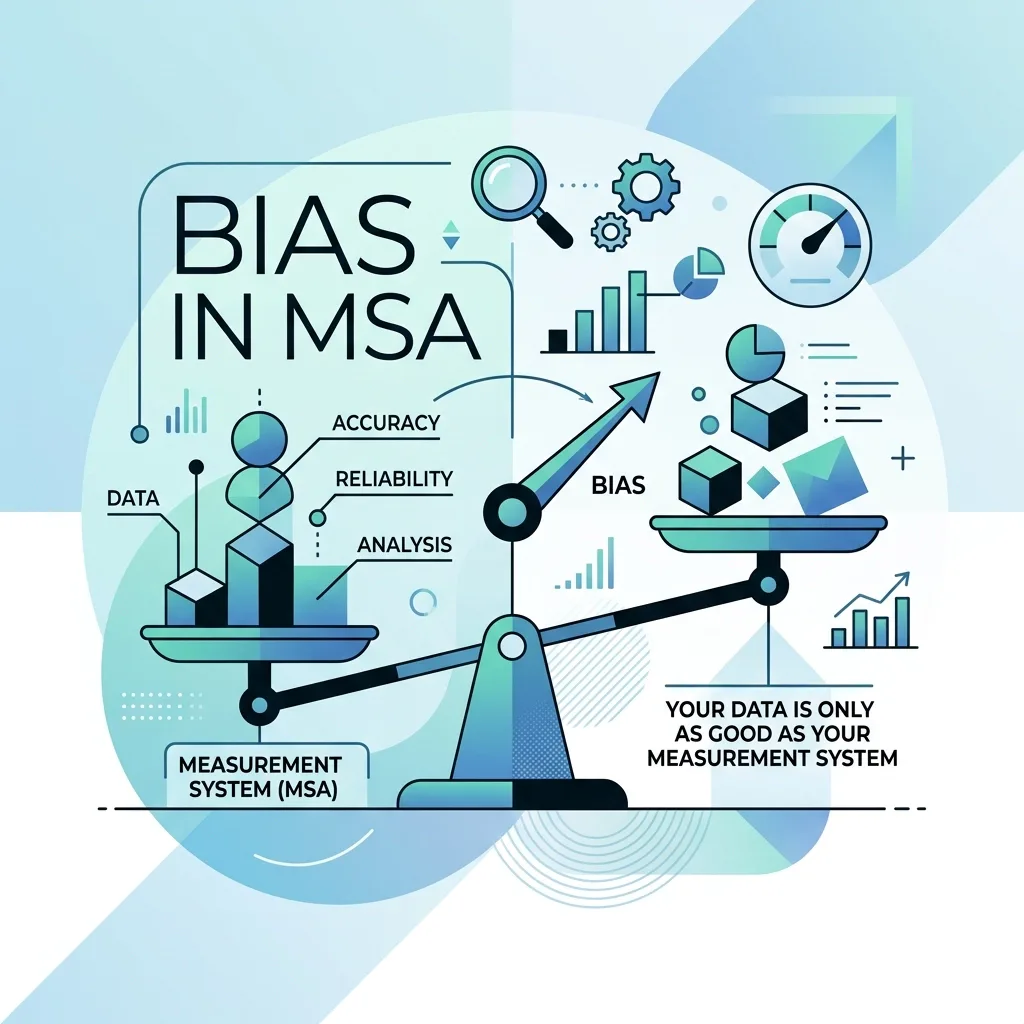
In the realm of process improvement, there is a fundamental truth that most Green Belts and even some Black Belts conveniently ignore: If your measurement system is lying to you, your data is fiction.
You can spend weeks running complex DOE (Design of Experiments) or performing sophisticated regression analysis, but if the foundation: your Measurement System Analysis (MSA): is flawed, you are essentially hallucinating results. You aren't making data-driven decisions; you are making guesses based on corrupted information.
The most insidious of these flaws is Bias. While repeatability and reproducibility (R&R) often get all the attention during the process mapping in the measure phase, bias is the silent killer of organizational efficiency. It is the systematic error that shifts your entire data set away from reality, leading to million-dollar mistakes disguised as "statistical significance."
The Fundamental Purpose of MSA: Detecting the "Broken Ruler"
To fully appreciate the danger of bias, we must first define it within the technical framework of Lean Six Sigma. According to our Lean Six Sigma concepts and glossary, Measurement System Analysis is a mathematical method of determining how much variation within a process is caused by the measurement system itself.
Bias is defined as the difference between the observed average of measurements and the reference value (the "true" value). Think of it as a broken ruler. If your ruler is missing the first half-inch but you don't know it, every single measurement you take will be half an inch too long. No matter how many times you measure (repeatability) or how many people use the ruler (reproducibility), the result remains consistently wrong.

Why Precision Without Accuracy is Useless
In many corporate environments, teams boast about their "high-precision" equipment. However, precision (the ability to get the same result consistently) is worthless without accuracy (the ability to get the right result).
- Precise but Biased: You hit the same spot on the target every time, but it’s the wrong spot. You are consistently wrong.
- Accurate but Imprecise: Your shots are scattered, but they average out at the bullseye.
- The Goal: Accurate and Precise.
If your measurement system has significant bias, you are in the "Precise but Biased" category. You have high confidence in your data, which is exactly why it is so dangerous. You are confidently steering the ship toward an iceberg because your compass is off by ten degrees.
The Technical Anatomy of Bias
To identify bias, you must compare your measurement system against a Master or Reference Standard. In a professional Lean Six Sigma environment, this isn't optional. Without a reference standard, you aren't measuring; you're speculating.
Calculating Bias
The formula is straightforward, yet the implications are profound:
Bias = Observed Average – Reference Value
To determine if this bias is statistically significant, we typically employ a one-sample t-test. We are testing the null hypothesis ($H_0$) that the bias is equal to zero. If the p-value is less than 0.05, you have a statistically significant bias. However, as any seasoned Master Black Belt will tell you, statistical significance does not always mean practical significance.
To evaluate the practical impact, we look at the % Bias, which is calculated as:
% Bias = (Bias / Process Variation) * 100
In the world of high-stakes manufacturing and services, a bias exceeding 5% to 10% of the process tolerance is a red flag that should halt all improvement activities until corrected.
Where Does Bias Hide?
Bias doesn't happen in a vacuum. It is the result of specific, often overlooked factors within your process. To eliminate it, you must first identify and control noise factors.
1. Equipment Calibration (The Most Common Culprit)
Instruments drift. Wear and tear, mechanical fatigue, or simple age can cause a gauge to lose its calibration. If your calibration schedule is "whenever we remember," your data is likely trash.
2. Operator Bias
Even with standard operating procedures, different human beings interact with measurement tools differently. One operator might apply more pressure to a micrometer than another. This isn't just a reproducibility issue; if a specific shift consistently uses a flawed technique, the entire data set for that shift becomes biased.
3. Environmental Factors
Temperature, humidity, and lighting are not just "background noise." In high-precision industries, a 2-degree Celsius change in room temperature can expand a metal part enough to create a biased measurement. Failure to account for these is a failure in the Measure phase.
Hypothetical Case Study: The $250,000 Ghost Problem
To ground these theoretical concepts in reality, let's look at a hypothetical scenario involving a high-end electronics manufacturer.
The company was seeing a sudden spike in "Out of Specification" (OOS) readings for a critical ceramic component. The engineering team, assuming the production kiln was failing, proposed a $250,000 CAPEX spend to replace the heating elements.
Before signing the check, a Black Belt performed a formal MSA. They used a certified reference standard (a block known to be exactly 10.000mm) and measured it 50 times using the existing digital calipers.
The Data:
- Reference Value: 10.000 mm
- Observed Average: 10.045 mm
- Standard Deviation: 0.002 mm
- Bias: 0.045 mm
- p-value: < 0.001
The statistical analysis revealed a massive bias. The calipers were consistently reading 0.045 mm higher than the true value. When this bias was factored into the process data, it was discovered that the process was actually perfectly healthy. The parts were within spec; the measurement tool was simply pushing the data points over the upper specification limit (USL).
By spending $200 on a new, calibrated gauge and implementing a rigorous calibration protocol, the company saved $250,000 in unnecessary equipment costs. This is the power of understanding bias.
How to Perform a Bias Study: A Professional Protocol
If you want to ensure your data is worth the paper it's printed on, follow this protocol:
- Select a Master Sample: Obtain a sample that has a known, traceable reference value. If you don't have one, you cannot perform a bias study.
- Collect Measurements: Have one operator measure the master sample at least 15 to 20 times in a controlled environment.
- Determine the Statistics:
- Calculate the mean of the measurements.
- Calculate the Bias (Mean – Reference Value).
- Use the Shapiro-Wilk test to ensure your measurement data is normal before proceeding with t-tests.
- Analyze Significance: Conduct a t-test to see if the bias is significantly different from zero.
- Assess Practicality: Compare the bias to the total process tolerance. If the bias consumes a significant portion of your "allowable error," the system must be fixed.

The Brutal Truth About "Good Enough"
Many organizations settle for "good enough" when it comes to measurement. They assume that if they bought a name-brand gauge, it must be accurate. This is a dangerous delusion.
In a Lean Six Sigma hypothetical project, the first thing we look at is the validity of the data. If the MSA fails, the project stops. You cannot "Improve" what you cannot "Measure." If you ignore bias, you aren't just doing bad Six Sigma; you are actively damaging your organization by providing false signals to leadership.
Whether you are working on setup time reduction or trying to scale a pilot study, your measurement system is your eyes. If your eyes are biased, you are flying blind.
Stop Guessing and Start Measuring
If you can’t confidently state the bias of your primary measurement systems, you are a liability to your company. Understanding the technical nuances of MSA, including bias, linearity, and stability, is what separates a true professional from someone who just knows how to make a few charts in Excel.
The Lean 6 Sigma Hub offers the training and tools necessary to master these concepts. Don't let your career or your projects be undermined by systematic errors that are entirely preventable.
Get the training you need to ensure your data is bulletproof. Enroll in our Lean Six Sigma Certification programs today and stop making decisions based on fiction.

Act now: Explore our Six Sigma Flash Cards to sharpen your knowledge or use our Project Selection Scoring Calculator to ensure you're working on the right problems with the right data.