
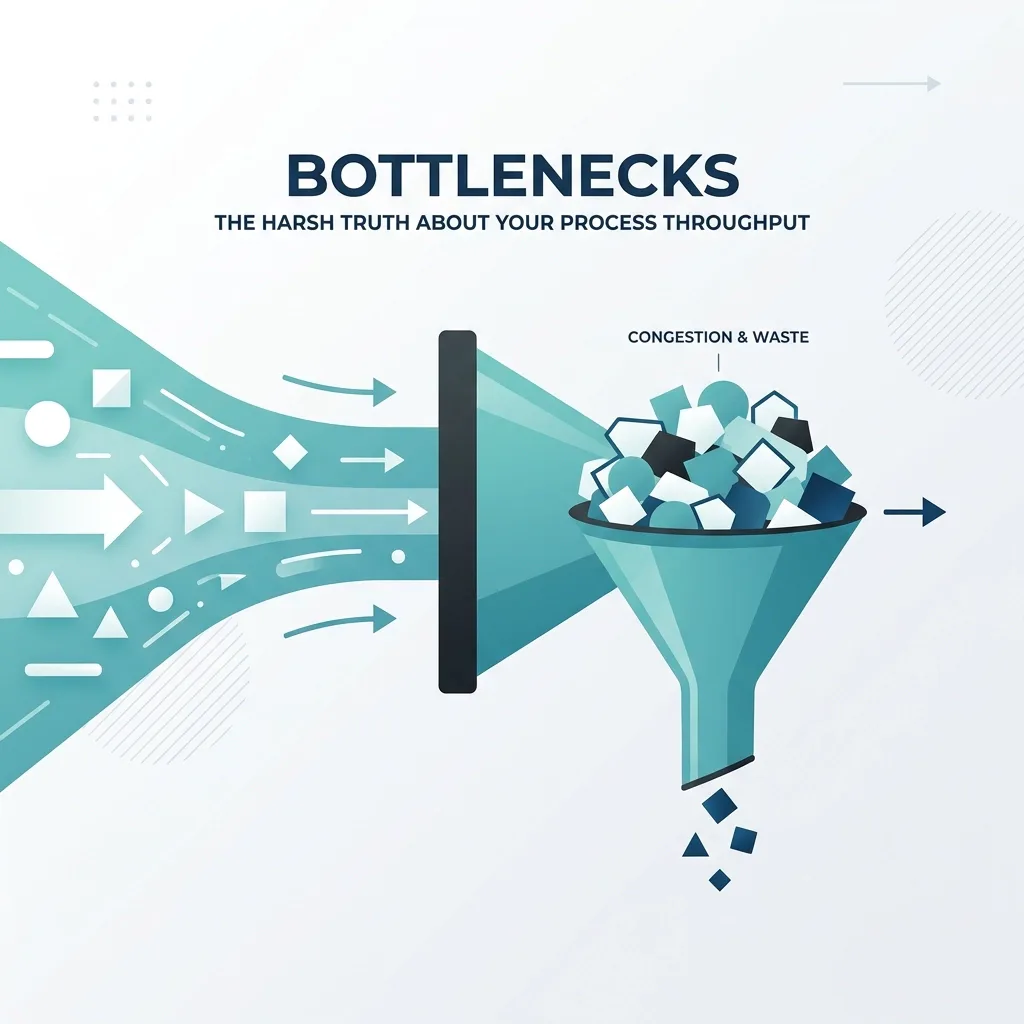
If you think your process is running efficiently just because every workstation is humming and every employee looks exhausted, you are likely lying to yourself. In the world of high-stakes process improvement, "busy" is often a mask for "broken."
The reality is brutal: If you are not managing the constraint, you are not managing the process. You are simply a spectator watching inventory pile up and margins evaporate. Most organizations spend millions on "efficiency" programs that fail to move the needle because they ignore the single most important factor in their operation: the bottleneck.
The Denial Phase: Why Busy Work is Killing Your Throughput
In the realm of operations, there is a fundamental law that many leaders choose to ignore: the throughput of any system is determined by exactly one thing: the bottleneck.
A bottleneck is not just a "slow spot." It is the physical or logical limit of your entire value stream. To fully appreciate this, you must accept a harsh truth: any improvement made at a non-bottleneck station is not just a waste of time: it is actually counterproductive. If your first machine can produce 100 units an hour, but your second machine (the bottleneck) can only process 50, "optimizing" the first machine to produce 150 units does nothing but create a massive, expensive pile of work-in-progress (WIP) that clogs your floor and drains your cash flow.
In the Lean Six Sigma concepts and glossary, we define throughput as the rate at which the system generates money through sales. If your output hasn't increased at the customer end, you haven't improved anything. You’ve just moved the mess around.
Harsh Truth #1: The Obvious Problem is Rarely the Real One
Most managers point at the oldest machine or the newest employee and scream "Bottleneck!" They are usually wrong. The obvious, visible slowdowns are often symptoms, not the disease.
The real constraints are frequently invisible. They hide in the shadows of "policy" and "standard procedure."
- The Decision Bottleneck: A process that stops for three days because a Director needs to sign off on a $500 expense.
- The Batching Bottleneck: A rule that says we only move products when the pallet is full, regardless of whether the next station is sitting idle.
- The Quality Rework Loop: A hidden factory where 20% of your capacity is wasted fixing what should have been done right the first time.
To uncover these, you cannot rely on anecdotes. You need data. You must use process mapping in the measure phase to document exactly how work flows: not how you think it flows, but how it actually happens on the floor.

Harsh Truth #2: You Cannot "Eliminate" a Bottleneck
This is the pill that most executives refuse to swallow. You do not "fix" a bottleneck and then live in a constraint-free utopia. You only shift the bottleneck.
When you successfully increase the capacity of your current constraint, the bottleneck will move elsewhere. It might move to a different machine, to your shipping department, or even to your sales team if they can't sell as fast as you can produce.
The goal of a Master Black Belt isn't to play a game of Whac-A-Mole. The goal is to choose where the bottleneck should be. A strategic organization chooses to have the bottleneck at the most expensive or hardest-to-scale part of the process and then subordinates everything else to it. If you aren't choosing your bottleneck, your bottleneck is choosing you: and it usually picks the most inconvenient spot possible.
The Science of Slow: Measuring the Constraint
If you want to stop guessing and start leading, you need to look at the numbers. You cannot manage what you do not measure, and you cannot measure what you do not understand.
One of the most frequent mistakes in bottleneck analysis is failing to account for variability. A process might look like it has enough capacity on paper, but when you factor in downtime, setup times, and quality issues, the "average" throughput becomes a fairy tale. To get to the truth, you must analyze your data distribution. This is why we advocate for rigorous statistical testing. For instance, knowing how to perform the Shapiro-Wilk test is essential to determine if your process data is normal. If your cycle times are skewed (which they almost always are at a bottleneck), using "average" times will lead you to disastrously wrong conclusions.
Key Metrics You Are Likely Ignoring:
- WIP Buildup: Where is the pile? Inventory is the physical manifestation of a bottleneck.
- Utilization Rate: If a machine is running 99% of the time, it’s a bottleneck. If it’s running 50% of the time, leave it alone.
- Cycle Time vs. Takt Time: If your bottleneck’s cycle time is slower than the customer demand (Takt time), you are losing market share every single minute.
The Technical Fix: Setup Time and Subordination
Once the constraint is identified, the high-attitude approach is to exploit it. Every second the bottleneck is not working is a second of lost revenue that you can never get back.
One of the most effective ways to boost throughput without buying new equipment is through understanding setup time reduction. If your bottleneck spends four hours a day in changeovers, you don't have a capacity problem; you have a management problem. By applying SMED (Single-Minute Exchange of Die) principles, you can reclaim that capacity and instantly boost your bottom line.
However, the hardest part for most managers is "Subordination." This means telling every other department to slow down and match the pace of the bottleneck. It sounds counterintuitive to tell a high-speed machine to sit idle, but if it's producing faster than the bottleneck can handle, it's just creating waste. You must use tools like the SIPOC complexity score calculator to understand how these interconnected parts affect the whole.
Protecting the Constraint: The "Never Starve" Rule
A bottleneck should never, under any circumstances, wait for work.
The fundamental purpose of upstream processes is to ensure the bottleneck is always fed. This requires a "buffer" of inventory immediately in front of the constraint. While Lean enthusiasts often scream "inventory is waste," the reality is more nuanced. Inventory in front of a bottleneck is insurance. If an upstream machine breaks down for an hour, but your bottleneck has a two-hour buffer, your throughput remains unaffected. If you have no buffer, the bottleneck stops, and your daily revenue target just went up in smoke.
The Role of Leadership: Stop Rewarding the Wrong Behavior
The harsh truth is that many corporate cultures actually encourage bottlenecks. We reward department heads for "100% labor utilization," which forces them to keep people busy even if they are just creating excess WIP. We reward "cost per unit" at the local level, ignoring the fact that it might be destroying the "cost per unit" of the entire system.
To change the throughput, you must change the culture. This is why high-level training is non-negotiable. A Green Belt certification provides the foundational tools to identify these issues, but it takes Black Belt and Master Black Belt leadership to overhaul the systemic policies that create these constraints in the first place.

Conclusion: Manage the Constraint or Get Out of the Way
Bottlenecks are the gravity of the business world: you don't have to believe in them for them to affect you. You can continue to focus on "efficiency" at the local level, or you can face the harsh reality that your process is only as strong as its weakest link.
Every minute you spend optimizing a non-constraint is a minute wasted. Every dollar you spend on a "solution" that doesn't increase throughput at the bottleneck is a dollar thrown away. Stop being an amateur. Start looking at the data, identify the real constraint, and subordinate everything else to it.
The difference between a struggling operation and a market leader is the ability to master the bottleneck. If you’re ready to stop guessing and start delivering results that actually show up on the balance sheet, it’s time to get serious.
Take control of your process and your career. Enrol in a professional Lean Six Sigma certification today and learn how to manage the constraints that are holding your organization back.