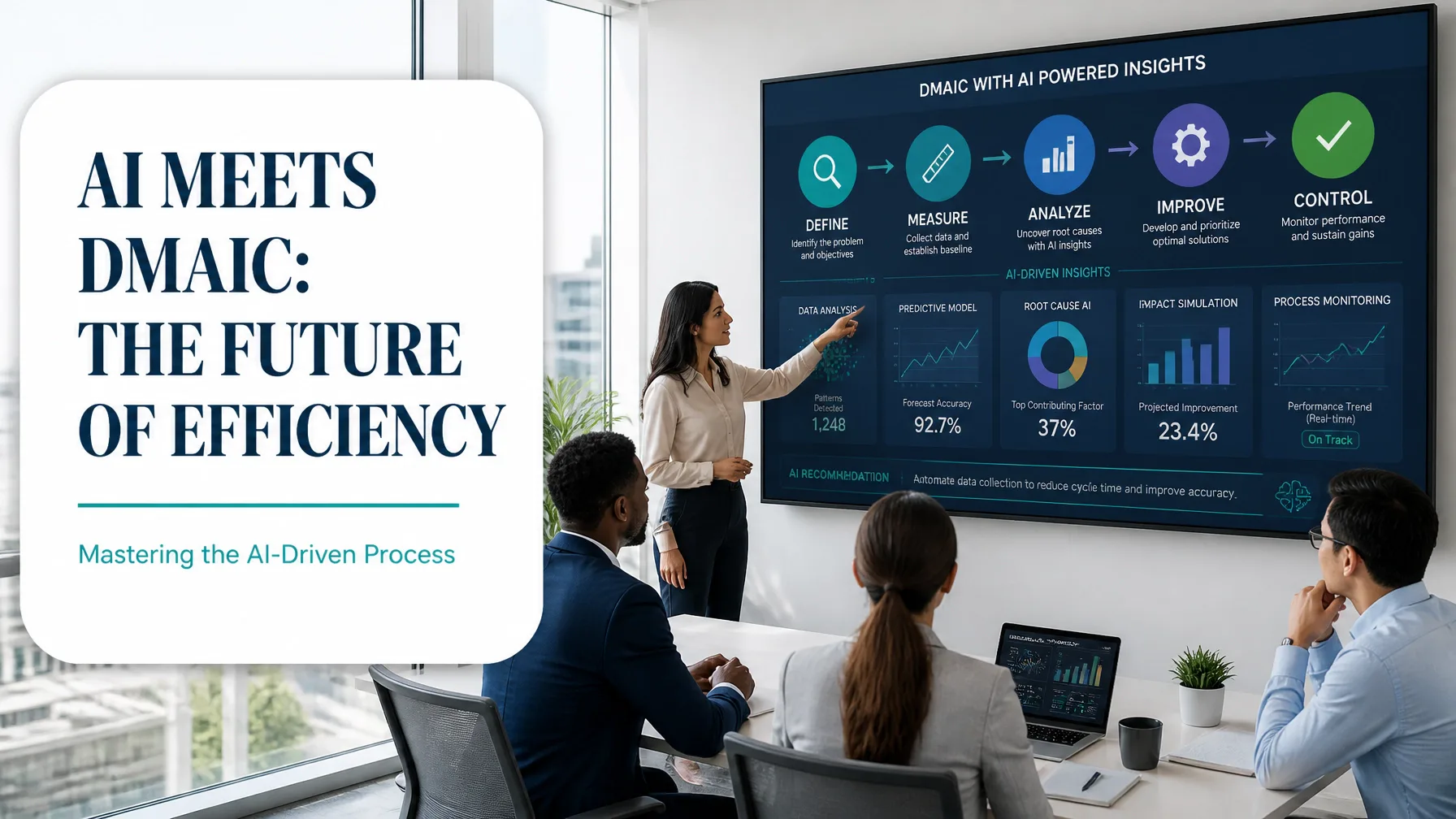
In the realm of process improvement, the conversation has shifted from "if" we should use Artificial Intelligence to "how" we can integrate it without losing the statistical rigor that defines Lean Six Sigma. The fundamental purpose of integrating AI with the DMAIC (Define, Measure, Analyze, Improve, Control) framework is to leverage unprecedented computational power while maintaining the governance and clarity of traditional methodologies.
To fully appreciate this evolution, one must view Lean Six Sigma as the steering mechanism and AI as the high-performance engine. While AI can process petabytes of data in seconds, it lacks the contextual wisdom to understand Value: defined strictly by the customer's willingness to pay. Without the structured discipline of a Lean Six Sigma Black Belt, AI initiatives often become "expensive toys" rather than strategic assets.
The Synergy of Y = f(x) and Machine Learning
At its core, Six Sigma is built on the transfer function Y = f(x). This equation posits that the output (Y) is a function of various inputs (x). Traditional Lean Six Sigma practitioners spend weeks manually identifying these critical inputs. AI, specifically machine learning, excels at uncovering these relationships in complex, non-linear environments where a human might miss subtle interactions.
However, the risk of Bias: the systematic deviation from the true value: is significantly amplified in AI models. If the training data is flawed, the AI will simply automate and accelerate bad decision-making. This is why the role of a trained team member, such as a Yellow Belt, remains vital for ground-truth validation.
Define: Aligning AI with the Business Case
The Define phase is where projects often succeed or fail. The goal is to establish a robust Business Case that justifies the investment of resources. AI saves hours here through text analytics and sentiment mining. By processing thousands of customer reviews or support tickets, AI can rapidly synthesize the Voice of the Customer (VOC) into measurable Critical to Quality (CTQ) requirements.
Where AI Saves Hours:
- Affinity Diagrams: Instead of manually grouping hundreds of sticky notes, AI can organize large volumes of ideas into meaningful categories based on natural language processing.
- Stakeholder Analysis: Predicting the impact of a project across diverse departments by analyzing historical organizational data.
Where It Misleads You:
AI might identify "interesting" patterns that have no actual alignment with the Voice of the Business (VOB). Just because an AI finds a correlation doesn't mean it’s a priority. A project must still be vetted against strategic organizational goals before a charter is signed.
Measure: Automating the Data Stream

In the Measure phase, we quantify the current state. AI-enabled sensors and process mining tools can automate data collection, drastically reducing the time spent on a Time Observation Sheet. This allows the team to focus on the Value Stream: the end-to-end flow of material and information.
Tracking the Right Metrics
To understand process health, we must track Yield. Specifically, First Pass Yield (FPY) and Rolled Throughput Yield (RTY) provide a clear picture of defect-free output. AI can monitor these in real-time, but it requires a solid Measurement System Analysis (MSA) to ensure the data is reliable. If the measurement system is unstable, the AI's output is effectively Waste (Muda).
We also look at Takt Time: the production rhythm required to meet customer demand. AI can dynamically adjust schedules to maintain this rhythm, but it often ignores the human element of Waiting or the psychological impact of over-automation.
Analyze: Root Cause Identification 2.0

The Analyze phase is where the technical heavy lifting happens. We use statistical tools like ANOVA (Analysis of Variance) to compare means across groups and Bartlett's Test to assess if variances are equal. AI takes this further by performing these tests across thousands of variables simultaneously.
The Power of Pattern Recognition
- Box Plots and Skewness: AI can instantly generate thousands of box plots to reveal spread and outliers across different shifts, regions, or product lines.
- Regression Analysis: Identifying which 'x' variables truly drive the 'Y' with high precision.
The "Black Box" Trap
The primary danger in the Analyze phase is the "Black Box" effect. Sophisticated AI models can provide a prediction without explaining why. In Lean Six Sigma, we require Voice of the Process (VOP) data that is explainable. If a Green Belt cannot explain the root cause to a stakeholder, the "solution" will never gain the necessary Approval for implementation.
Improve: Optimizing the Value Stream

During the Improve phase, we design and test solutions. This is where Agile methodologies often blend with Lean Six Sigma. AI allows for "Digital Twin" simulations, where we can test a process change virtually before touching the real-world shop floor.
Theory of Constraints (TOC)
AI is exceptional at identifying the Bottleneck: the constrained step that limits overall Throughput. By applying the Theory of Constraints, AI can suggest optimal work-sequencing to maximize the flow of Work in Process (WIP).
Autonomation (Jidoka)
The concept of Autonomation: intelligent automation that detects issues in real-time: is the pinnacle of AI in the Improve phase. However, practitioners must be wary of over-optimizing. A process that is 100% efficient but produces what the customer doesn't want is still a failure. We must always return to the Value Stream Mapping to ensure we are creating what is actually required.
Control: The New Age of Monitoring

The Control phase ensures that our gains are sustained. Traditional X-bar Charts and R charts are used to detect shifts and trends in process averages. AI transforms these into predictive alerts.
Predictive Andon
Instead of a physical Andon light that signals a problem after it happens, AI uses anomaly detection to signal a problem before it occurs. This pushes the organization toward a philosophy of Zero Defects.
Managing Variation
We must distinguish between Common Cause and Special Cause Variation. AI is often "too sensitive," flagging common cause fluctuations as problems. This leads to "tampering," which actually increases variation. A seasoned practitioner knows when to trust the AI and when to trust the statistical limits of the process.
Practical Integration: A Checklist for Success
To successfully integrate AI into your DMAIC projects, follow these professional protocols:
- Validate the Data: Never feed data into an AI model without performing a rigorous MSA and checking for Attribute Data consistency.
- Maintain Human Oversight: Ensure a Master Black Belt or Black Belt reviews all AI-generated hypotheses.
- Perform Break-Even Analysis: Justify the cost of the AI tool against the projected project savings.
- Monitor for Model Drift: AI models degrade over time. Include model recalibration in your official Control Plan.
- Focus on the Goal: The goal is not "to use AI"; the goal is to reduce waste, minimize variation, and maximize value.
Conclusion: The Path to Mastery
Integrating AI with DMAIC is not about replacing the methodology; it is about supercharging it. By understanding the technical definitions of Yield, Z-Score, and Variation, and by maintaining a firm grip on the Voice of the Customer, you can navigate the complexities of modern process improvement without being misled by the hype.
The future of industry belongs to those who can marry the "what" of data science with the "how" and "why" of Lean Six Sigma. Whether you are a White Belt just starting or a seasoned professional, the requirement for data literacy has never been higher.
Take the next step in your professional development and master the tools that drive global efficiency. Enroll in our CSSC-accredited certification courses today and lead the change in your organization.