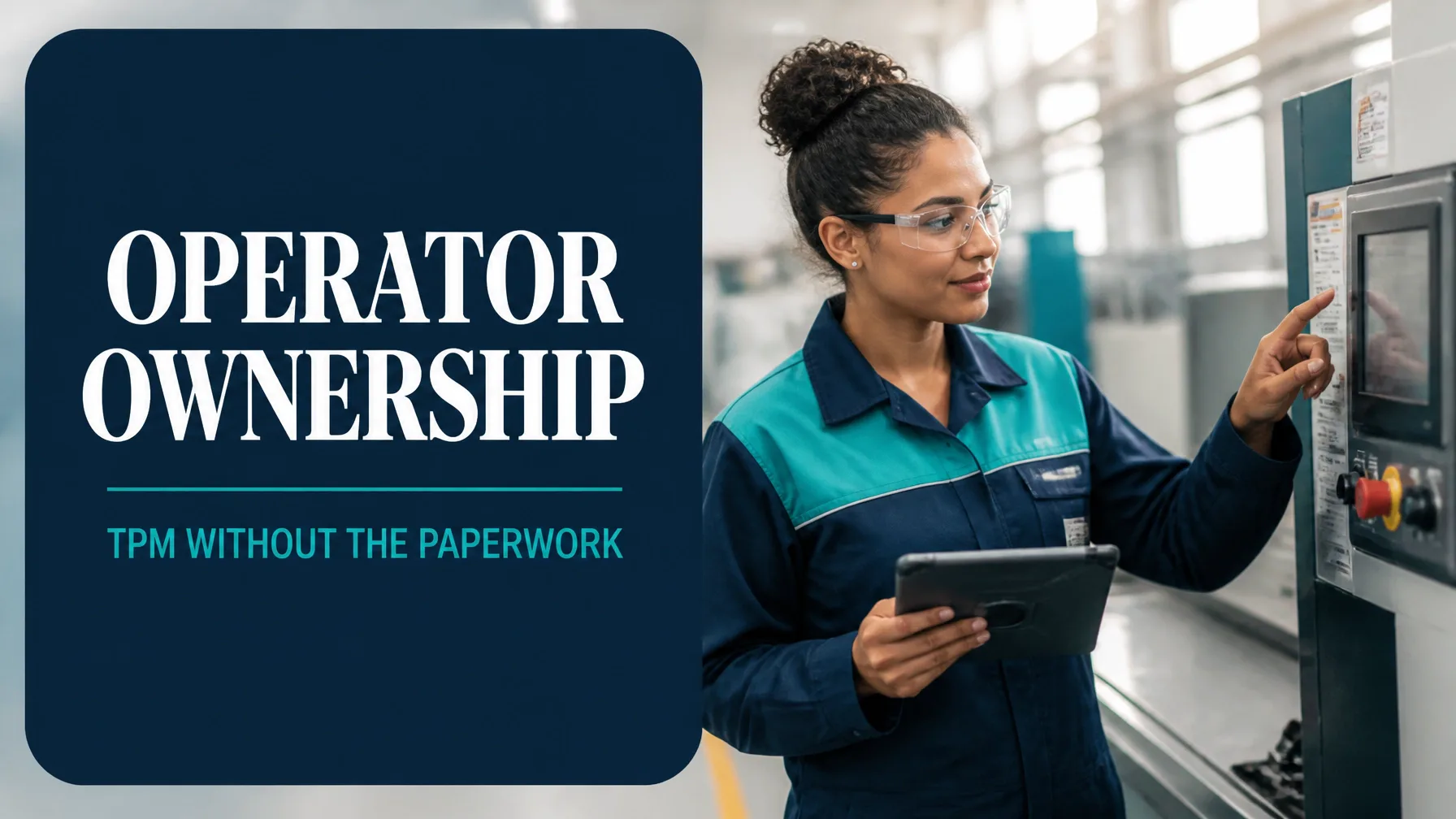
In the realm of manufacturing and process optimization, Total Productive Maintenance (TPM) is often hailed as the holy grail of equipment reliability. However, most implementations stumble at the same hurdle: the transition from "Maintenance owns the machine" to "Operators own the machine." Historically, management has tried to bridge this gap with a mountain of checklists, logbooks, and clipboards.
The result? Operators feel like administrative clerks rather than asset owners, and the paperwork becomes a Waste (Muda) of time that yields zero actual improvement in machine health.
To fully appreciate how to build true ownership, we must shift our perspective. We aren't just asking operators to "clean more." We are asking them to control the critical inputs (x) that dictate our process outcome (Y). In the fundamental equation Y = f(x), the health of the equipment is a dominant independent variable. If you don't control the 'x' of equipment stability, your 'Y' (Productivity and Quality) will always be a victim of randomness.
The Role of the Empowered Operator
Before we dive into the "how," let’s define the players. Building a culture of ownership requires a tiered understanding of Lean Six Sigma principles.
- Lean Six Sigma White Belt: At this entry-level, operators gain awareness of DMAIC and the basic concept that every process step should add Value.
- Lean Six Sigma Yellow Belt: These are your "boots on the ground" experts. A Yellow Belt is trained to support larger projects and master the essential tools: like 5S and basic data collection: that make TPM possible.
When an operator understands that their role is to protect the Value Stream, they stop seeing autonomous maintenance as "extra work" and start seeing it as the foundation of their professional success.
Technical Definitions: The Metrics of Ownership
To move away from paperwork, we must move toward data. Specifically, we need to track how operator intervention affects the bottom line.
- Yield (First Pass Yield and Rolled Throughput Yield): We track defect-free output. If an operator performs a "Clean, Inspect, Lubricate" (CIL) routine and catches a loose belt, they prevent a mid-run failure. This directly protects the First Pass Yield (FPY).
- Throughput: This is the number of units produced per period. By reducing minor stoppages through Autonomation (Jidoka): where machines are designed to stop and alert the operator to a problem in real-time: we maximize the speed and efficiency of the line.
- Takt Time: We divide available production time by customer demand to set the rhythm. Operator ownership ensures the machine stays in sync with this rhythm, preventing the Waiting waste that occurs when a downstream process is starved of material.

Caption: Replacing paper logs with digital dashboards allows operators to see the Voice of the Process in real-time.
Step 1: Mapping the Value Stream
The first step is to perform Value Stream Mapping (VSM). By creating a current state map, you can identify where equipment downtime acts as a Bottleneck. In the Theory of Constraints (TOC), we know that an hour lost at a bottleneck is an hour lost for the entire system.
When operators see the VSM, they realize that their machine isn't just a hunk of metal; it’s a critical leverage point. If they can improve the uptime of that bottleneck, the entire organization's Throughput increases.
Step 2: Implementing Visual Controls (Andon & Jidoka)
Paperwork is a symptom of invisible processes. If an operator has to write down every time a sensor fails, the system is broken. Instead, utilize Andon systems: visual signals that alert the team to problems in real-time.
When we integrate Autonomation (Jidoka), the machine itself becomes the "inspector." It detects a deviation and stops. The operator’s job is then to perform a Time Observation Sheet analysis on the recovery process: how much of the downtime was spent waiting for a technician versus actually fixing the issue? By recording actual step times, we can separate value-added work from non-value-added frustration.
Step 3: Monitoring with X-Bar Charts
Ownership is sustained when operators can prove they are in control. We teach our Green Belts and Yellow Belts how to use X-bar Charts to monitor process averages.
By plotting data alongside an R chart, operators can detect shifts and trends before they turn into defects. This is the Voice of the Process (VOP) speaking directly to the operator. If the VOP shows that the process is drifting, the operator has the authority: and the data: to take corrective action without waiting for a supervisor’s Approval.
Practical Application: The 15% Downtime Challenge
Consider a hypothetical case study at a logistics hub. A sorting conveyor had a 15% downtime rate, primarily due to "minor stoppages" (parcels getting stuck). The initial "solution" from management was a 4-page daily checklist for operators. Ownership plummeted.
We scrapped the paperwork and implemented three things:
- Visual Standards: Photos showing exactly how the tensioner should look.
- Digital Huddles: A 5-minute meeting using an Affinity Diagram to organize operator ideas on why jams happen.
- Basic ANOVA: We used ANOVA to compare the downtime between different shifts. We found a significant difference and used Bartlett’s Test to confirm the variances were equal before concluding that Shift B had discovered a "Standard Work" trick that Shift A didn't know.
The result? Downtime dropped to 4%, and First Pass Yield increased by 12%. The operators weren't doing "paperwork"; they were solving problems using data.

Advanced Analysis: Ensuring Reliability
For those leading these initiatives, such as Black Belts, the focus is on deeper statistical reliability. We must ensure there is no Bias in how data is collected. We use Box Plots to reveal the five-number summary of our downtime data, helping us identify outliers: those "black swan" events that skew our averages.
We also conduct a Break-Even Analysis to justify investments in better sensing technology. If spending $5,000 on an automated lubrication system saves 100 hours of manual labor and $20,000 in parts per year, the Business Case is undeniable. This document is essential for securing leadership buy-in and ensuring the project has the resources to succeed.
Moving Toward Zero Defects
The ultimate goal of TPM is Zero Defects: a philosophy popularized by Philip Crosby. It’s about doing things right the first time. This requires balancing the Voice of the Customer (VOC): which demands quality and speed: with the Voice of the Business (VOB): which demands cost-efficiency.
Operator ownership is the bridge between these two voices. When an operator is trained to see Variation: both common cause and special cause: they become the first line of defense against waste.
Conclusion: Stop Counting, Start Improving
If your TPM program feels like a clerical exercise, you have failed to build ownership. True ownership is the result of empowerment, education, and the right tools. It’s about moving from "I have to check this box" to "I am controlling the 'x' that ensures our 'Y'."
To lead this transformation, you need more than just a checklist; you need a toolkit. Whether you are starting with a White Belt to understand the basics or aiming for a Master Black Belt to build enterprise-wide governance frameworks, the journey starts with a commitment to mastery.
Ready to transform your career and your organization? Enroll in our Lean Six Sigma certification courses today and start mastering the tools that drive real-world results.