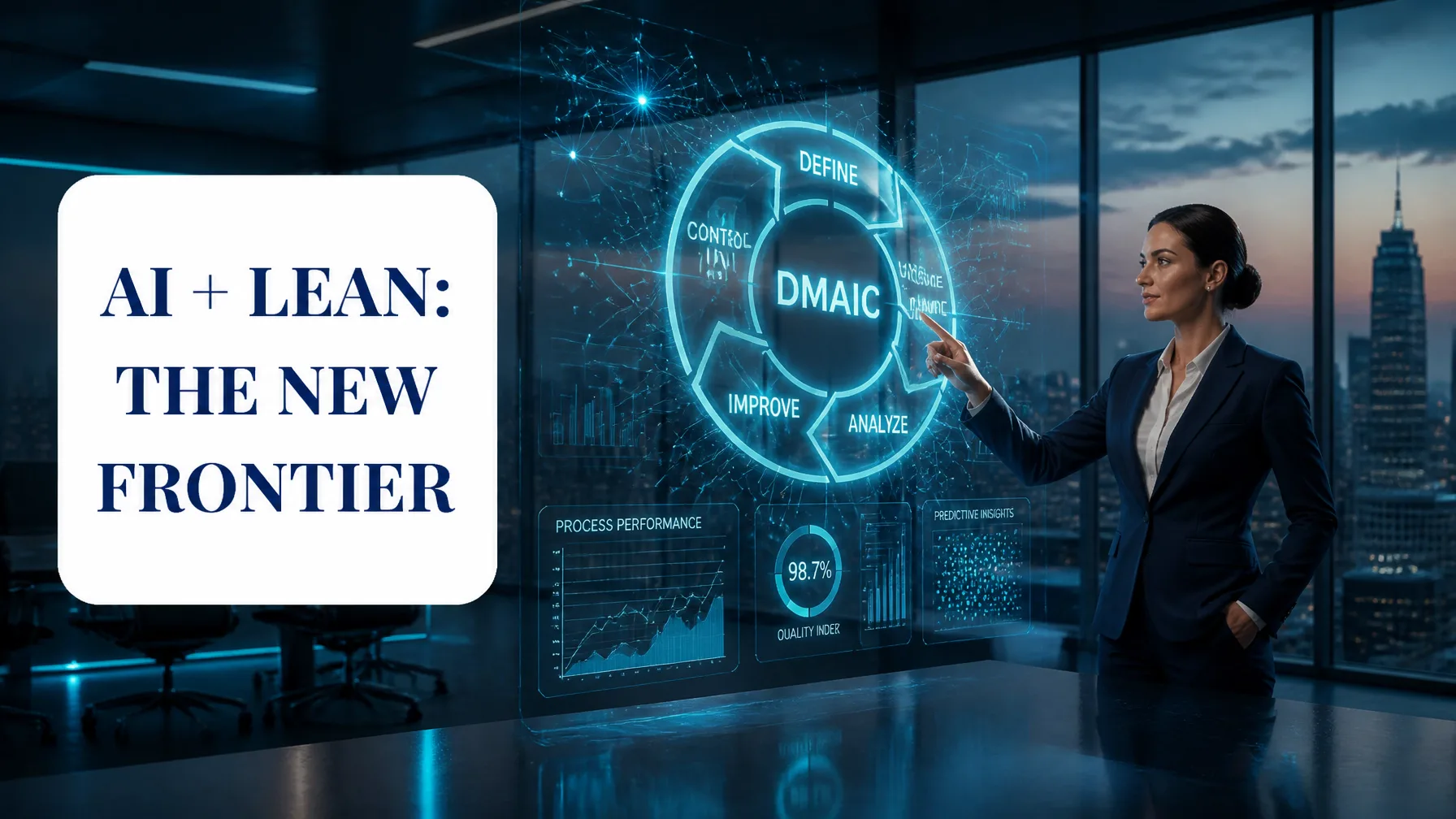
In the realm of modern process improvement, a dangerous myth has begun to circulate: that Artificial Intelligence has rendered traditional methodologies like Lean Six Sigma obsolete. This could not be further from the truth. In 2026, the most successful organizations are those that realize AI isn't a replacement for the disciplined rigor of DMAIC; it is a high-octane fuel for it.
To fully appreciate the synergy between these two forces, one must understand that Lean Six Sigma provides the logical framework: the "brain": while AI provides the computational muscle. Integrating AI with your lean six sigma training transforms you from a traditional analyst into a "Hybrid Belt," capable of solving complex problems at a velocity that was previously unthinkable.
The Fundamental Purpose: Supercharging Y = f(x)
The core of Six Sigma has always been the transfer function Y = f(x). Our goal is to control the critical inputs (x) to influence the desired outcome (Y). In the past, identifying those 'x' variables required weeks of manual data collection and painstaking observation.
Today, AI allows us to monitor thousands of variables simultaneously. By feeding massive datasets into machine learning models, we can identify non-linear relationships and hidden correlations that a standard Average (Mean) or simple linear regression might miss. However, without the Lean Six Sigma professional to define what 'Y' matters to the customer, AI is just a calculator running in a dark room.
The AI-Powered DMAIC Cycle
To integrate AI effectively, we must look at how it enhances each phase of the process improvement journey.
1. Define: The Voice of the Digital Customer
The fundamental purpose of the Define phase is to establish the Voice of the Customer (VOC) and translate it into measurable Critical to Quality (CTQ) requirements. In 2026, we no longer rely solely on slow, manual surveys. We use LLM-based sentiment analysis to scan millions of data points: emails, social media, and chat logs: to identify natural groupings of customer pain points.
An Affinity Diagram that once took a team three hours to build can now be generated by AI in seconds, organizing large volumes of ideas into meaningful categories. This allows the team to focus on building a robust Business Case to secure leadership Approval, rather than getting bogged down in sticky-note administration.
2. Measure: Process Mining and Real-Time Yield
The Measure phase has undergone a revolution. Instead of standing on a factory floor with a stopwatch, professionals now use Process Mining to reconstruct the Value Stream from digital footprints in ERP and CRM systems.
This automated data collection provides a real-time view of First Pass Yield (FPY) and Rolled Throughput Yield (RTY). By tracking defect-free output at every stage, the AI flags exactly where Waste (Muda) is occurring. Whether it is Waiting (idle people or information) or excessive Work in Process (WIP), the AI highlights these "silent killers" of the bottom line instantly.

3. Analyse: Statistical Rigor at Scale
In the Analyse Phase, we identify root causes. This is where the integration of AI and statistics becomes critical. AI can suggest potential root causes, but the Black Belt must still validate them.
For instance, when comparing multiple production lines, we might use ANOVA to see if there are significant differences in their means. Before running that ANOVA, however, the professional must perform Bartlett’s Test to assess whether the variances of the groups are equal. AI can run these tests in milliseconds, but the human must check for Bias: ensuring that systematic deviations from the true value in the data haven't led the AI to a false conclusion. Tools like the Box Plot remain essential for visualizing spread and identifying outliers that the AI might otherwise "smooth over" in its pursuit of a pattern.
4. Improve: Simulation and the Digital Twin
When it comes to the Improve phase, AI-driven simulations allow us to test solutions in a virtual environment before a single dollar is spent on a pilot. By creating a digital twin of the Value Stream Map, we can adjust variables like Takt Time (dividing available time by customer demand) to see how it impacts Throughput.
We use the Theory of Constraints to identify the Bottleneck and then use AI optimization algorithms to propose the most efficient workflow. This is where Agile methodologies often intersect with Lean Six Sigma; we iterate quickly in the simulation, failing fast and cheap until we find the optimal configuration that maximizes Value: defined strictly by the customer's willingness to pay.
5. Control: The Intelligent Andon
The Control phase ensures that gains are sustained. Traditional X-bar Charts and R-charts are now "always-on." Instead of a human checking a chart once a shift, AI monitors process averages 24/7.
When a Special Cause variation is detected, the system triggers an automated Andon signal, alerting the team to production problems in real-time. This is the ultimate expression of Autonomation (Jidoka): intelligent automation that detects and responds to issues without human intervention, moving the organization closer to the goal of Zero Defects.

The Role of the Human: Why Certification Still Matters
You might ask: "If the AI can do all this, why do I need a lean six sigma certification?"
The answer lies in governance and logic. AI is prone to "hallucinations" and can find patterns where none exist. It doesn't understand the "Gemba": the actual place where the work happens. A Black Belt is required to lead these complex projects, mentor Green Belts, and ensure that the Voice of the Business (VOB) is balanced with the Voice of the Process (VOP).
Even a Yellow Belt plays a vital role by supporting these larger projects with their mastery of essential tools, ensuring that the data being fed into the AI is clean and relevant. Without a foundational understanding of Variation: distinguishing between common cause and special cause fluctuations: a professional will constantly "over-adjust" the process based on AI suggestions, actually making performance worse.
Future-Proofing Your Career
To remain relevant in 2026, you must be able to speak both the language of data science and the language of process excellence. This means understanding how to calculate a Z-Score to compare distributions across different AI models, or how to conduct a Break-Even Analysis to justify the cost of a new AI implementation.
Organizations are no longer looking for "just" a data scientist or "just" a Lean expert. They want the practitioner who can use a Time Observation Sheet to record actual step times, identify non-value-added work, and then program an AI to eliminate that waste across ten global sites simultaneously.

Conclusion
Integrating AI with Lean Six Sigma is not a choice; it is an evolutionary necessity. By combining the structured discipline of the DMAIC framework with the predictive power of AI, you can drive business excellence at an unprecedented scale.
Don't let the machines do the thinking for you. Learn how to direct them. Whether you are starting with a White Belt to understand the basics or pursuing a Master Black Belt to build enterprise-wide governance frameworks, the time to upgrade your toolkit is now.

Ready to lead the next generation of process improvement? Take the first step toward your Lean Six Sigma Certification today.