Let’s be brutally honest: most manufacturing and service operations are terrified of the "Stop" button. We’ve been conditioned to believe that if the wheels aren’t turning, we’re losing money. We obsess over OEE (Overall Equipment Effectiveness) like it’s the only metric that matters, pushing teams to keep the line moving at all costs.
But here is the reality check: If you are running a high-speed line and producing even a 2% defect rate, you aren't "efficient." You are efficiently generating trash. You’re burning cash on raw materials, labor, and energy to create something that will either be scrapped, reworked, or: worst of all: shipped to a customer who will then hate you.
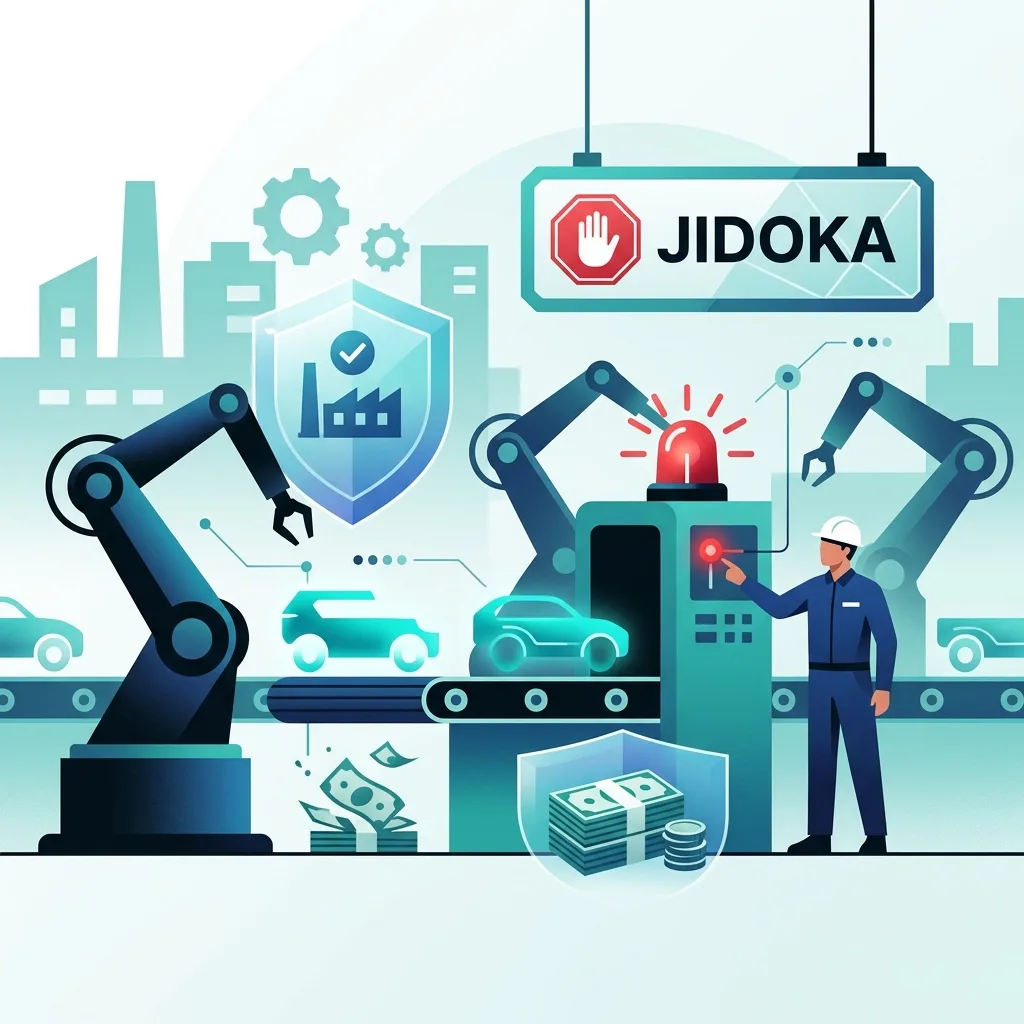
This is where Jidoka comes in. In our Lean Six Sigma concepts and glossary, we define Jidoka (Autonomation) as "automation with a human touch." It’s the radical idea that a machine should be smart enough to realize it’s making a mistake and brave enough to quit immediately.
If you want to stop the financial bleeding and actually build a world-class operation, you need to master the art of stopping the line.
The "Human Touch" in a Digital World
The term Autonomation is a portmanteau of "Autonomous" and "Automation." It sounds like something out of a sci-fi flick, but it’s actually deeply practical. Standard automation just does the same thing over and over. If a standard automated drill starts walking off-center, it will happily drill 5,000 holes in the wrong place until a human notices.
Jidoka changes the game. It adds a "human" element of judgment to the machine. By using sensors and logic, the machine detects an abnormality, halts production, and signals for help. It refuses to pass a defect down the line. To fully appreciate this, you have to look at the Measure phase of a project; if your sigma level is tanking because of hidden defects, Jidoka is your primary line of defense.

The Four Pillars of Jidoka
Implementing Jidoka isn't just about buying a sensor and calling it a day. It is a systematic approach to quality at the source. If you’re going to do this right, you need to follow the four-step protocol:
- Detect the Abnormality: This can be done by the machine (using Poka-Yoke sensors) or by a human who notices something is "off."
- Stop the Process: The moment a deviation is detected, the line stops. No "let's just finish this batch." No "we'll fix it in post." You stop. Period.
- Fix the Immediate Problem: A human (the "human touch") intervenes to clear the jam, replace the tool, or reset the software. You get the process back to a "Good" state.
- Investigate the Root Cause: This is where the real money is made. You don't just restart and pray. You use the DMAIC framework to ensure the defect never happens again.
Without step four, Jidoka is just a very expensive way to have a lot of downtime. But when paired with effective process documentation, it becomes a continuous improvement engine that pays for itself in weeks.
Why "Stopping" is Actually Faster Than "Running"
It feels counterintuitive. How can stopping the line make you faster?
Think about the Cost of Quality. If a defect costs you $1 to catch at the source, it will cost you $10 to catch it at final inspection and $100 (or $1,000 in reputation damage) once it reaches the customer. By stopping the line the millisecond a defect occurs, you are preventing the "Hidden Factory": that invisible segment of your workforce that spends all its time fixing mistakes that should never have happened.
When you implement Jidoka, you drastically reduce rework. You eliminate the need for massive "quarantine" areas where thousands of parts sit waiting for inspection because someone realized a tool broke three hours ago. In the realm of Lean, we call this "Quality at the Source." It’s the difference between a high-performing Six Sigma process and a chaotic fire-fighting operation.

The Andon Cord: Empowerment or Fear?
You can’t talk about Jidoka without talking about the Andon Cord. In the legendary Toyota plants, any worker on the line had the authority: and the requirement: to pull a cord and stop the entire multi-million dollar assembly line if they saw a problem.
Most Western managers have a heart attack just thinking about that. They think, "My workers will just stop the line to take a break!"
Here is the truth: If you don't trust your people to stop the line when something is wrong, you have a leadership problem, not a production problem. Jidoka is a tool of empowerment. It tells the operator that their eyes and their judgment are more important than the machine's speed. When you combine this with Robotic Process Automation (RPA), you create a system where humans and machines work in a feedback loop that guarantees quality.
Breaking the "Broke" Cycle: The Financial Impact
Let's talk numbers. Why will Jidoka save you from going broke?
- Scrap Reduction: You stop making junk the moment the process drifts.
- Labor Efficiency: Instead of having three people "inspecting" at the end of the line, those people are moved to value-added activities.
- Capacity Liberation: When you stop rework, you suddenly find "hidden" capacity. You don't need that second shift or that new $500k machine; you just need to stop making mistakes.
- Customer Retention: Shipping perfect products every time is the best marketing strategy ever devised.
To see the potential ROI, you can even use a Project Charter ROI Calculator to estimate how much "stopping the line" could save your specific operation.

Common Pitfalls: Where Jidoka Fails
The fundamental purpose of Jidoka is to highlight problems so they can be solved. It is not a magic "fix-it" button. Jidoka fails when:
- The "Pit Crew" is slow: If the line stops and the supervisor takes 20 minutes to show up, the system fails. You need a "rapid response" culture.
- Band-aid fixes: If you just "clear the error" and restart without asking "Why?", you’re just engaging in expensive downtime.
- Fear of the "Stop": If workers are penalized for stopping the line, they will hide defects. This is the fastest way to go broke.
To avoid these, you need to capture lessons learned and treat every line stop as a gift: a free data point telling you exactly how to get better.
Conclusion: Stop the Line, Save the Business
Jidoka is the ultimate "High-Attitude" Lean principle. It demands that you value quality over optics. It demands that you stop being a slave to the "Running" light and start being a master of your process.
If your floor is covered in scrap, if your rework costs are eating your margins, or if you're constantly apologizing to customers for "slips in quality," you don't need more speed. You need Jidoka. You need the guts to stop the line, find the root cause, and fix it forever.
The choice is simple: Stop the line today to solve the problem, or keep running until the market stops it for you.
To elevate your expertise and learn how to implement Jidoka and other advanced Lean strategies in your organization, explore our Lean Six Sigma Master Black Belt Training today and lead your team toward operational excellence.