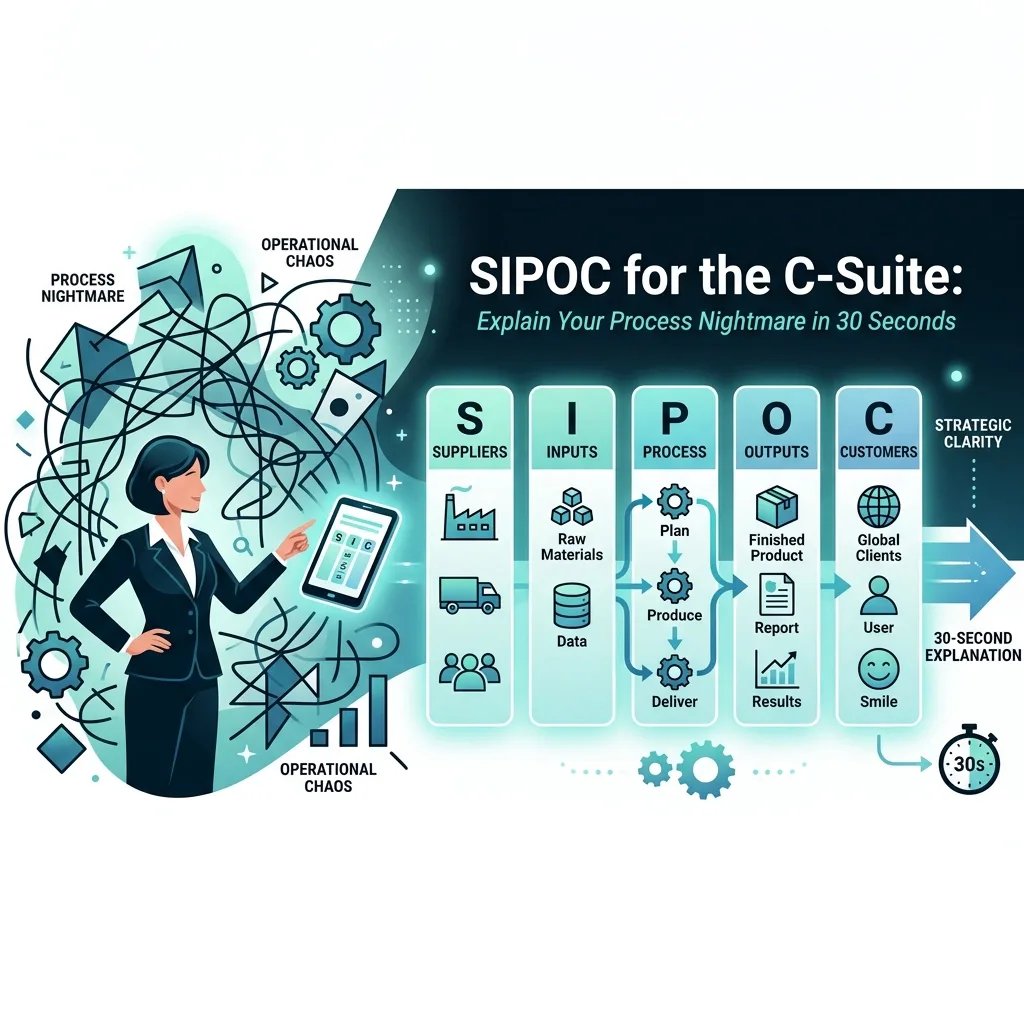
In the realm of corporate leadership, time is the most expensive commodity. For an executive, hearing that a process is "broken" or "a nightmare" is frustratingly vague. It lacks the data-driven precision required for strategic decision-making. When a middle manager spends twenty minutes explaining a bottleneck, they have already lost the room. To bridge the gap between operational chaos and executive clarity, Lean Six Sigma professionals utilize one of the most potent high-level tools in existence: the SIPOC.
The fundamental purpose of a SIPOC is to provide a bird’s-eye view of a system and its boundaries. By condensing a complex, multi-layered operation into a single, high-impact visual, you can transform a technical disaster into a structured roadmap for improvement. If you cannot explain your process nightmare in 30 seconds, you haven't used a SIPOC.
What is a SIPOC? The Technical Definition
As defined in our Lean Six Sigma concepts and glossary, SIPOC stands for: Suppliers, Inputs, Process, Outputs, and Customers.
It is a high-level process mapping tool that transcends departmental silos. Unlike a detailed functional flowchart that might document every single click of a mouse, the SIPOC remains at the 30,000-foot level. It identifies what goes into a process, what happens inside that process, and: most importantly: who receives the end result.
To fully appreciate the utility of this tool, one must understand its components:
- Suppliers: The internal or external entities that provide the raw materials, information, or resources.
- Inputs: The specific items (data, components, labor) provided by the suppliers.
- Process: The high-level steps (usually 5 to 7) that transform inputs into outputs.
- Outputs: The final products, services, or documentation resulting from the process.
- Customers: The individuals or systems that receive the outputs and define their value.

Why the C-Suite Demands SIPOC (Even if They Don’t Know It)
Executive leadership is rarely interested in the minutiae of how a specific software ticket is routed. They are, however, deeply invested in Scope, Risk, and ROI.
A common failure in organizational improvement is "scope creep": projects that grow until they are unmanageable and fail to deliver results. The SIPOC acts as a diagnostic gatekeeper. By defining the "Start" and "End" points of a process, it establishes ironclad boundaries. In the context of tollgate reviews in Lean Six Sigma, a SIPOC is often the first document an executive should demand to see. It answers the critical question: "What exactly are we fixing, and where does it stop?"
The 30-Second Executive Pitch
When presenting to a Chief Operating Officer or a VP of Supply Chain, your communication must be surgical. Instead of detailing the "nightmare," present the SIPOC and follow this script:
- "Our current procurement process is failing to meet lead-time targets. As this SIPOC demonstrates, our Suppliers are providing inconsistent Inputs (raw data), which forces our 5-step Process to stall at the approval phase. Consequently, the Output (finalized purchase orders) is reaching our internal Customers (Production) three days late. We are targeting a 20% reduction in cycle time by standardizing the input phase."
This approach moves the conversation from emotional frustration to objective analysis. It demonstrates that you have a firm grasp of the system boundaries and the stakeholders involved.
Strategic Scoping: Preventing the "Everything is Broken" Fallacy
When an organization experiences a decline in quality or a rise in costs, the knee-jerk reaction is often to declare that "the whole system is a mess." This is rarely true. Usually, the "nightmare" is localized within a specific handoff between a supplier and an input, or an output and a customer.
By using a SIPOC complexity score calculator, teams can quantify the density of their process. If your SIPOC reveals 15 different suppliers for a single process step, you haven't found a nightmare; you've found a primary source of variation.
Case Study: Reducing "Downtime" in Financial Reporting
Consider a global finance department struggling with month-end closing.
- The Nightmare: Closing takes 10 days; the target is 4. Executives are flying blind for over a week every month.
- The SIPOC View: The map reveals that the "Suppliers" (Regional Controllers) are sending "Inputs" (Expense Reports) in four different formats. The "Process" requires a manual normalization step that adds 72 hours of non-value-added work.
- The Outcome: By standardizing the input at the source, the process was streamlined. The ROI was measured in hundreds of saved man-hours and a 60% improvement in reporting speed.
Integrating SIPOC into the DMAIC Framework
In the Lean Six Sigma methodology, the SIPOC is a staple of the Define and Measure phases. While it provides the high-level view, it serves as the foundation for more granular process mapping in the Measure phase.
Once the C-suite has signed off on the SIPOC, the project team can dive deeper into the data. For instance, if the SIPOC identifies a specific output as "defective," the next step might involve understanding the Measure phase to calculate the exact DPMO (Defects Per Million Opportunities).
The transition from a high-level SIPOC to a detailed data analysis is where real organizational change happens. You start with the bird’s-eye view to get executive buy-in, then you use statistical rigor to prove your case.
Common Mistakes When Presenting to Leadership
To maintain your professional authority, avoid these three SIPOC pitfalls:
- Too Much Detail: If your "Process" column has 25 steps, you aren't doing a SIPOC; you're doing a functional deployment map. Keep it to 5-7 high-level blocks.
- Ignoring the Customer: In Lean, the customer defines value. If your SIPOC doesn't clearly link the process outputs to a customer need, the C-suite will see the project as a "vanity metric." Use a Voice of Customer priority matrix to ensure your SIPOC aligns with strategic goals.
- Failing to Update: A SIPOC is not a static document. As you achieve quick wins, your SIPOC should reflect the new "current state."

Conclusion: Mastering the Art of Process Clarity
A "process nightmare" only exists in the absence of structure. For the C-suite, a SIPOC is the antidote to complexity. It provides the necessary context to approve budgets, support initiatives, and drive a culture of continuous improvement. By mastering this tool, you position yourself not just as a practitioner, but as a strategic asset to the organization.
The ability to distill a chaotic multi-million dollar operation into five clear columns is a hallmark of leadership. If you are ready to move beyond basic troubleshooting and start leading enterprise-wide deployments, you must master the high-level tools that command executive attention.
Take the next step in your professional evolution by enrolling in our accredited certification programs. Elevate your career and gain the skills to lead high-impact projects today.
Explore our Lean Six Sigma Certification Courses