
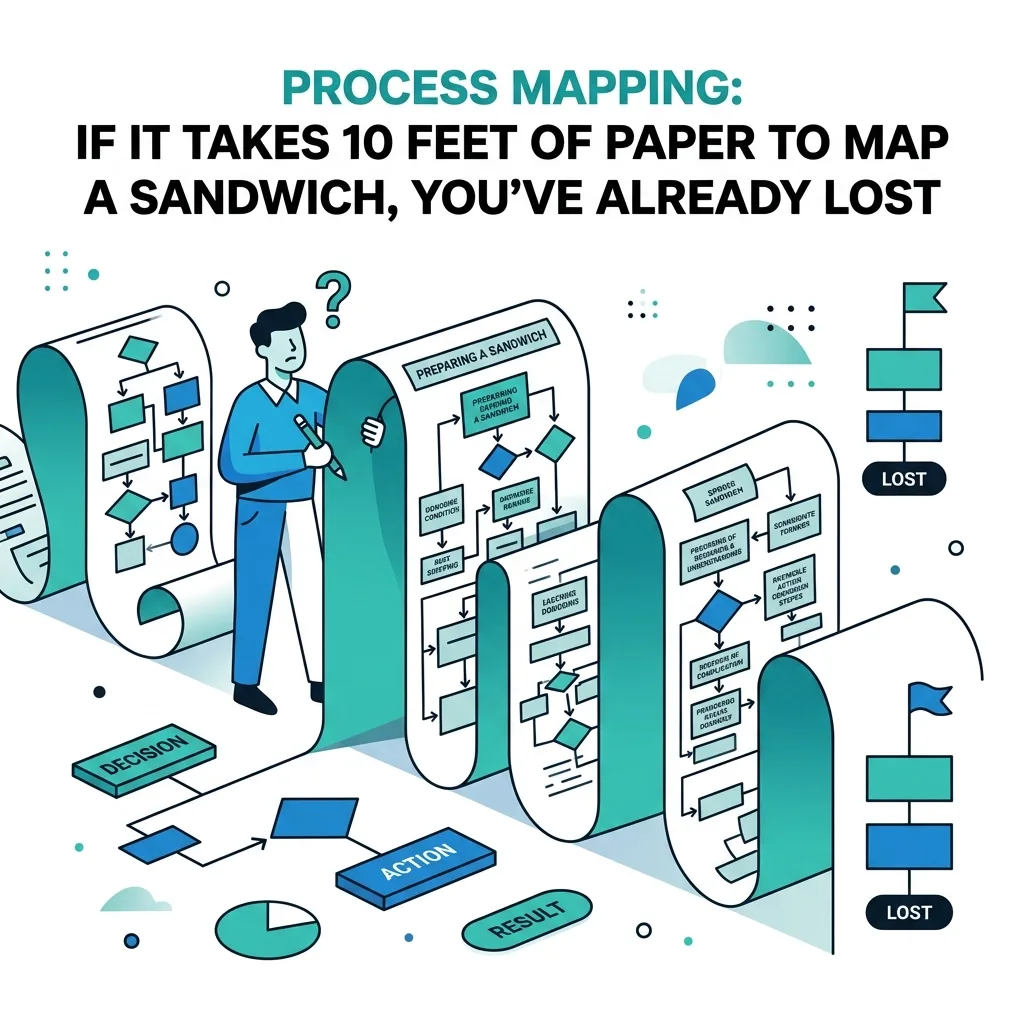
In the realm of operational excellence, there is a pervasive sickness: the worship of the map over the reality of the work. Organizations frequently confuse the length of a scroll with the depth of their understanding. If you find yourself standing before a ten-foot-long "brown paper" exercise detailing the granular mechanics of a process as simple as making a sandwich, you haven't achieved clarity: you’ve built a monument to inefficiency.
Process mapping is a fundamental Lean Six Sigma tool designed to expose waste and streamline flow. However, when practitioners lose sight of the objective, the map itself becomes a non-value-added (NVA) activity. To fully appreciate the utility of a process map, one must understand that its primary purpose is to drive decisions, not to act as a wallpaper for the conference room.
The Documentation Delusion: Why More Isn't Better
The fundamental purpose of a process map is to provide a visual representation of the sequence of events that transform an input into an output. It is a diagnostic tool, not a creative writing project. Many project teams fall into the "Documentation Delusion": the belief that by capturing every micro-twitch of an operator’s hand, they are being "thorough."
In reality, over-complication is a defensive mechanism. It is easier to document a mess than it is to fix one. When a map is too detailed, the critical bottlenecks and hand-off failures: the "white space" where most Lean Six Sigma projects find their savings: are buried under a mountain of trivia. If a box on your map does not influence a decision, trigger a quality check, or impact the final customer requirement, it is likely noise.
To prevent this, practitioners must start at the right altitude. Before diving into the weeds, one must utilize a SIPOC (Supplier, Input, Process, Output, Customer) diagram to establish boundaries. If you cannot define the process in five to seven high-level steps, you do not understand the process well enough to map it. For those struggling with this initial scoping, utilizing a SIPOC complexity score calculator can provide an objective reality check on whether your project scope is already spinning out of control.
Process Maps vs. Work Instructions: The Sandwich Rule
The most common error in process mapping is the failure to distinguish between a Process Map and a Work Instruction (SOP).
- A Process Map explains what happens, in what order, and who is responsible.
- A Work Instruction explains how to perform a specific task.
Let us apply the "Sandwich Rule." In a process map for a commercial kitchen, a step labeled "Assemble Sandwich" is sufficient. It indicates the point in the sequence where the value is added. However, an over-mapped "ten-foot" version might include: "Pick up knife," "Orient blade downward," "Unscrew jar lid," and "Check expiry date."
This is an exercise in futility. If your audience requires a diagram to know how to unscrew a jar, you don't have a process problem; you have a foundational competency problem. By cluttering the map with work-instruction-level detail, you obscure the bottleneck identification necessary to improve the actual lead time of the sandwich delivery.

The 80/20 Rule of Process Visualization
Sophisticated practitioners understand that a process map should represent the "Happy Path": the standard flow that occurs approximately 80% of the time. The remaining 20%: the exceptions, the edge cases, and the "what if the bread is moldy" scenarios: should be handled through decision diamonds or separate sub-processes.
Attempting to model every possible variation on a single sheet of paper results in "spaghetti mapping." A map that looks like a bowl of noodles is impossible to analyze. To maintain a professional and objective focus, you must prioritize the primary value stream. If you are in the Measure or Analyse phase of a DMAIC project, your map must remain clean enough to allow for data overlay.
When you lose the ability to follow the flow of a single unit through the system because there are too many "if/then" branches, the map has lost its utility. At this stage, you are no longer doing Lean Six Sigma; you are simply doodling.
Focus on the Hand-offs: Where the Gold is Buried
If you want to find actual savings: the $50K to $100K typical of a Green Belt project: you must look at the Swim Lanes. Swim lanes categorize steps by the department or role responsible for them.
The most "brutally honest" revelation of a well-constructed process map is often the "ping-pong effect" between departments. When a map shows a document moving from Sales to Finance, back to Sales for clarification, then to Operations, and finally back to Finance for a second approval, you have identified a massive source of waste.
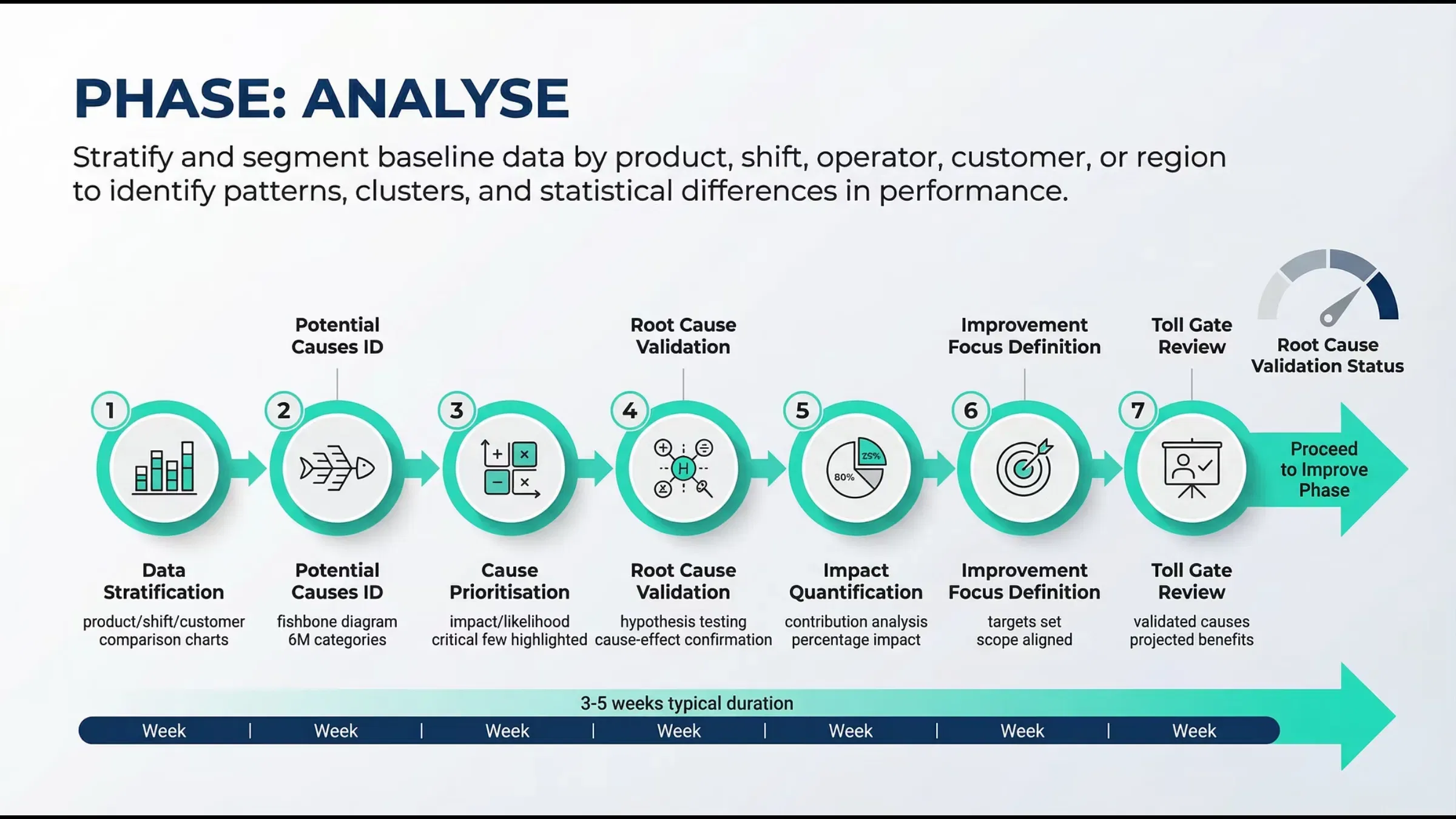
The value is rarely found inside the boxes; it is found in the arrows between the boxes. These hand-offs are where:
- Information is lost.
- Queue time accumulates.
- Defects are introduced.
- Rework cycles begin.
By focusing on these transitions rather than the granular mechanics of the tasks themselves, you can significantly impact the voice of the customer (VOC) by reducing total cycle time.
Risk Management and the "Hidden Factory"
Every excessive foot of paper on your process map often represents what we call the "Hidden Factory." This refers to the undocumented, unofficial work that people do to fix errors caused by a poor process. While it is important to acknowledge the hidden factory, mapping it in agonizing detail often validates its existence rather than challenging its necessity.
Instead of mapping the rework in detail, use the map to highlight where risk management is failing. A streamlined map should point directly to the failure modes. If your map is so cluttered that you cannot identify where a defect might originate, you cannot perform an effective Failure Mode and Effects Analysis (FMEA).
Knowing When to Stop: The Red Flags of Over-Mapping
To ensure organizational efficiency, a leader must know when to put the marker down. You have gone too far when:
- The team begins debating whether a step takes 180 seconds or 190 seconds (this is a data collection issue, not a mapping issue).
- The map requires a legend more than one page long to understand the symbols used.
- The "process experts" in the room start arguing about things that have no impact on the final quality or cost of the product.
- You spend more time discussing the aesthetics of the map than the waste it reveals.
If you find your project team stuck in "Analysis Paralysis," it is time to simplify. Use a project selection scoring calculator to ensure you are even working on the right problem before you waste another roll of butcher paper.
The Path to Mastery: Practical Skill-Building
Process mapping is not a passive skill; it is a clinical discipline. A Lean Six Sigma professional must be able to walk into a chaotic environment, observe the "Gemba" (the place where the work happens), and distill that chaos into a coherent, actionable visual. This requires more than just knowing how to draw boxes; it requires the ability to distinguish between what is essential and what is "noise."
If your current process maps are gathering dust or serving as confusing wallpaper, it is a symptom of a deeper lack of formal training. Mastery of these tools is the difference between a "coordinator" and a "leader of transformation." Organizations do not pay six-figure salaries for people who can draw long maps; they pay for people who can find and eliminate the waste within those maps.
To move beyond the "10-foot sandwich" and start delivering real ROI, you must ground your theoretical knowledge in practical, accredited methodology. Whether you are aiming for Green Belt or Black Belt certification, the goal is the same: clarity, efficiency, and measurable results.
Stop decorating your walls with waste. It is time to master the tools that actually drive business transformation. Pursue your professional certification today and learn how to map for results, not for show.
Enrol in the Lean Six Sigma Green Belt Certification
Elevate to the Lean Six Sigma Black Belt Certification