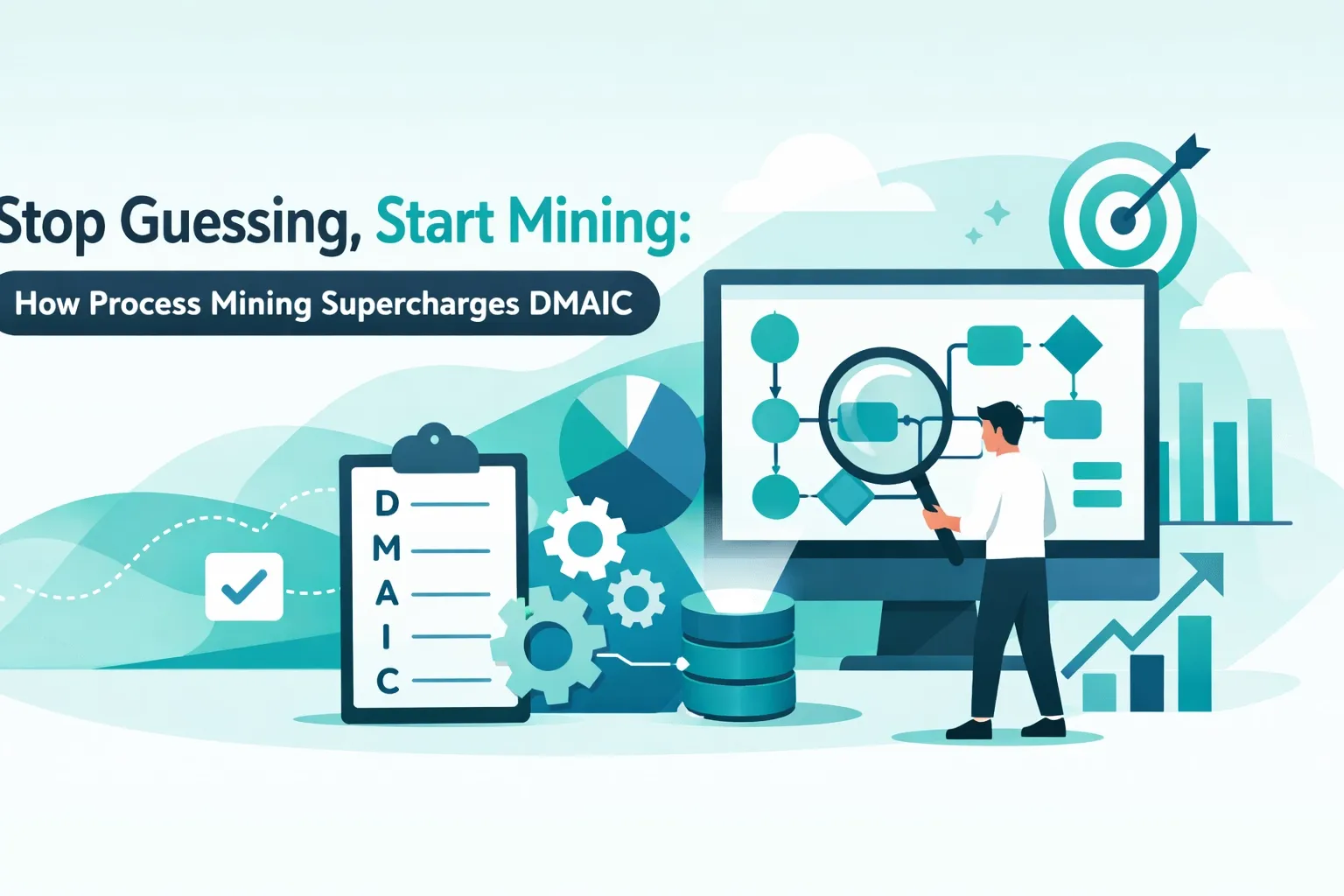
In the realm of operational excellence, the DMAIC (Define, Measure, Analyze, Improve, Control) framework has long served as the gold standard for structured problem-solving. However, even the most seasoned practitioners acknowledge a persistent challenge: the reliance on human observation and subjective interviews. Traditional Lean Six Sigma projects often stall when stakeholders provide conflicting accounts of how a process functions. The fundamental purpose of process mining is to bridge this gap between perception and reality.
By leveraging the digital footprints left behind in enterprise systems: such as ERP, CRM, and SCM software: process mining provides a transparent, data-driven "X-ray" of organizational workflows. This technology does not replace Lean Six Sigma; rather, it supercharges the methodology by replacing anecdotal evidence with empirical event logs. To fully appreciate this synergy, one must examine how process mining transforms each phase of the DMAIC cycle from a workshop-based exercise into a high-velocity data science initiative.
The Paradigm Shift: From Workshops to Event Logs
Traditionally, a six sigma training curriculum emphasizes the use of "Gemba walks" and sticky-note mapping sessions. While these activities possess cultural value, they are inherently limited by the participants' memory and biases. Process mining shifts the focus to event logs, which consist of three essential data points:
- Case ID: A unique identifier for a specific transaction (e.g., an invoice number or a support ticket).
- Activity: The specific step being performed (e.g., "Invoice Received" or "Quality Check Completed").
- Timestamp: The exact date and time the activity occurred.
When these logs are fed into a process mining engine, the software automatically reconstructs the end-to-end process. This allows practitioners to identify the "Happy Path" versus the countless "shadow processes" that actually occur in daily operations.

Define: Establishing an Objective Scope
In the Define phase, the primary goal is to identify the problem and determine the project scope. Frequently, projects suffer from "scope creep" because the initial process boundaries were poorly understood. Process mining eliminates this ambiguity by providing an immediate visualization of the current state.
Instead of spending weeks debating the process boundaries in a conference room, practitioners can use process mining to see exactly where a process starts and ends across different departments. This objective view is critical when using tools like the SIPOC Complexity Score Calculator to assess the feasibility of an improvement initiative. By seeing the actual complexity upfront, project leaders can make more informed decisions during the project selection process.
Measure: Achieving 100% Data Transparency
The Measure phase is traditionally the most time-consuming stage of a Lean Six Sigma project. Practitioners must identify data sources, validate measurement systems, and collect a representative sample. Process mining bypasses the limitations of sampling by analyzing the entire population of cases.
Key benefits in the Measure phase include:
- Total Population Analysis: Instead of measuring 30 or 50 samples, you analyze 10,000 or 1,000,000 transactions.
- Precise Lead Times: Process mining calculates the exact duration between every step, identifying "wait times" and "touch times" with millisecond precision.
- Automated Data Collection: Since the data is pulled directly from system logs, the risk of manual data entry errors is virtually eliminated.
For those pursuing a lean six sigma certification, mastering this transition from manual sampling to full-scale data analysis is a critical competency. You can test your foundational knowledge of measurement concepts using our Free Lean Six Sigma Yellow Belt Practice Exam.

Analyze: Rapid Root Cause Identification
During the Analyze phase, the objective is to pinpoint the root cause of defects or delays. Traditional methods involve creating a cause-and-effect (fishbone) diagram based on team brainstorming. While useful, this is often a "trial and error" approach.
Process mining allows for Variant Analysis. In a typical process, there may be one "standard" way of working, but the data often reveals hundreds of variations. By comparing the most efficient variants against the least efficient ones, practitioners can conduct a granular gap analysis to see exactly where deviations occur.
Common insights discovered in the Analyze phase via mining include:
- Rework Loops: Identifying steps that are performed multiple times for a single case.
- Bottlenecks: Visualizing "traffic jams" where work piles up before a specific activity.
- Non-Conformance: Detecting steps that are skipped or performed in the wrong order, violating standard operating procedures (SOPs).
Improve: Validating Solutions through Simulation
In the Improve phase, teams develop and pilot solutions. One of the greatest risks in Lean Six Sigma is the "unintended consequence": where improving one part of a process inadvertently breaks another. Process mining software often includes simulation capabilities, allowing practitioners to test a "what-if" scenario before implementing changes in the real world.
For example, if the team proposes adding a second approval step to improve quality, a simulation can predict how much that change will increase the total lead time. This level of predictive accuracy allows for a more robust Project Charter ROI calculation, ensuring that the proposed improvements will yield the expected financial benefits.

Control: Sustainable, Real-Time Monitoring
The Control phase is where many projects fail. Once the Six Sigma team leaves, processes often revert to their old, inefficient ways. Traditional control mechanisms, such as manual audits or periodic P-charts, are reactive. They tell you that a process failed last week.
Process mining transforms the Control phase into a proactive, continuous monitoring system. By setting up a live connection to the event logs, organizations can create dashboards that alert managers the moment a "non-conforming" activity occurs. This is the ultimate evolution of implementing self-control mechanisms for sustainable improvement. Instead of a project closure checklist being the end of the journey, the process enters a state of "Always-On" DMAIC.
Case Study: Procurement Transformation
To illustrate the power of this integration, consider a global manufacturing firm struggling with "Maverick Buying": purchasing outside of approved contracts.
- Define: The team used process mining to discover that 35% of purchases were not following the standard flow.
- Measure: They quantified the exact financial loss per non-conforming transaction using a Six Sigma Calculator.
- Analyze: The data revealed that the root cause wasn't a lack of training, but a specific software bottleneck that forced users to bypass the system to meet deadlines.
- Improve: The software interface was streamlined, and the "Happy Path" was automated.
- Control: A real-time dashboard was implemented to flag any Maverick Buying the moment it occurred, reducing non-conformance by 90% within three months.
Conclusion: The Future of Operational Excellence
The integration of process mining into the DMAIC methodology represents a significant advancement for the Lean Six Sigma community. It reduces the time spent on data collection, eliminates the "politics" of process mapping, and provides a sustainable framework for long-term control. For professionals looking to stay competitive in an increasingly digital economy, understanding these tools is no longer optional.
Whether you are just beginning your journey or are an experienced leader aiming for a Black Belt credential, the transition to data-driven process discovery is the key to unlocking higher levels of efficiency and value.
Enroll in our comprehensive Lean Six Sigma training today to master the intersection of data science and process improvement. Secure your future and validate your expertise with an industry-recognized Lean Six Sigma certification.